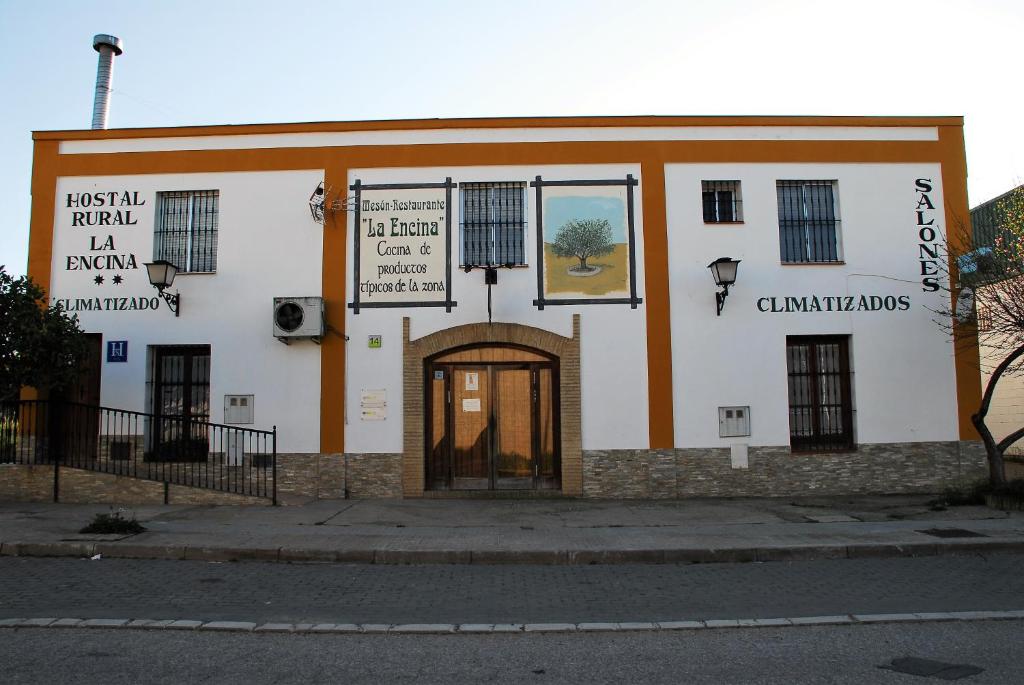
In the late autumn of 2015, we set out from Sevilla to walk north for as far as we could, before the weather turned cold. On the fourth day we reached the small village of El Real de La Jara. It was my second time of walking north from Sevilla. The place where I previously stayed was not available, but I was able to reserve Hostal La Encima.
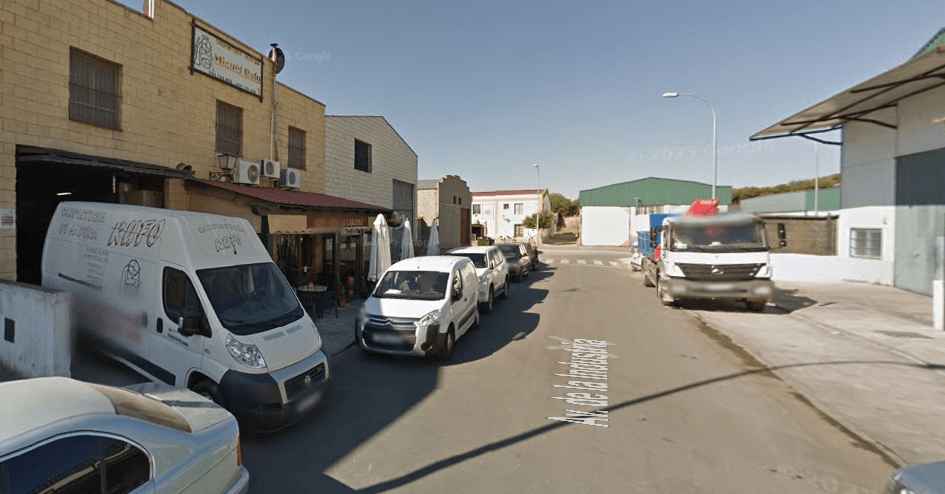
It turned out that the hostel was out on the edge of the village, in an industrial area, an unlikely site for pilgrims. As we tramped past factories and warehouses, we started to wonder if we had made a mistake in our directions. But there it was, at the far end of the road.
There was a bar connected to the hostal with extremely friendly and hospitable staff. We obtained our room key, and after a refreshing cold beer, we went to our room, via an adjacent entrance door. And that evening we ate a delicious plate of garlic shrimps and drank a bottle of local wine at a table on the pavement, sitting under the stars.
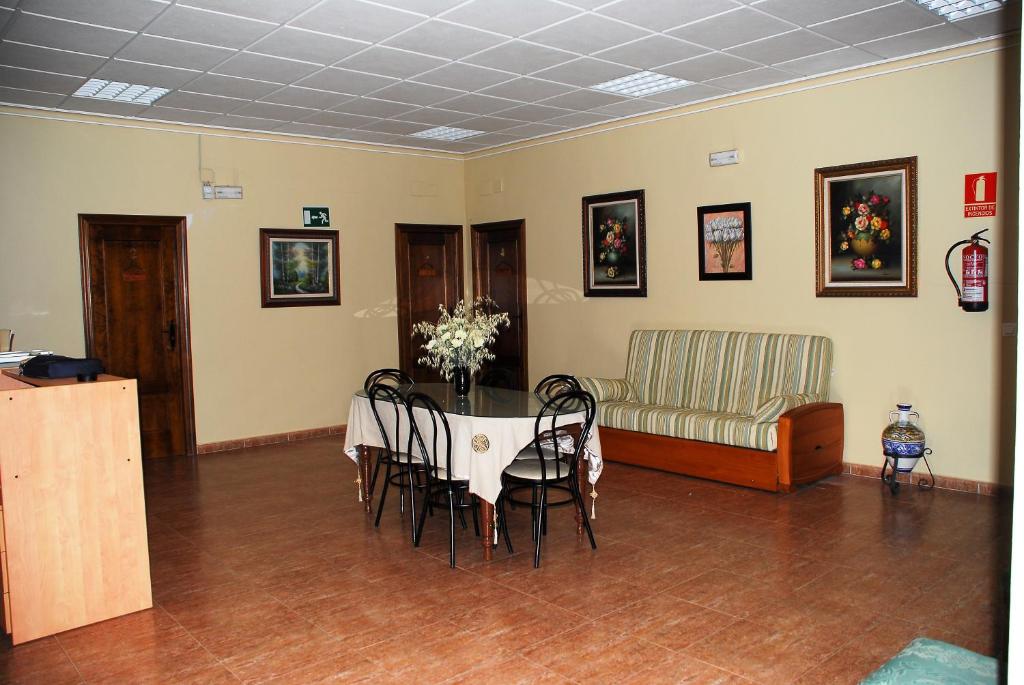
The next morning breakfast was served in the common area that ajointed the rooms.
I struck up a conversation with the guy who served the breakfast and I commented that it seemed to be a strange place for a hostal, rather far from the tourists and pilgrims. He said that most of their clients were connected to the mines or to the industrial area. I was not aware that there were productive mines in the area. I learned something new.
In late 2022, my investment research produced Atalaya Mining (ATYM) as a firm prospect. When I got into the details, I found that their main copper mines were just north-west of Seville and they had promising discoveries in both Galicia and in Sweden. Now I don’t know if ATYM has ever been a client of Hostal La Encima, but my gut feel was that this was a good one. I made a substantial investment in AYTM.
As of today, that investment has increased by more than 165%.
I believe that successful investment is a combination of skill and luck.
‘The most important thing in life is not to have the most, but to need the least’ (Plato)
In this era of conspicuous consumerism, of ‘shop until you drop’, of buying more of what you already possess, and loading credit cards with money that you don’t have, I consider myself to have been most fortunate in having parents who had a ‘waste not, want not’ attitude. We had the basics, but no more.
When I left home at 18 to migrate to Canada, my posessions barely filled a very small suitcase. Apart from the clothes on my back and the shoes that I was wearing, I had a couple of shirts, underwear and socks. I had also my football boots and a sweater for when the weather got colder. There wasn’t much else, for the case was very small.
My ambition was to see as much of the world as I could, so keeping my processions to a minimum became a priority. For the next 20 years, I roamed, working for a time in each destination, to Canada, Australia, US, England, Nigeria, Venezuela, Peru, slowly enhancing my IT career. Sometimes I was employed, at others I was a contractor. Regardless of the mode of employment, I made a point of never leaving a project before it was completed to the satisfaction of the client. My professional reputation was important to me.
When I eventually settled down in England and had a family, my minimalist habits still prevailed, with one exception: my collection of books. They were intended as an intellectual investment for my dotage when I might be no longer able to travel. In the meantime, they remain unread in their bookshelves in England, for I am not yet ready to put my feet up and wait to die.
And now in Cape Town for the past nine years, I am still ambitious to see some more of the world, not as an old-age-pensioner-tourist on a cruise or bus, but as a traveller, with my pack on my back, and the open road ahead. Walking from village to village with a light backpack, through towns and cities, I realized how few are the possessions that I really need.
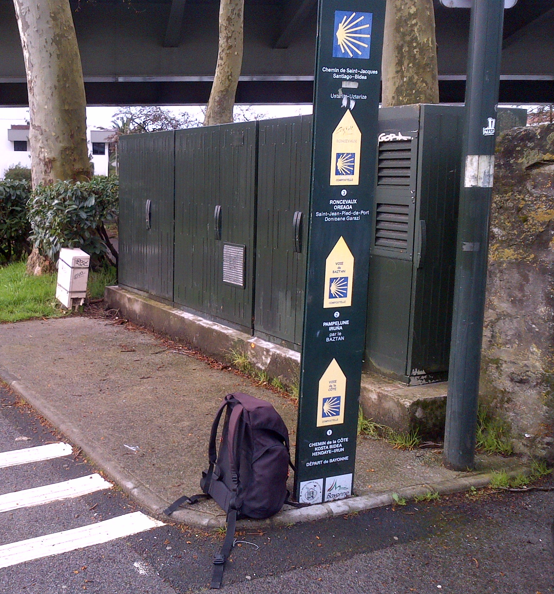
Setting out from Bayonne to walk up the Baztán valley to Pamplona, and then west to Burgos
Way back in 1965, just before I left home, I saw Cliff Richard and the Shadows in a concert in Belfast. One of their hit songs was ‘Travelling light’. I often sang that song as I walked along on one of my pilgrimages.
One day soon I hope to walk another pilgrimage and sing it again.
In 1977, ‘The Complete Book of Running‘ by Jim Fixx was published. It was credited for starting the boom in competitive road running in the US, and soon after, globally. When I arrived in Caracas in late 1978, there was already established a dedicated group of runners, who met most evenings in the Parque del Este.
Despite his reputation for being a symbol of health and fitness, Jim Fixx died in 1984 of a heart attack while jogging. He had a previous history of smoking and being overweight and had underlying health issues. But I suspect that he died doing what he wanted to do.
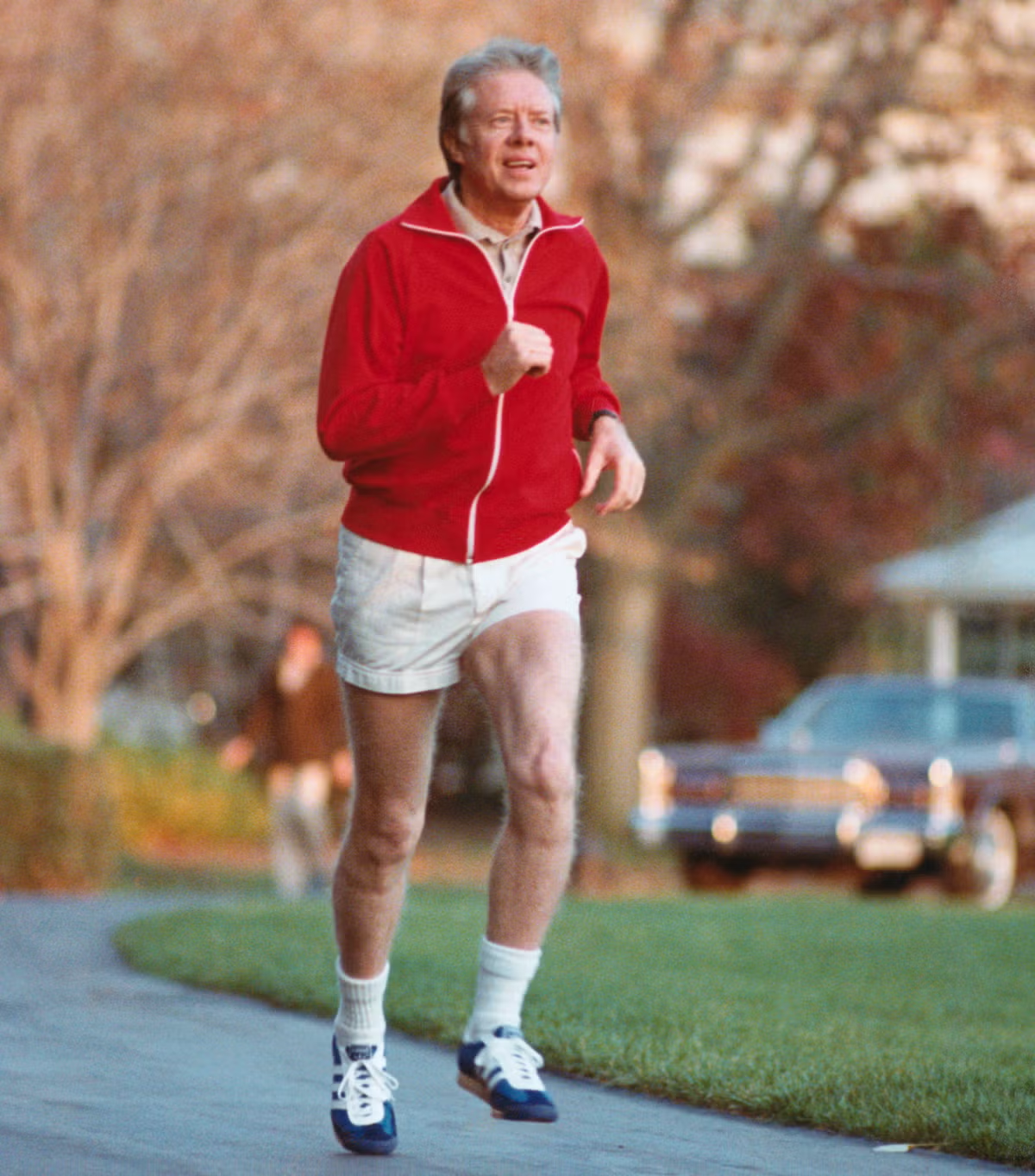
Jimmy Carter, the then-precedent of the US, took up jogging in 1978. He was often to be seen trotting around, with his body guards puffing along with him.
He hit the headlines in 1979, when he collapsed during his first race, The Catoctin Mountain Race, a hilly 10 km that started beside Camp David, the presidential retreat.
But he was fine later, with no lasting ill effects, and turned up for the award ceremony.
He was born on 1 October 1924 in Plains, Georgia, the son of a peanut farmer. He married Rosalynn Smith in 1946, with whom he had four children. He served seven years as a naval officer and was president 1977-1981.
When I drove from California across the southern US in 1977, on my way to Canada and eventually the UK, I passed through Plains, Georgia. It seemed like an unimpressive dusty rural town. I didn’t stop.
My only ‘near-contact’ with Jimmy Carter was in 1984. I was at Jorge Chavez Airport in Lima, waiting to collect a colleague, Richard Austin, from Miami. Richard was scheduled to spend a few days conducting a quality assurance of the software product for which I was responsible. The flight was very late, with no explanation. Finally it landed and soon after a group of VIPs strode through arrivals, led by Jimmy Carter. Apparently all was delayed because of his late connecting flight.
In 2002, Jimmy Carter was awarded the Nobel Peace Prize for his work to find peaceful solutions to international conflicts. From what I know of the man, the award was well deserved.
In his autumn years, he and his wife worked tirelessly as volunteers building, renovating and repairing affordable housing for needy people. They lived modestly and when they travelled, it was commercial rather than first class or private.
Rosalynn Carter died 19 Nov 2023 at the age of 96 and Jimmy Carter on 29 December 2024 at the age of 100.
When he played on a beach with his older brother in the south of France in the late 1990s, little did I know that Philip would become a serial-achiever. In addition to some of his achievements that I mentioned in my previous blog, he was about to become an Ironman.
Philip and John in about 1999
In case you are not aware, an Ironman triathlon is a long-distance race that consists of three consecutive stages: a 2.4-mile (3.9 km) swim, a 112-mile (180.2 km) bike ride, and a 26.2-mile (42.2 km) run, for a total distance of 140.6 miles (226.3).
The original Ironman World Championship was held in Hawaii in 1977 and has been held annually ever since. It is the culmination of a series of qualifying races around the world that take place throughout the year.
Together with another brother, Bob, Philip completed his first full marathon in Barcelona in 2017. It was with Bob that he previously cycled from England to Venice
Bob and Philip after finishing the Barcelona marathon
For his Ironman triathlon, Philip chose that of Tempe, Arizona, about 350 miles west of San Diego, where he lives with his partner, Nicole.
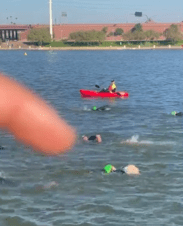
Waiting to start the 2.4-mile (3.9 km) swim
Nicole’s finger pointing to Philip in his green cap
One 40-mile lap completed, 80 miles to go
Their little dog, Milo, looking out for Philip
Approaching the finish line
With his medal and not looking even slightly tired!
Philip finished in 14h48, well within the cut-off time, and professed the next day that he was ‘definitely sore, but not as bad as he expected‘.
Oh, to be young again!
So, I have updated my previous blog with my son’s achievement, and I added two that I had overlooked – both Bob (2012) and Philip (2019) completed a skydive. You can read the updated version by clicking here.
I suspect that I will have to update that blog many times before I go on my last walkabout!
They will go further than I could have ever imagined possible
Although I was happy in my primary education at Carnalridge – the school was about 100 m from the entrance to our farm, the strict discipline of a 1950’s grammar school education in Coleraine, with its constant threat of corporal punishment, grated with my yearning for independence. I left school at the earliest opportunity and soon after I set off to seek my fortune. I’m still seeking!
Thankfully, times and teaching methods have changed, and my sons were never caned, kept in detention after school and made write hundreds of lines like ‘I must not forget my homework’. It may now be hard to believe, but grammar schools in the UK and Ireland were like that. It seems to me that the strict discipline was intended to break rebellious spirits. In my case they failed.
In comparison, my sons received an excellent primary education at Lyndhurst in Camberley, well followed by Salesian College in Farnborough. All four boys achieved a plethora of ‘A’ levels, the UK equivalent of university entrance.
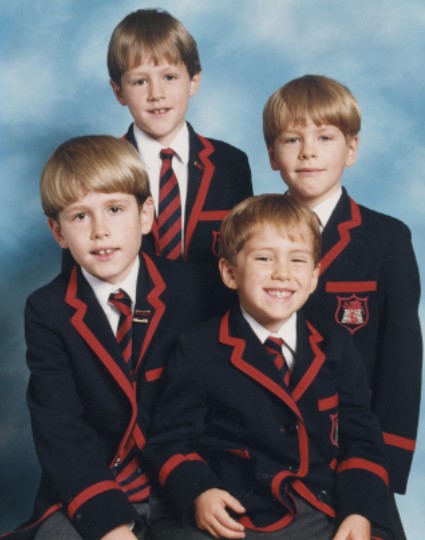
In Lyndhurst, all four were there in Andrews’s last year.
They were all very much involved in their school sports from an early age, and I loved taking them to their many varied sports – football, rugby, cricket, basketball, javelin, judo etc .
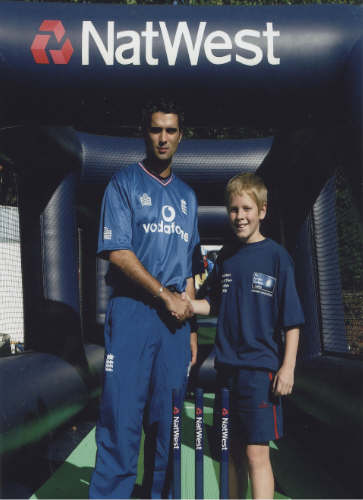
John receiving an award at Lords, the home of cricket.
John in action with the Camberly youth team
Both Andrew and John pursued the academic path, attaining degrees from Imperial College in London and the University of Southampton respectively. Bob and Philip took a sabbatical from studies, before embarking on careers in accounting and software development.
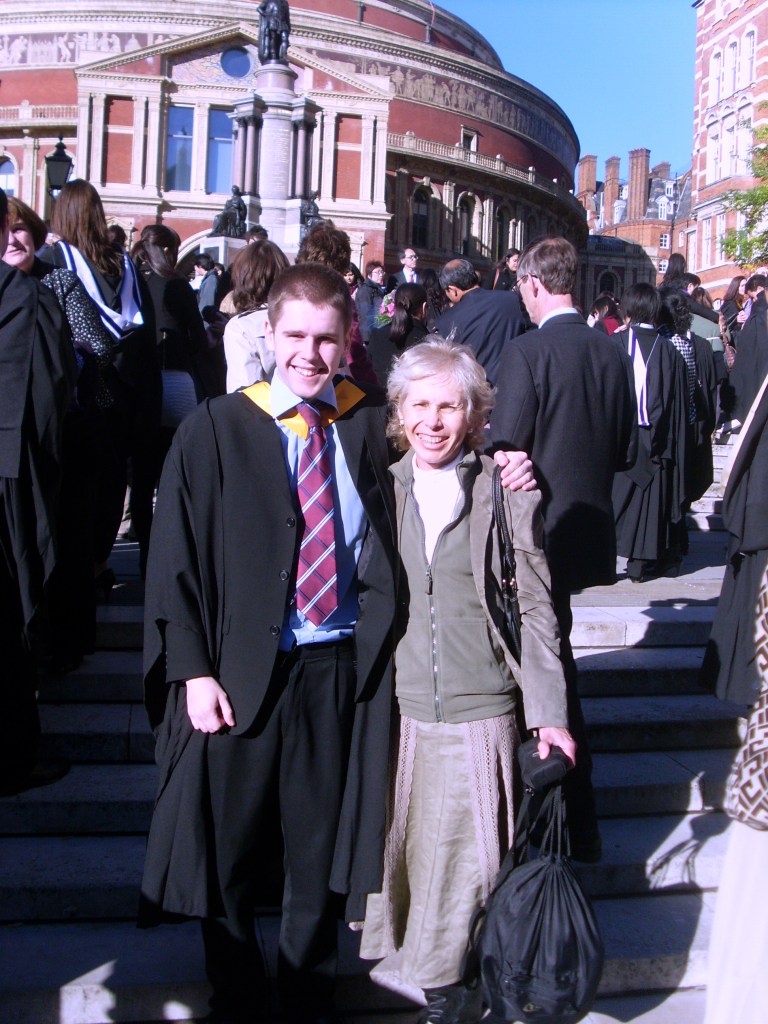
Andrew and his mother outside the Royal Albert Hall
John with Hazel, his now- wife
Between them, my sons have travelled in more than 60 countries and territories, and they have resided and worked in Australia, New Zealand, US, France, Spain, Germany, as well as being road warriors in several other countries. At this rate they will soon overtake me!
They are all competent skiers, thanks to a UK artificial slope and Lotta’s introduction to Swedish ski slopes.
Philip at Branäs in Sweden
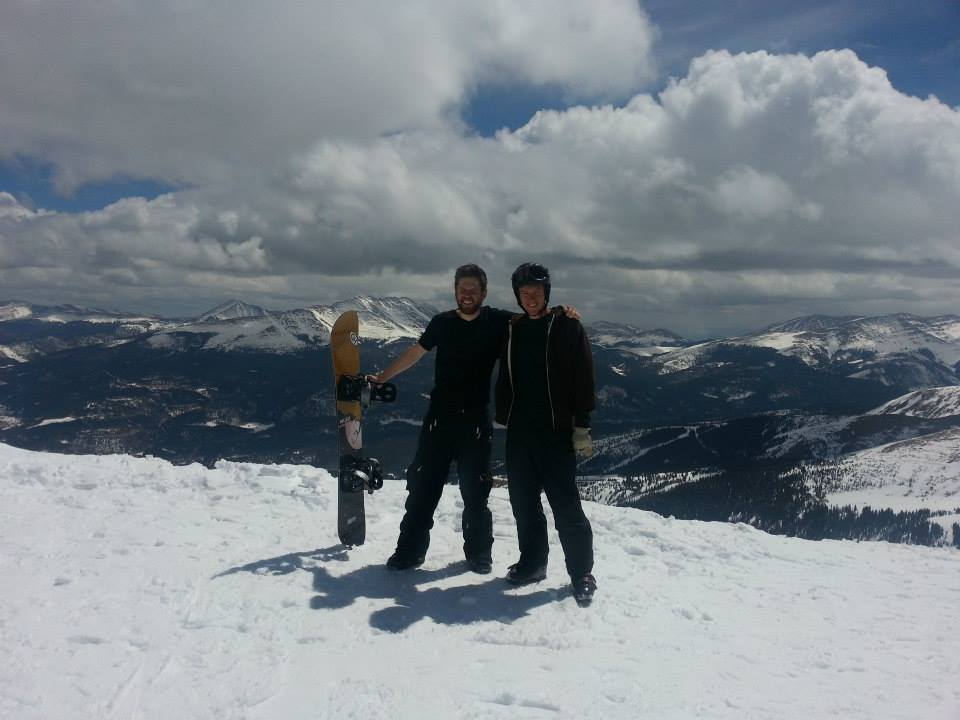
Andrew and Bob at Breckenridge, in Colorado, where Bob used to work.
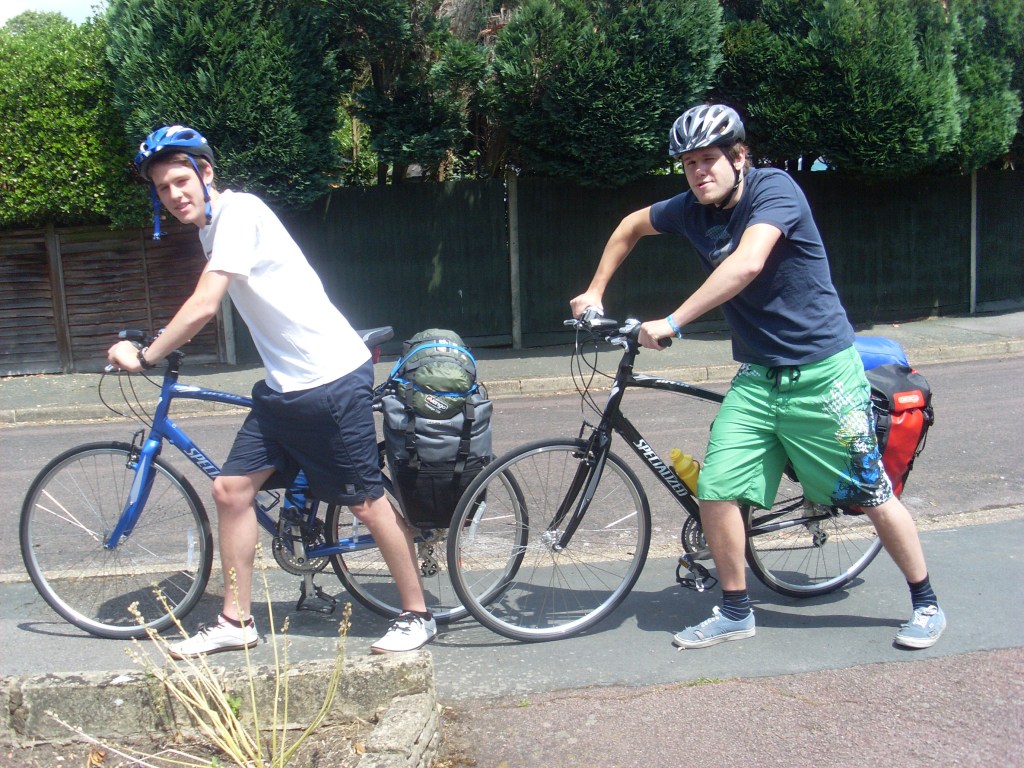
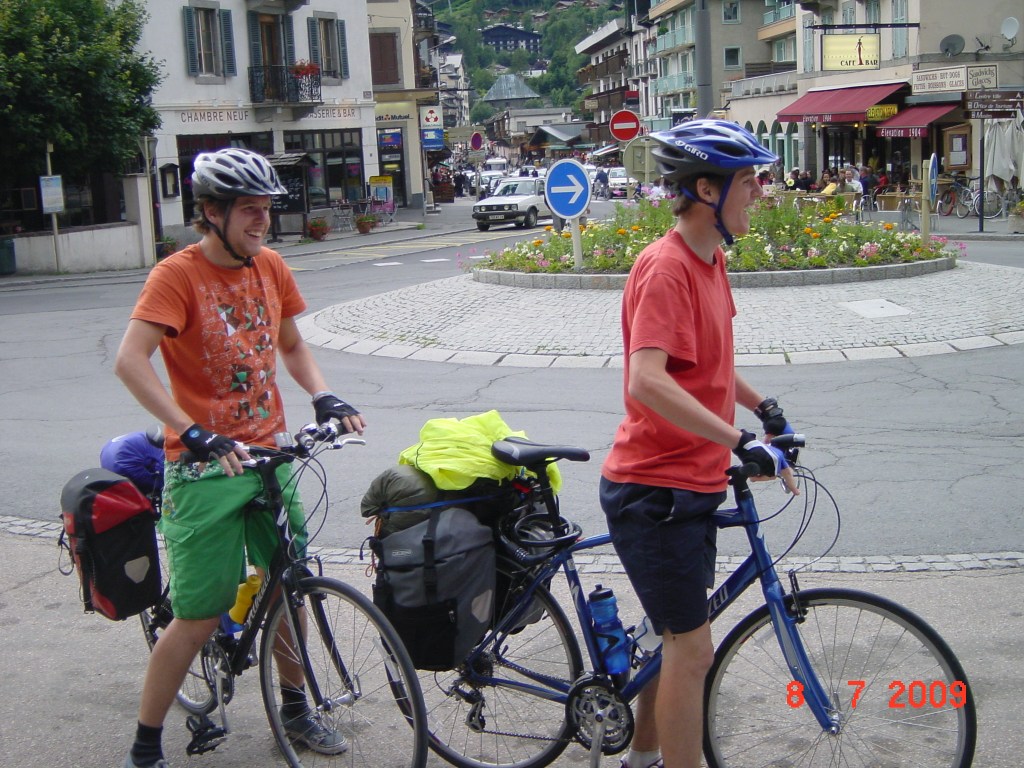
Andrew, Bob and Philip are accomplished long distant cyclists, with treks from the UK to Chamonix and Venice and Philip across the US coast-to-coast.
Bob and Andrew about to set off from Camberley to Chamonix in the summer of 2009
And arriving in Chamonix many days later
Philip arriving at the west coast of California after cycling 44 days and 4800 km from the US East coast.
Until I suffered a stroke, for many years I was an enthusiastic mountain hiker, mainly in Switzerland and France, but also in the UK. My sons have climbed further and higher than I have ever done.
Andrew in the Andes with a street dog that adopted him.
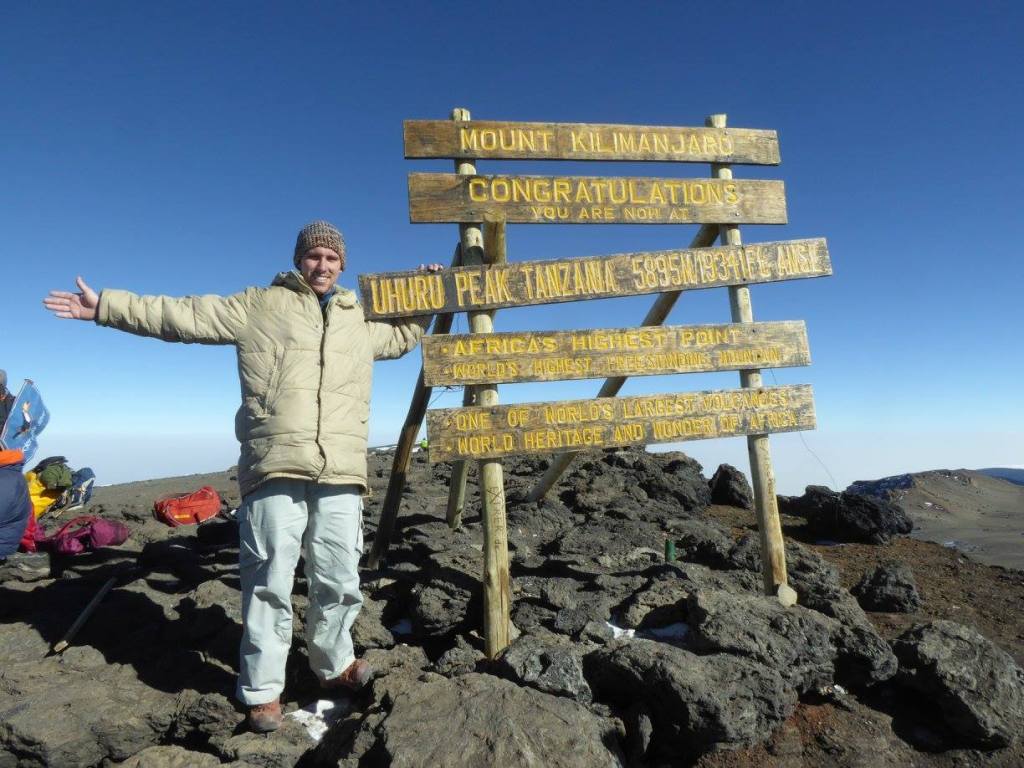
Philip on the summit of Kilimanjaro at 5895 m
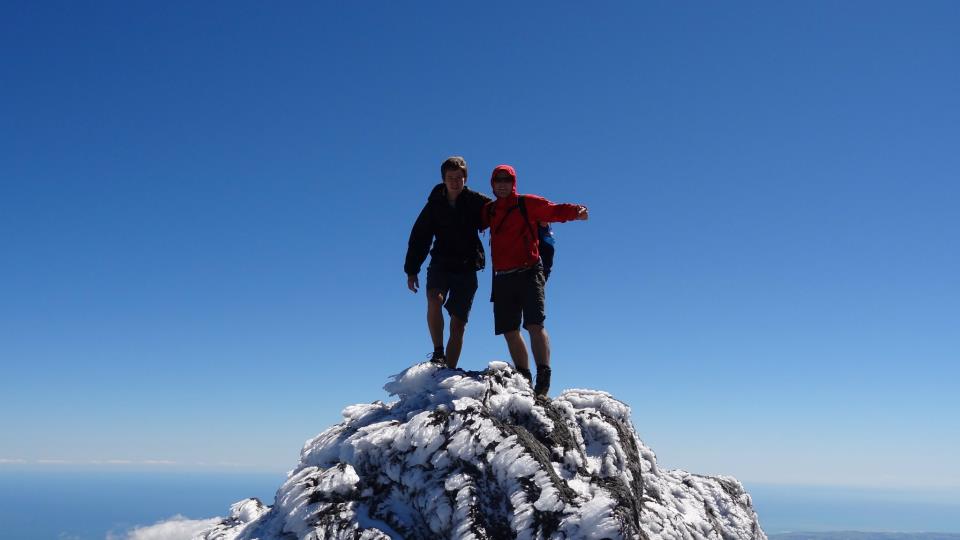
Bob and a friend on the summit of the dormant volcano Mount Taranaki at 2518 m, on the north island of New Zealand
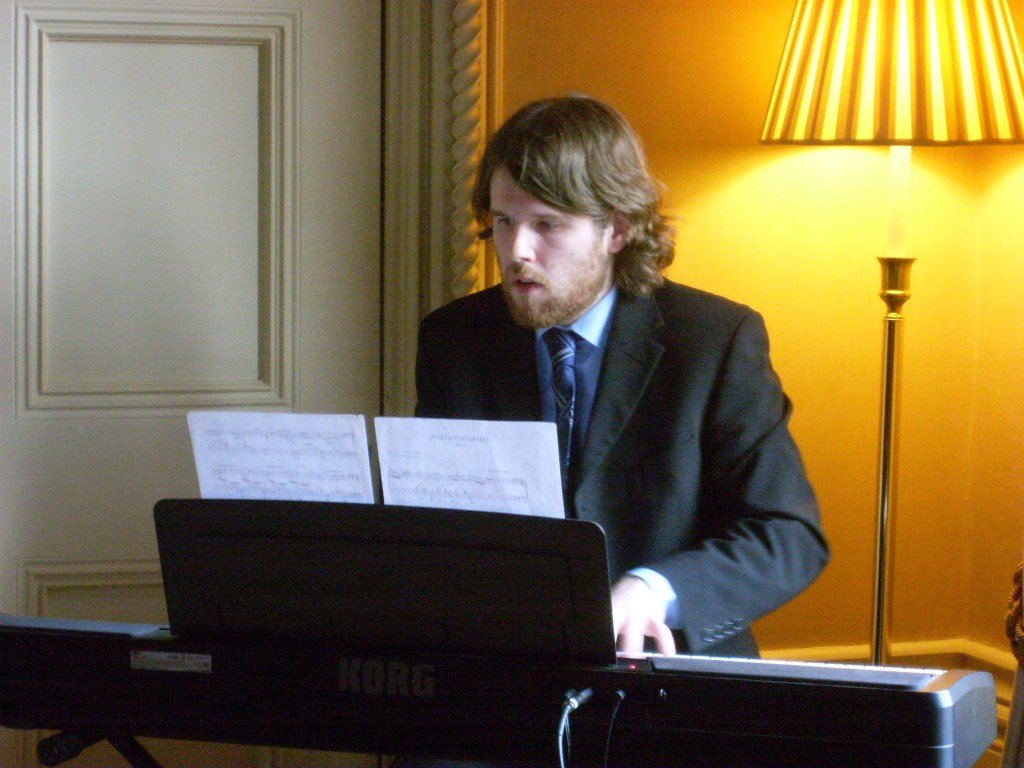
And all had an excellent music education, with Andrew excelling on the piano. His grandfather and great-grandfather, both musicians, would have been proud of him.
Andrew entertaining at a wedding reception.
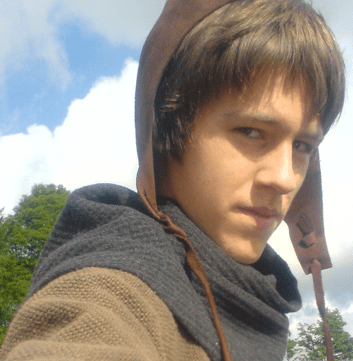
And there were a couple of wannabe actors in the family…
Bob about to go on the set of a Robin Hood movie
Philip performing in a musical
Philip’s volunteer work is impressive. At his own cost, he participated in projects in Tanzania, the Philippines, and Mozambique.
Philip on a volunteer assignment in Tanzania
Both Bob (2012 in New Zealand) and Philip (2019 in California) completed skydives.
Philip in ariel action!
And Philip is now an Ironman!
Yup, they have gone further than I could ever have imagined, and there’s almost certainly more to come.
It was in late 1984 in Lima, when I was about to return to Miami to a new assignment, that the Bank of America country manager, Bill Schoeningh, asked me to write an article about the new product, Versatel, for which I had been responsible.
I delivered a draft the next day, and Bill called me to his office.
‘Have you studied Hemingway‘, he asked.
‘Nope, not a word. Why do you ask?
‘Because your writing style is similar – short, direct and to the point.’
I took his comment as a compliment, and my article was later published, in both English and Spanish, in a company marketing brochure.
Since that day, now a distant memory, I have read almost all of Hemingway’s published works, some more than once. It was William Faulkner who once said that Hemingway ‘had never been known to use a word that might send the reader to the dictionary’. For me, that’s one of the attractions of Hemingway’s writing – it’s unpretentious.
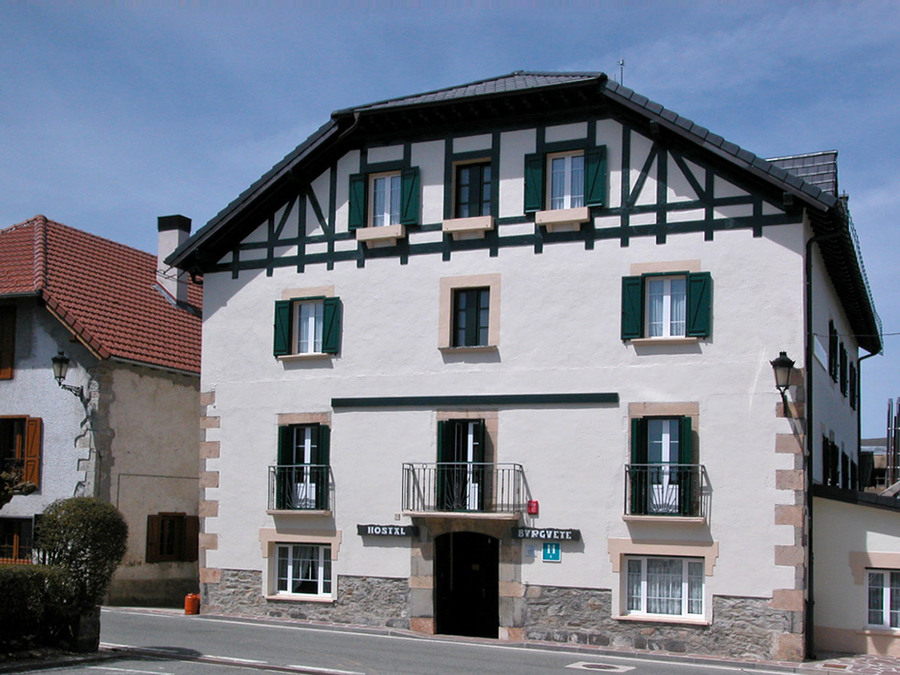
A few years ago, when I started out on a pilgrimage from France to Santiago de Compostela, just over the French/Spanish border I came upon the village of Burguete, and the rural hotel that was made famous by Hemingway in his novel ‘The Sun Also Rises‘.
Hostal Burguete
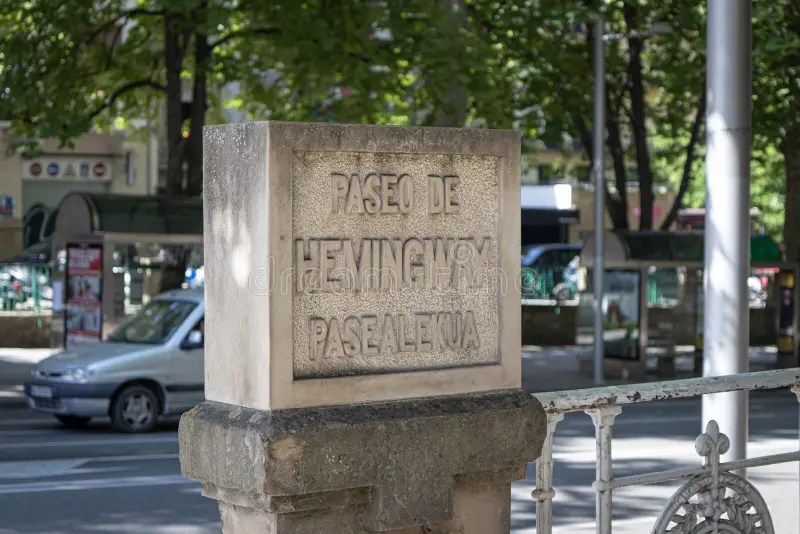
And a couple of days later, I came across many visual memories of Hemingway in Pamplona – outside hotels, in bars and on road signs. Hemingway has been well-remembered in Pamplona.
A street in Pamplona
Hemingway was a complex character.
He was seriously wounded as an ambulance driver in WWI in Italy. He spent time in Paris and mixed with the arty group that included James Joyce, Gertrude Stein, Ezra Pound, Pablo Picasso, John Dos Passos, F. Scott Fitzgerald and many others. He served as a journalist in the Spanish Civil War and witnessed both the Normandy landings and the liberation of Paris.
He travelled extensively and in successive days in 1954, he was badly injured in two plane crashes in Africa. He spent much of his later days between Havana, Key West and eventually Idaho.
In 1954, he received the Nobel Prize for Literature.
Hemingway at work
But his history of heavy drinking coupled with the legacy of his many injuries, played havoc with his health. In 1961, Hemingway ended his life by committing suicide, as had his father before him. His brother, sister, and a granddaughter – the model and actress Margaux Hemingway, also terminated their own lives.
Like the Kennedy family, the Hemingways seem to have been cursed.
Despite the years that have passed, literary tourists still visit the hotel in Burguete, to sleep in the room reputed to have been his and visit the bars and places he used to haunt in Pamplona.
My first five years were spent in a wooden house on the Loquestown Road, that passed by the village of Glenmanus. The little house was one of many that ringed a large field, temporary accommodations that were provided by the local council for destitute or near-destitute families. It was just after WW2 and there was much poverty. Thanks to my mother’s uncle Bill and one of his fields across the road, my father was able to start his fledgling poultry farm, subsidized by his talent as a semi-professional pianist.
Eventually, my father was able to get an ex-serviceman’s mortgage, and had a small bungalow built on another of Uncle Bill’s fields, about a kilometer up the Coleraine Road, close by Ballywillan Church.
In that era our bungalow had no utilities. Water was carried from a nearby well. The toilet was a can in an outside brick house, that my father emptied on the farm’s midden heap. Light was by means of oil lamps. The only heat was from the kitchen stove and on occasional weekends, from a fire in the living room. The winters were bitterly cold, and we took hot water bottles to bed. I still remember there often being ice on the inside of the bedroom window.
In time, an electricity service reached the house, and the box room (store room) was converted into a bathroom, with the toilet flushing to a cess pool some fifty metres down the slope.
I left home for Canada when I was 18, in 1965. It was then that I realized how relatively poor my family was. We lacked so much that Canadians took for granted. We had no central heating. My poor mother had no fridge. Perishable food was stored in a pantry, that had access to the outside air. She had no washing machine, all being done by hand, including sheets. She had no dryer; she depended on a clothesline and a ‘drying wind’ day. And a shower was unheard of.
Some years later, when I could afford to help them, I sent them some money to install a shower in the bathroom, and later, to install a heating system. The result was not a great success. There was not sufficient water pressure for the shower to be more than a ‘pissing flea’, and the central heating seemed to do little more that gurgle and leak. My parents remained by their kitchen fire and little changed.
Some many years later, I find myself in Cape Town. It’s cold and the lights are about to go out again for the second or third time today. Candles will be lit, or we will have yet another early night.
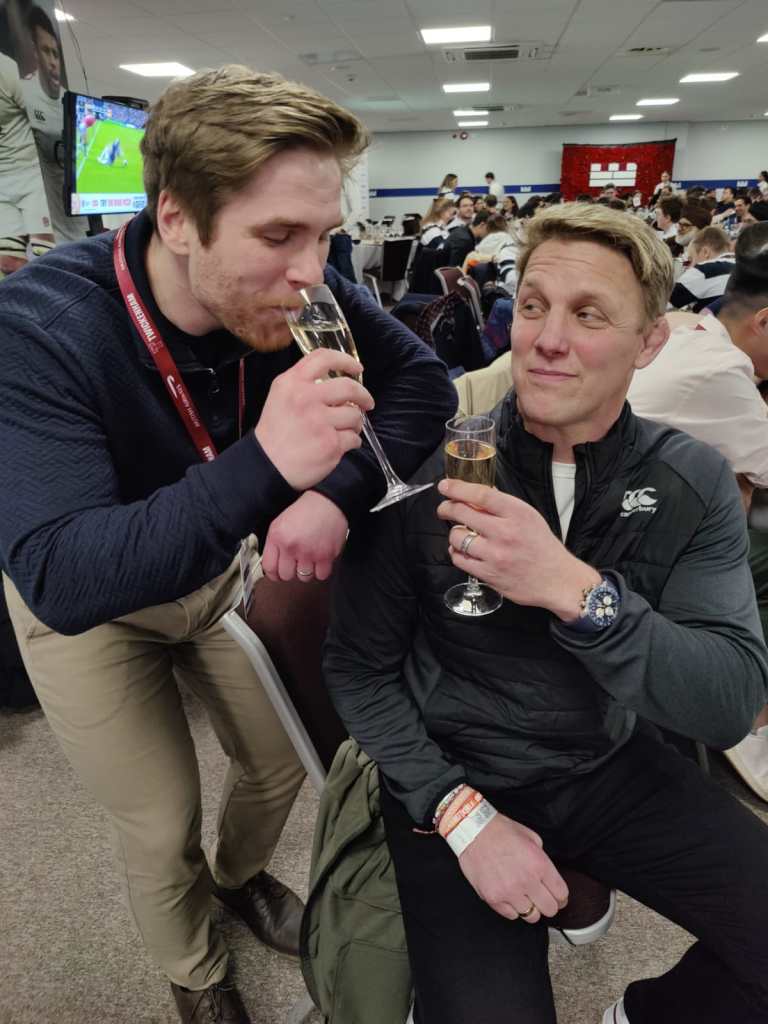
I had just returned from my usual walk past the Cape Town Stadium, along the promenade and back through Green Point Park, when I received a ‘whatsapp’ message from John, one of my sons. He said that he was at a work event, where one of the guest speakers was Lewis Moody. He wanted to know if I had that photo of him with Lewis Moody at a Milk Marketing Board event, sponsoring the England Rugby team, when they had a World Cup training camp at Pennyhill Park in Camberley. John was one of the invited mini rugby players from their school, Lyndhurst.
Et voilà.
John with Lewis Moody at Pennyhill Park in 2003
Lewis Moody was born in 1978 in Ascot and played mini-rugby until the age of 11, at Eagle House in Bracknell, near Camberley. He joined Leicester Tigers and played his first league game at the age of 18, in 1996.
He was selected for England from 2001-2011, where he scored 9 tries, plus one for the British & Lions in their New Zealand tour of 2005. He was a member of the English team that won the World Cup in 2003. He remained with Leicester until 2010, when he moved to Bath. He retired in 2012.
John must have shown the old photo to Lewis for they staged an updated version, with Lewis looking at John and John leaning on his shoulder, sipping champagne.
John with Lewis Moody in 2023
A careful observer might notice that, twenty years later, both now wear wedding rings!
‘On Saturday, I was a surgeon in South Africa, very little known. On Monday, I was world renowned.’ (Christiaan Barnard)
It is now more than two months since I was discharged from the Christiaan Barnard Memorial Hospital in Cape town. I entered the hospital in an ambulance and left six days later in an Uber. I entered with a bloody head from a mugging, and left with my head, a knee, an ankle and my groin bandaged, and two pre-cautionary stents in an artery. I also left with a prescription for seven pharmaceuticals, four more that I had when I entered. During my stay, I had been patched up, injected for tetanus, x-rayed, scanned, MRI-ed, blood and urine tested, and for four days, I was hooked up to monitors in the cardiac intensive care unit (ICU). All in all, a most interesting experience, but one I could happily have done without.
But there were some positive outcomes resulting from my six-day stay.
Firstly, I did not have to get up to go to the bathroom, especially in the middle of the night; my nurse would bring me a bottle, tilt the bed, and return when I had finished.
Then there was the morning bed bath, followed by the changing of the sheets, with me still in the bed. And of course, there was the food – breakfast, lunch and dinner, with a choice of five courses to each. I must say that when I started to eat after a couple of days, I found the food to be excellent, unlike any institutional food I had ever experienced. My only complaint was the lack of a wine choice!
And to cap it all, there was no load-shedding. While the rest of the country was struggling with two or three blackouts every day, the hospital had constant power. If it had not been for the lack of wine, I would have been tempted to try and stay on for a few more days!
But my most outstanding impression was the quality of the nursing staff. In the ICU, there was a nurse for every two patients. They worked 12-hour shifts and were in constant attendance. There were patients like me, under observation, but there were many others who were obviously very seriously ill. I suspect that the nurses’ jobs were not easy, especially when there was an emergency with a patient.
I don’t have any recall of the doctor in emergency. I guess that I had concussion for at least the first day. After that I was visited every day by Dr Mothilal and Dr Levetan. They always left me feeling that I was in good hands. And it was Dr Levetan who later entered the theatre, singing the Irish Rugby national anthem, before he explored my artery via my groin, and eventually inserted the pre-cautionery stents.
The original Christiaan Barnard Memorial hospital was in the Cape Town city centre until 5 December 2016, when it moved to a brand-new location on the foreshore, adjacent to the Cape Town International Conference Centre. The new hospital has 245 beds and eleven theatres.
The view of the end of Table Mountain from the tenth floor ICU
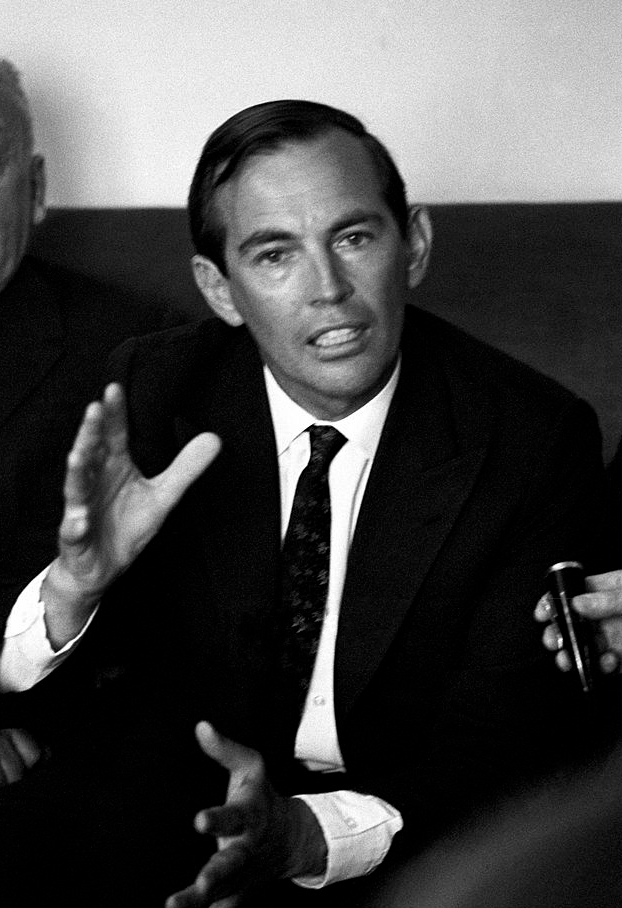
Christiaan Barnard (1922-2001) was the South African surgeon who performed the world’s first human-to-human heart transplant operation. It was in late 1967 and at that time, I was living in Toronto. I remember the occasion very well, for news of the operation was sensational and daily reports were included in news broadcasts, world-wide.
The operation, led by Christiaan Barnard and his team of some 30 medical staff, took place in the Groote Schuur hospital, in Cape town. They transplanted the heart of Denise Darvall, an accident victim, into the chest of Louis Washkanshy, who had a terminal heart disease. He survived 18 days, before succumbing to pneumonia. Barnard’s second transplant patient, Philip Blaiberg, survived for 18 months in early 1968, and was able to return home. The possibility of heart transplants became a reality.
Christiaan Barnard in Florence in 1969 (photo from internet)
Christiaan Barnard retired in 1983, when rheumatoid arthritis ended his surgical career. He died in 2001 in Cyprus, following an asthma attack. His memory lives on in the hospital that carries his name.
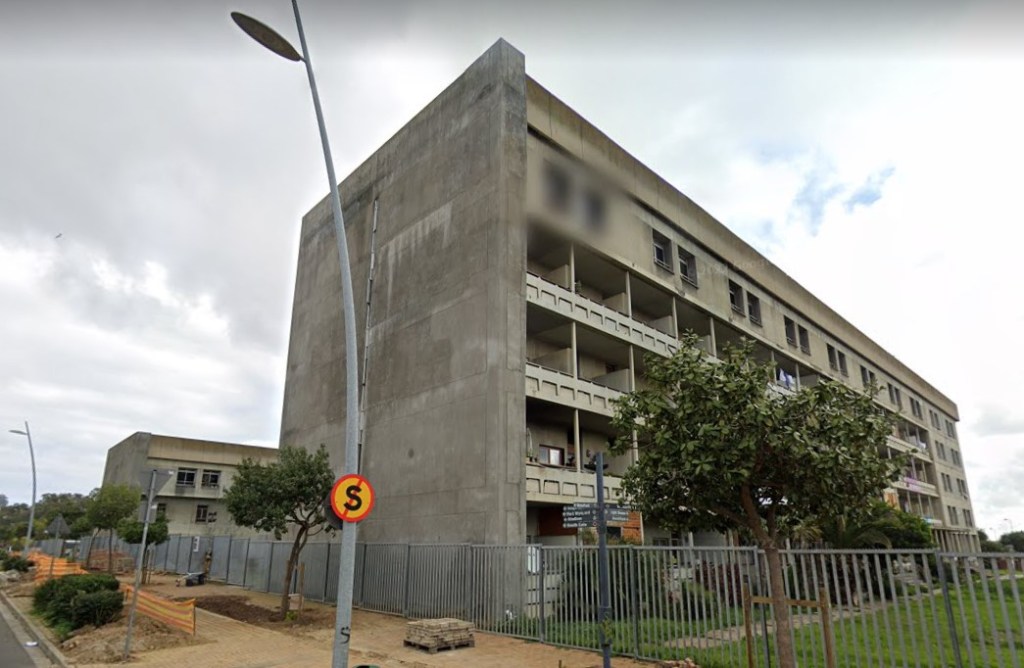
Granger Bay Boulevard runs from the ocean alongside the Waterfront complex to Main Road in Green Point. Where it crosses Beach Road, on one side are the buildings of Somerset Hospital and on the other side a five/six storey derelict building, that looks like it has been possessed by the dispossessed. The grounds are usually littered with rubbish, and I can imagine that a typical affluent international tourist on the way to Water Front could be feel rather intimidated by the neighbourhood.
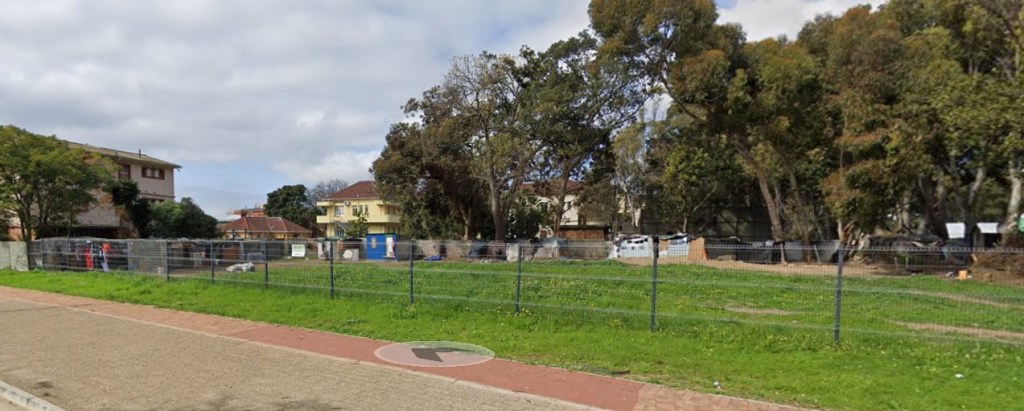
The road continues past the Fort Wynyard military complex to the rear of the Cape Town Stadium. Across the road is another block of land that has been taken over by the homeless, with shacks made of wood, tin, plastic and cardboard, and the area strewn with rubbish.
But jointly or severally we have walked this road at least once a week for the part 5-6 years and never encountered a single problem, until Friday 16 September, when I was alone and felt a sickening thud on back of my head. I knew nothing further until I found myself on a concrete bench beside the Stadium. I could see nobody around and I still had my backpack, but I didn’t want to check if I had been robbed. I decided to walk to a wall at McDonalds, but I have no recollection of getting there. But I do remember finding nothing missing from my backpack. It was then I realized that I was bleeding heavily from my head. I needed to get home to get cleaned up.
I guess that I had concussion, because I wanted to order an Uber, but I could not remember where I lived. Somehow, I managed to walk home and our security immediately saw that I was in a mess and called for an ambulance. I got in the elevator, but again I couldn’t remember where my apartment was. Security took me to my door and a few minutes later an ambulance arrived. I was taken to the Christian Barnard hospital.
For the next two or three days, all was a bit of a blur. I was convinced that I had been mugged, but as I had not been robbed and there were no witnesses, the doctors assumed that I had tripped, had a blackout, or had another stroke. A chunk of my hair was shaved off, so that the laceration on my head could be stapled. Similarly, my left knee and right ankle were bandaged. As I had a previous history of having had a stroke, had previously had a blackout, and I was on my own – Lotta was in Sweden visiting her parents, the doctor did not feel that I could be released under the circumstances, and I was placed in the Intensive Care Unit (ICU), under observation.
I was subjected to a battery of tests, to the end of identifying the cause of my collapse. The only suspect was a narrowing of the artery to leads to my right leg, and while there, the surgeon inserted two stents, as a precautionary measure.
Recovering from the stent
Wired
Pulsed
In the meantime, Lotta had been made aware and had returned as soon as she could get a flight. The next day she walked the area to see if she could find any witnesses to my assault. She found some construction workers who had seen two thugs hit me on the head from behind with something heavy. They had shouted and chased them away and left me on a bench near the stadium. Knowing myself, I probably thanked them and assured them that I would be fine.
When Lotta reported this to me and to the doctors, I felt a great sense of relief. It had really bothered me that in future, I could be walking along on one of my pilgrimages and suddenly have a blackout. The fact that the doctors had found nothing obviously amiss, I found encouraging. After six days, I was discharged, with a prescription for three more drugs to add to the four I have already been taking!
It has now been over three weeks since I came home, and I am almost back to normal, albeit the progress having been very slow, especially in the first ten days. My hair is starting to grow back, so I am less looking like a monk as each day passes. The sun is getting warmer, the birds are singing, and summer is on the horizon. All is looking good again.
















 The Irish Rover