Greenacres

My father’s WWII duty ended in Northern Germany, at Lübeck, northeast of Hamburg. He was demobbed in late January 1946, after more than six years of active service, having been involved in the invasion, wounded in the fighting in France, Belgium, The Netherlands and Germany. He made his way back to England, where he received £95 and a suit from the UK government, visited his parents in Norfolk, and reunited with my mother in Glenmanus, a small rural village just outside Portrush on the north coast of Ireland.

Nine months later, almost to the day, I was born.

My father had a commitment from his former employer, Sainsbury, to enable him to resume his pre-war managerial career, but he turned it down. Despite having no agricultural background – his father was a classical musician and his mother a teacher, he had decided to start a poultry breeding farm. His interest in poultry dated from when he was rested from the fighting and spent two weeks at a poultry farm in The Netherlands. With most of his limited capital, he bought a pedigree cockerel and twelve hens and started his fledgling breeding farm on a small plot of land allocated to him by his father-in-law.

In the meantime, while his stock of birds slowly expanded, he subsidized his income by playing piano with his dance band, initially at Barry’s dance hall in Portrush, and later at the Northern Counties Hotel, in that era one of the premier hotels in Ireland.

By 1951, the poultry flock grew too large for the small plot of land in Glenmanus. My mother’s uncle Bill Douglas, a retired farmer, granted my father a 99-year lease on some fields that he owned beside Carnalridge Primary School, on the road to Coleraine. A new house was built and in 1952 we transferred to our new home. It was the start of Greenacres Poultry Farm. Expansion was rapid and within a relatively short time, the fields were fully utilized. All income was reinvested, and my parents never had a holiday; they worked every day of every year. There is never a break from livestock on a small holding.

The house and farm buildings, the photo dating from circa 1960
A schematic layout of the farm, together with the neighbours – Ard Rua, where my paternal grandparents lived, the Collins farm, the Bankhead (the Carnalridge headmaster), Boyd and Gurney, Houston and Walker.
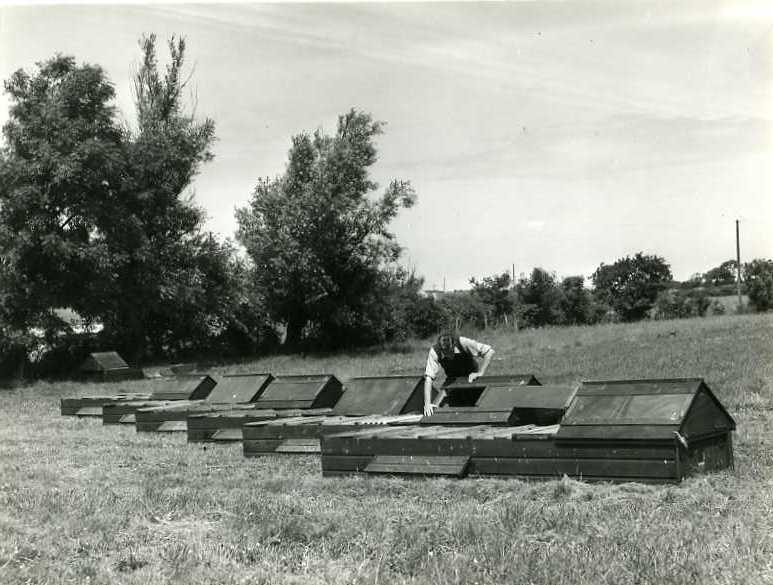
The fleet of small arks that housed the young chickens, while they grew accustomed to being outdoors. The arks were moved every few days across the field, leaving behind manure to fertilize the grass.
There were four houses thay housed the free-range laying flocks. In the background can be seen the family house.
One of my father’s Light Sussex cockerels. Note the spurs!
A small flock of Brown Leghorns, with a laying house in the background

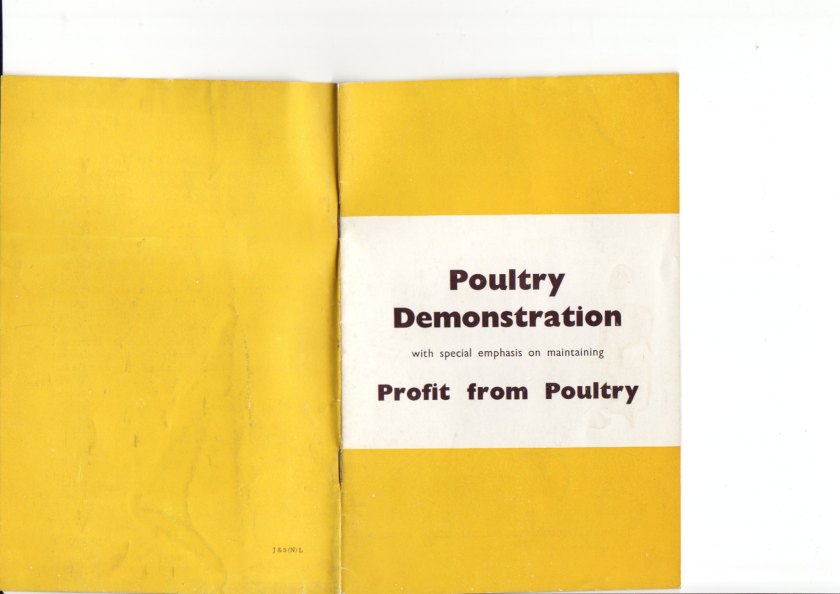
My father’s reputation soon spread and in 1958 Silcock, the leading animal feed company, sponsored a ‘Poultry Demonstration’, to which were invited farmers over all the north of Ireland. A large tent was erected, with tables and chairs, and for two days the invitees arrived and were hosted with presentations, demonstrations, tours of the farm and Irish hospitality.

It was judged to have been a great success and my father’s business prospered.
The farm was never exclusively for poultry breeding. A herd of pigs was introduced together with a small flock of 30 sheep, to keep the grass under control. In addition a flock of turkeys was added and once a year pheasant chicks were hatched for a local landowner.

My father’s prize boar

But disaster struck in Northern Ireland in about 1964 with a severe outbreak of fowl pest, a devastating chicken disease. Ireland was very dependent on its agriculture and despite strict quarantine practices, somehow the disease had entered the country. The government mandated that there could be no movement of any livestock between farms. My father had little capital and in a short time he was out of cash. Despite his years of being a solid client, his bank was of no help. It was yet another example of banks being your fair-weather friend!

Everything on the farm that could be sold was sold and with the pittance that he accumulated, he bought a small grocery business that was then available in Portrush, across the road from the train station. It belonged to a Mr Gibson, who was retiring.

The business was never a great success. Portrush was in long-term tourism decline. There were fewer and fewer visitors and a new supermarket in Coleraine negatively impacted local small grocers. My father persisted for several years but finally surrendered to the inevitable and finished his working years as the store manager at Kelly’s, a nearby complex of hotel, bars, restaurant and nightclub.

After my mother died in 1985, my father returned to his first love – music. He bought a then-state-of-the-art organ and re-established his reputation as a talented musician. And until the week he died in November 1995, he provided background music in several local hotels and restaurants.

My father was talented at everything in which he was involved. He was a brave and courageous soldier, wounded but refusing to succumb. He was an innovative farmer, who challenged the boundaries of poultry breeding. He survived through his prior training in the grocery business. And his talent as a musician never failed him.

He has proven to have been a difficult act for me and for my sons to follow.

Going for it

‘One day you will wake up and there won’t be any more time to do the things you wanted to do. Do them now.’

(Paolo Coelho)

BC (Before COVID), I had a clear vision of how I wanted to spend whatever time I had left – four months in South America, similar in Southern Europe and the rest in South Africa, repeated ad infinitum. That was my ambition. ‘Following the Sun‘ was my mantra and it seemed to be within my grasp.

Until COVID came along and screwed up the world.

Now we are all in life’s waiting room. And governments have seized their opportunity to legislate and control us. But given their inevitable incompetence, they will mostly fail, and we will eventually regain some independence., albeit probably with another useless layer of bureaucracy.

In the meantime, I continue with my efforts to improve my ability in Spanish, French, Portuguese and Italian. In Spanish, I am conversant and relaxed, in French I can defend myself, in Portuguese I still valiantly struggle, and Italian is virgin territory, but I hope to eventually sufficiently improve.

My linguistic goal has never been perfection, but to be able to communicate effectively, with a minimum of glaring error, and without having to use English. I will always have the intrusion of my Irish accent, and that I am unlikely to lose.

At school, I was never a great student of Latin and French, although I generally achieved acceptable marks. I never understood why we bothered to study languages. I received no encouragement from my parents, who were monolingual. My father always said that he had had enough of Europe after his six years of war service, and he never ever wanted to return. My mother used to say that ‘the only good German was a dead one’, a view that caused many a clash between us. I understood her bitterness, but I also felt that my generation and our children had to turn the page and start a new chapter.

I first travelled around western Europe in 1968, and it was then that I was bitten by languages. I became fascinated by the communication challenges, and when I later realized that ability in Spanish and Portuguese could open new opportunities for me in Central and South America, I was well on my way.

And I have been going for it ever since!

The Clock

Every day I sit at my desk, looking toward the green wall of Signal Hill on my left, and the South Atlantic Ocean to my right.  To be tired of that view, one would be tired of living in Cape Town, to paraphrase the reputed saying of Dr. Samuel Johnson.

Directly in front of me, across the red-tiled roofs of an apartment complex, stands the clock tower of Reddam House (http://asb.reddamhouse.com/), a well-respected private school.

But despite the reputed quality of the school’s teaching, the accuracy of the school’s clock leaves a lot to be desired.  During my almost five years of living here, the clock has rarely displayed the correct time.  It has always been a few minutes slow and it has frequently stopped for days after a heavy rain storm or strong winds. Recently one of the segments of the clock face disappeared in a high wind, and for a time, there was only one hand on the side facing me.  To compound the confusion, the four faces of the clock don’t all display the same time, on the occasions when the clock actually works!

I confess that I find it very frustrating to see a clock that is often only accurate twice a day.  But here in Green Point, we have a reliable alternative: the Noon Gun.  Every day, save Sunday and public holidays, it booms across the city, at precisely 12:00. And these days, the guns are fired by an electronic signal from the South African Astronomical Observatory.

,The Noon Guns – there are two of them, with one as a backup, stand above the city at the end of Signal Hill.   This historic time signal has existed since 1806. Originally the guns were located in front of Cape Town Castle, but were relocated to their position on the hill in 1903, no doubt to the relief of the city residents and all pigeons.

The guns were cast in 1794 and were brought to Cape Town during the 1795 occupation. They are reputed to be the oldest guns in daily use in the world.

If you stand in the square by the Cape Town Stadium, at precisely noon, you can get a practical example of the difference between the speed of light and the speed of sound. You first see the puff of smoke from the cannon and what seems like at least a second later, you hear the boom, for light travels at about 300 million metres per second, almost a million times faster than sound, which trundles along at only 340 metres per second. The difference is even more apparent from further away at the promenade along the ocean.

It sometimes occurs to me that Reddam students have excellent local conditions to enable them to conduct experiments to measure the difference between the speed of sound and light.

But they can’t rely on the accuracy of their clock!

The Ghost

Not long before my father died in 1995, he asked me to contact his cousin, Joyce, and share with her my research into our family history, at least that part pertaining to my father’s mother. Joyce was most curious but did not have the means or skills to research her own family history for herself. We exchanged numerous mails and I traced her family back to the 1700s in Birmingham. Given the tools and databases available today, I could have taken her lines back much further.

It was later that I finally got around to visiting Joyce. She lived with her husband, Gordon, in Leamington, just south of Birmingham and Coventry.

Joyce was very much part of my father’s extended family and she spent a lot of her youth in Harpley, my father’s home village in West Norfolk. She seemed rather shocked by some of the illegitimate relationships that I had uncovered within by grandmother’s family, relationships that were never spoken of, that were ‘brushed under the carpet’, in typical Victorian fashion. She found it hard to accept my findings, until I showed her the proofs.

In her turn, Joyce shocked me with facts about a relationship involving my grandfather, a relationship about which she was certain my father was never aware. She was told about it by her own mother, shortly before she died, and Joyce saw the evidence for herself.

With Joyce Twycross, my 2nd cousin, in Leamington Spa, in the late 1990s

In that era, I travelled a lot, both within the UK and internationally. When I had an early start, usually around 05:00, I went to bed early and slept in our spare room. When on my own, I always left the curtains partly open. I almost always woke up with the early morning light. I rarely ever needed an alarm.

Not long after I had visited Joyce, I was disturbed in my sleep. I felt a hand stroking my head. I thought that I was dreaming. But the feeling persisted, and when I opened my eyes, in the half-light I saw an old woman bending over me.

She was dressed in black, and her hair was long and looked rather greasy. There was nothing threatening about her. On the contrary, she was touching me lovingly, as if I was a child.

I tried to speak, but no words came. I was mute. I tried to reach out, but I could not move my arm. It felt paralyzed. She must have sensed my increasing agitation, for she seemed to panic, and before I could do anything further, she disappeared out the window, like a scene being reduced to the size of a pin hole.

I did not get back to sleep that night. I remember having an intense feeling of euphoria, a realization that communication with those who have become before me, might just be possible.

That night, even though I did not have to get up early the next morning, I slept in the same room. I tried to recreate the conditions of the previous night. I willed the old woman to come back to me. I wanted to know who she was, but to no avail. There was no repeat visit. In the years since, she has never re-appeared.

Of course, it may have been just a dream, stimulated by my recent conversations with Joyce, coupled with a fertile imagination. But I am not so sure.

One day I may know more.

Although we corresponded from time to time, I only ever met Joyce in person that one time. Shortly after, I changed employment and was based in Switzerland, and later, in Paris.

Joyce died in 2005, followed by her husband in 2006.

She may be gone, but she is not forgotten.

Ulster Rugby

It was in 1960/1 that the South African Springboks undertook their fifth tour of the British Isles, Ireland, and France. Between 22 October 1960 and 18 February 1961, they played 34 games, drawing two and losing one, the latter to the Barbarians. In that era, rugby union was an amateur sport with rules that differed greatly from those of today. And what a difference to the modern-day international tours of just three or four weeks.

On Saturday, 28 January 1961, the Springboks played Ulster at the Ravenhill (now called Kingspan) ground in Belfast. I was but fourteen years old, there with a small contingent from my grammar school in Coleraine. Of the day, I can recall little, except that it was very cold, and we were in standing room only. The Springboks won 19-6. That was the first and only time so far that I have attended an Ulster game.

The years rolled by, the rules changed quite radically, and in 1995, after the World Cup in South Africa, rugby union turned professional.

In 1999, the Welsh-Scottish league was formed and the next year it became the Celtic league, with the inclusion of the four Irish provinces. It became the Pro-12, when two Italian teams joined in 2011, and in 2017 was renamed the Pro-14 with the addition of two South African teams.

Many times, I have considered going over to Belfast to see an Ulster game, but the cost of the airfare, transportation, hotel, meals, ticket etc., has always put me off. I am very careful with my money. It is for good reason that I am known to many as ‘Uncle Scrooge’. So, I managed for many years to follow the fortunes of Ulster Rugby on my laptop, via free-to-view sports channels!

In 2020, Covid-19, travel restrictions, together with lack of funds, ended the involvement of the two existing South African teams.

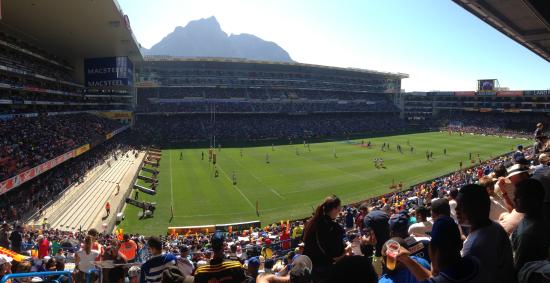
But a British & Irish Lions tour was planned for mid-year 2021 and the enhancements to the Cape Town Stadium were already under way, to provide two hospitality areas, which were not included in the original development.

Construction of the hospitality enhancement, with the scaffolding reaching half-way up the stadium wall

At the same time, the Cape Town team, the Stormers, would move their base to the Stadium. Their old headquarters at Newlands had been sold to property developers.

Newlands as it used to be

And then came the news that four of the top South African teams – the Stormers (Cape Town), Sharks (Durban), Bulls (Pretoria), and the Lions Johannesburg), would join the Pro-12 European league of four Irish, four Welsh, two Scottish and two Italian teams.

The initial tournament was to be called The Rainbow Cup. There were to be two pools of eight teams, each with two Irish teams, two Welsh, two South African, one Scottish and one Italian team, with a final to be played between the pool winners. It was to be a prelude to a full league program in the autumn of 2021.

So finally, it seemed that I would be able to walk the short distance down the hill in Green Point to the stadium and witness my second Ulster game. I even considered buying a season ticket, when they become available.

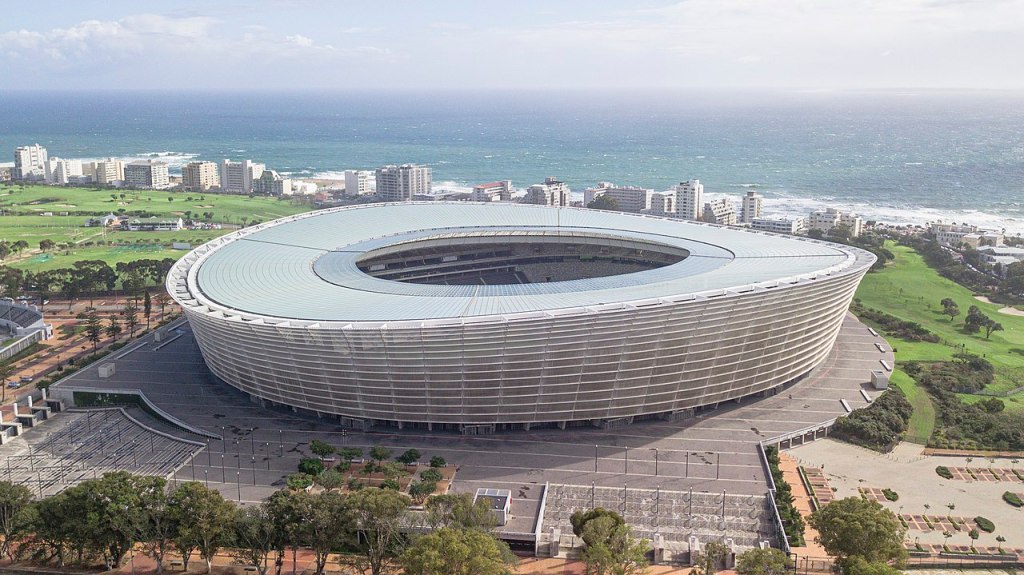
Cape Town stadium, as can be seen from Signal Hill

But alas, it was not to be, at least not for now. Covid and UK travel rules have killed the possibility.

But I continue to live in hope…

My Paris

Gosh, I find it hard to believe that it now almost fourteen years since I left Paris.

I first went there in 1968, just after the student revolt, when I was hitch-hiking around Europe. I was somewhat inspired by the movie, Two for the Road, starring Audrey Hepburn and Albert Finney, and the scenery in Sound of Music. I was not disappointed.

The next year I had the good fortune to be involved in a European IT development project with Singer Sewing Machines. For a short time I was based in Paris for system testing, near Place d’Italie.

In May 1985, I ran the Paris Marathon in 2:59 and for a couple of years in 1996-98 I was responsible for a Swiss company, that included a small office in Paris, in La Defence.

And then came my pièce de résistance; based in Paris and responsible for the European IT and later Operations for a global company. For me, it was Nirvana.

So, for some seven years, I had a small duplex apartment on the fourth floor of a renovated building on rue de Lille, a short block from the Seine, opposite the Louvre. The apartment was perfect for an undemanding tenant, like me, with no ambition to cook or entertain; the kitchenette had only a small hotplate and a tiny fridge, nothing more.

In reality, my little apartment was but a place to sleep and leave my clothes, when I was in Paris. I travelled a lot. I had projects running in several of the European countries and most months I visited many of the others. With my laptop and Internet, I was a true road warrior. I loved the new way of working.

But I did have a lot of control over my itinerary, and I tried to make sure that I was able to spend at least a few days every other week with my family in the UK.

In that era, I was still an enthusiastic runner, and after work I would run loops of Jardin les Tuileries. On Sundays, the road alongside the river was closed to traffic and open to the public, and allowed me to have a longer run.

Some evenings I would make myself a sandwich, but more usually I would go to La Frégate, on the corner of rue du Bac and quai Voltaire, where I was well known, and had a table in the far corner of the restaurant. I became good friends with the maître d’, Patrick. We were both rugby enthusiasts. Every time that he welcomed me, he would insist on reading out the menu du jour, but I almost always ordered une omelette au fromage or une salade mixte, much to his frustration. Eating the remains of bits of former living things has never appealed to me.

La Frégate, on the corner of rue du Bac and quai Voltaire

On weekends, especially in colder months, I would often head to Pizza Vesuvio, just off Boulevard Saint-Germain, across the street from the church. On the way, I would almost always stop in the bookshop, l’écume des pages. I could never resist browsing there. Floor to ceiling with ladders and books, tables piled high, no two books the same. For a lover of literature, it is a paradise.

l’écume des pages

Next to the book shop are the Cafe de Flore and Les Deux Magots, famous for their connection with the aristocracy of literature in the 1930s.

Originally Les Deux Magots was a novelty shop, founded in 1812, on nearby Rue de Buci. It moved to Place St-Germain-des-Prés in 1873.

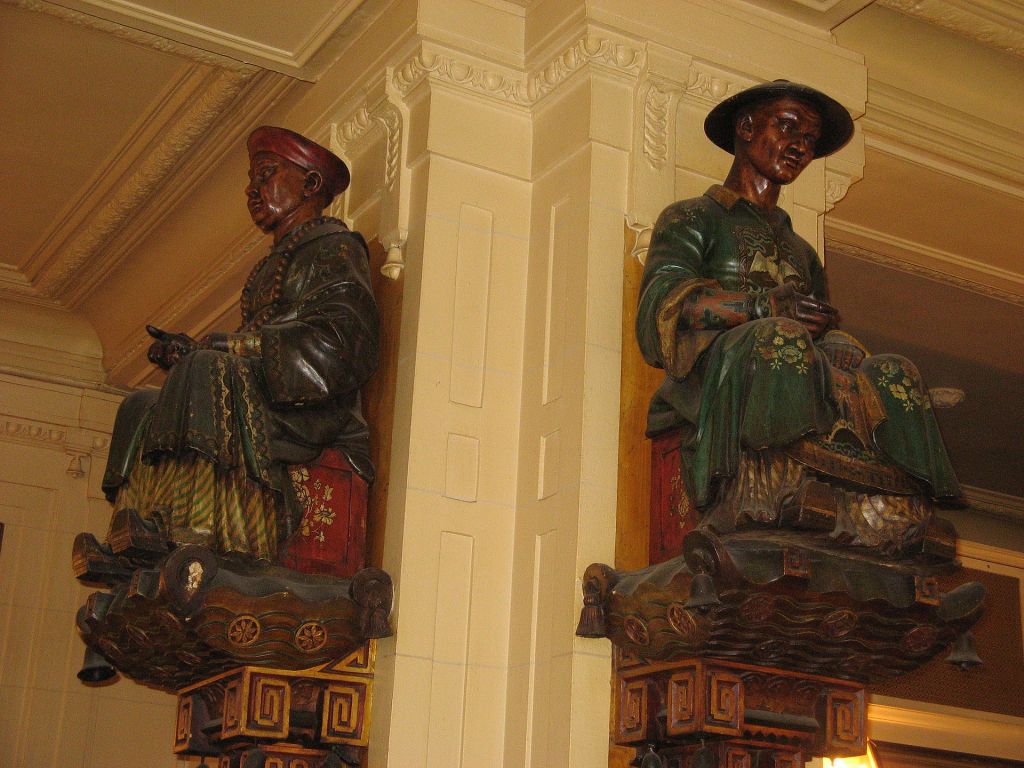
In 1885 it transformed to a café.  ‘Les Deux Magots‘ are two figurines from the original shop.

For a time, Paul Verlaine and Rimbaud, famed young poets of the late 1800s, were regular clients. Later, in the 1930s, Les Deux Magots became a regular haunt of Jean Paul Sartre and Simone de Beauvoir, Andre Gide, Picasso, Ernest Hemingway, J Scott Firzgerald, James Joyce and many others. These days, it is the haunt of tourists, with elevated prices.

Les Deux Magots

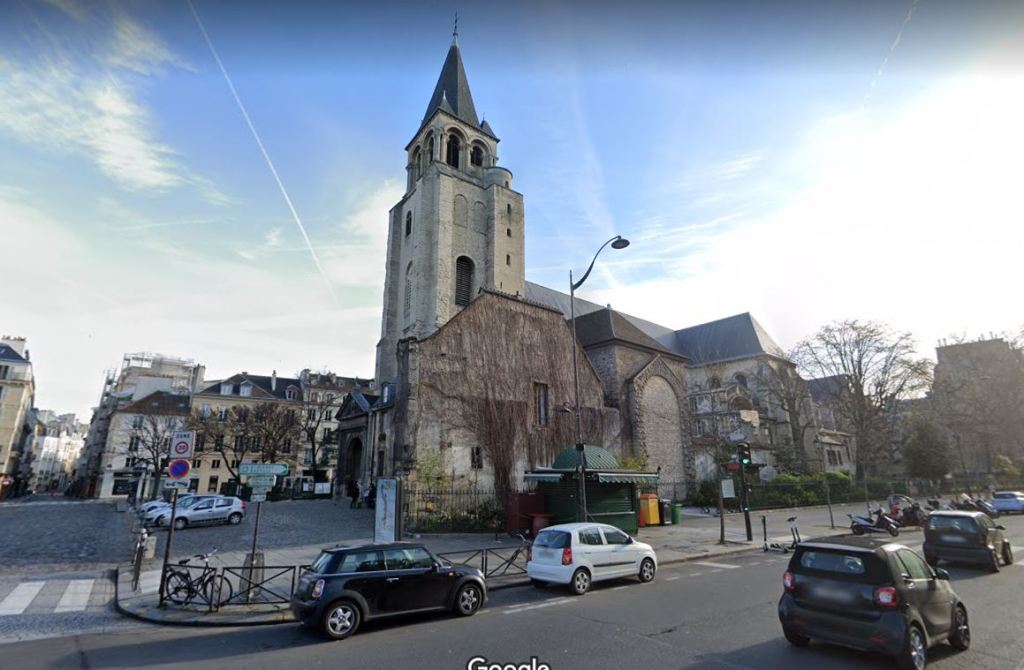
Across the square is Saint Germain-des-Prés, first built in the 6th century, raided by the Vikings in the 9th century, and over the centuries since, evolved to its present state.

Saint Germain-des-Prés

Across the street from the church, there is a statue of Denis de Diderot (1713-1784), one of the most powerful writers of his day. It was Diderot who wrote:

‘Man will never be free until the last king is strangled with the entrails of the last priest’.

Given the scandals in the surviving royal families and in the various religions, there are many of us who have an increasing sympathy for Diderot’s view.

Denis de Diderot

On a corner from the statue, is Pizza Vesuvio. After I had been there a couple of times, I found myself being welcomed as a local, rather than as a tourist. There were seven reserved tables behind the pizza oven, just after the entrance, arranged in an ‘L’ shape. If I arrived before 19:30, I almost always was given the table on the end.

Two of the tables in the corner always had a reserved sign. One was for a tiny elderly couple. Even in their advanced years, they looked beautiful. They must have been stunning in their prime.

The other table was reserved for a portly eccentric-looking man, always immaculately dressed in a tan-coloured suit with waist coat, white shirt, and bow tie. He must have had a physical problem, for he moved slowly and deliberately, and sat on a cushion. When he arrived, he always went to a picture hanging on the nearby wall, and removed a book of puzzles from behind it. When I first saw him, I could have sworn I had seen him before in the movie, La Bicyclette Bleue, based on the novel by Regine Deforges, and playing the part of Raphaël Mahl. I never did find out if it was him. The actor, Jean-Claude Brioly, died in 2007.

P

In 2007, I left Paris. Due to ill health, I was deemed to be not capable of performing my former multi-national role. Perhaps I could have challenged that decision, but in my heart, I was ready for the next stage of my life. I have no regrets.

But now I am ready to return. I plan to walk the camino from Paris to Santiago de Compostela, as soon as it is feasible, given the Covid situation.

But before I set out from Tour Saint-Jacques, I hope to have been able to have met up with some old friends and visited my old haunts.

Life is what you make of it. And I have some great memories.

The Missing Link

Until very recently, if I were to have been asked to name a deceased person with whom I would most want to spend a short time, without hesitation it would have been Robert Blackwood of Wreningham in Norfolk, England.

Who was he?

He was an agricultural labourer who married a Mary Watts in 1756, in the adjacent parish of Hethel. They had nine children.

Extract from the Hethel parish records documenting the marriage of Robert Blackwood and Mary Watts

It is significant that Robert Blackwood could sign his own name, in an era when most people could only make a mark, as did Mary Watts and one of the witnesses. None of the Blackwood children were able to sign their own name.

Robert died in Hethel in 1782 and his wife in 1800. They were my 4th great grandparents, and I am descended from their son, John.

Given the opportunity, of all the deceased people I could spend with, why would I choose him?

Because he has been my genealogical ‘brick wall’. For about 35 years, on and off, I had been trying to find his birth record, without success. My father had never heard mention of him, but he did say that his father had once told him that the Blackwood family was from Bungay, on the Norfolk/Suffolk border.

It was later, when I was researching in the Norwich archives, that I decided to take a side trip to Lowestoft, where I was told that there was a copy of the Suffolk records. It proved to be a worthwhile trip, for I found evidence of a Blackwood family residing in the Bungay area in 1688-1700 – James and Elizabeth Blackwood, with children James, John, Elizabeth, and Robert.

So, my grandfather’s claim proved to be true, but which of the three Bungay sons was the father of my 4th grandparent, Robert of Wreningham. Over time I carefully searched all the parishes in a wide radius, but the missing link eluded me. I found the marriage of Elizabeth, but no sign of the sons nor the birth of Robert.

Until one day last year when I received a mail from a lady in Australia. She had come across my blog, when researching information on Blackwoods in Norfolk. She was also descended from Robert of Wreningham and had hit the same ‘brick wall’. But using a genealogical site, to which I did not have access, she found the birth of a Robert Blackwood (born 1723 in Bixley), and his father James, that approximately matched up with dates and the names of my families in Wreningham and Bungay. As the Blackwood surname was relatively rare in Norfolk in that era and in that area, I am convinced that we have found the missing link.

Then, following up on my knowledge of the Bungay family, the lady found a copy of James Blackwood’s will in the Sussex archives and transcribed it.

So, what do we now know of James, Robert of Wreningham’s grandfather?

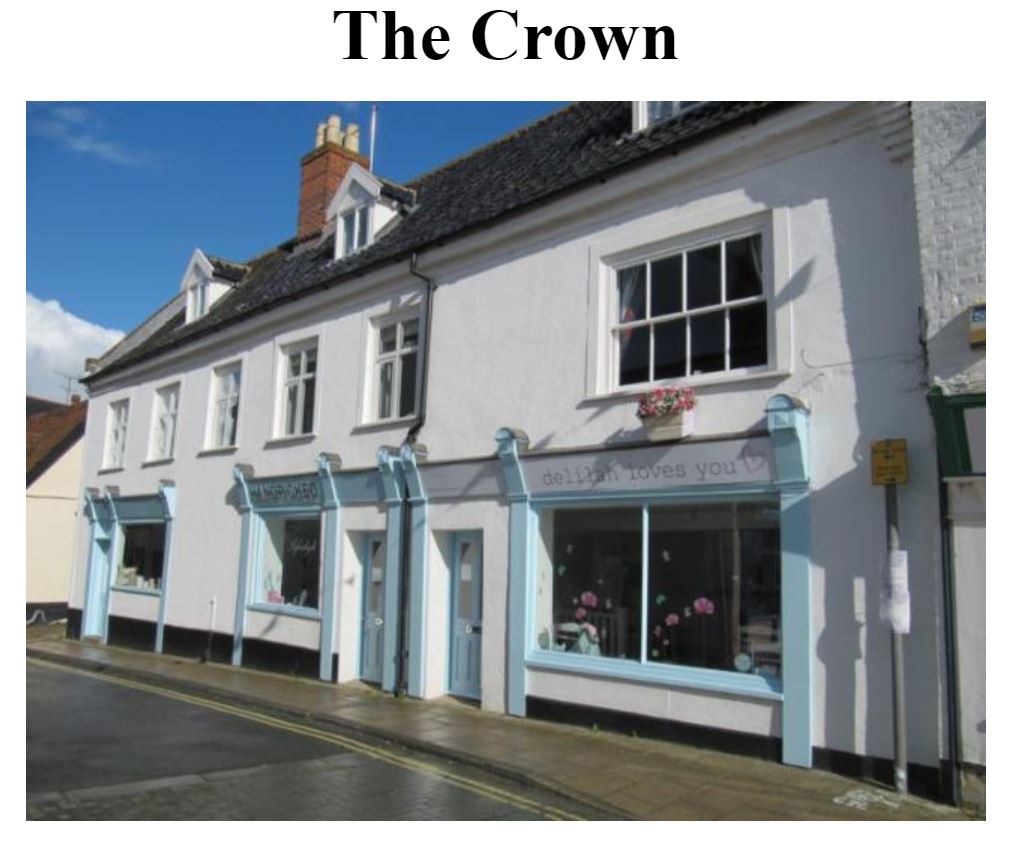
From the record of his death, we estimate that he was born about 1668, and his wife was called Elizabeth. We don’t know where he was born, nor where he was married. He owned a public house, The Crown, in Bungay. He left a will in 1700 and he died shortly after.

An extract from the will of James Blackwood, written not long before his death

I am not certain of the location of the public house. There was a pub called ‘The Crown’ at 24 Cross Street, but it closed sometime between 1925 and 1930. On 22 February 1777, the Ipswich Journal advertised a ‘Crown’ for rent at the end of Cross Street, on Market Place and that pub appears on the Ordnance Survey map of 1905.

An extract from the Ordnance Survey map of 1905

The Crown Inn was at 24 Cross Street, Bungay, but the business no longer exists. The building now houses retail shops

So my Blackwood ancestral linenow looks like the following:

James Blackwood (c1668-1700) = Elizabeth?

-> James Blackwood (1692-?) = Elizabeth Smith

-> Robert Blackwood (1723-1782) = Mary Watts (c1733-1800)

-> John Blackwood (1764-1848) = Mary Harvey (c1764-1847)

-> Robert Blackwood (1809-1867) = Susannah Ringwood (1811-1889)

-> William Blackwood (1847-1927) = Lucy Ann English (1846-1934)

-> Leonard Clive Blackwood (1881-1965) = Agnes Pilgrim (1883-1958)

-> Harry William Blackwood (1918-1995) = Beatrice Elizabeth Stewart Douglas (1924-1985)

-> Leonard Douglas Blackwood (1946-)

I doubt if we will ever uncover any more evidence from Bungay, so now we now have the challenge of finding the birth of James Blackwood, his marriage, and the identity of Elizabeth.

As always in genealogy, when one door closes, two more open.

And I wonder what ever happened to that silver tankard…

Load Shedding

Do you know what load shedding is?

Before I came to South Africa, four years ago, I had never heard of the expression. If I had been asked its meaning, I would have probably guessed that it meant reducing the load on a truck that had become stuck, or removing cargo or passengers from a plane, in order that it could safely take-off.

In South Africa load shedding refers to the forced reduction of demand for electricity by means of rolling blackouts.

Why is this drastic measure necessary?

Due to equipment failures and essential maintenance, the supply of electricity is often not sufficient to meet the demand. New power generation is being constructed but is years behind schedule and way over budget.

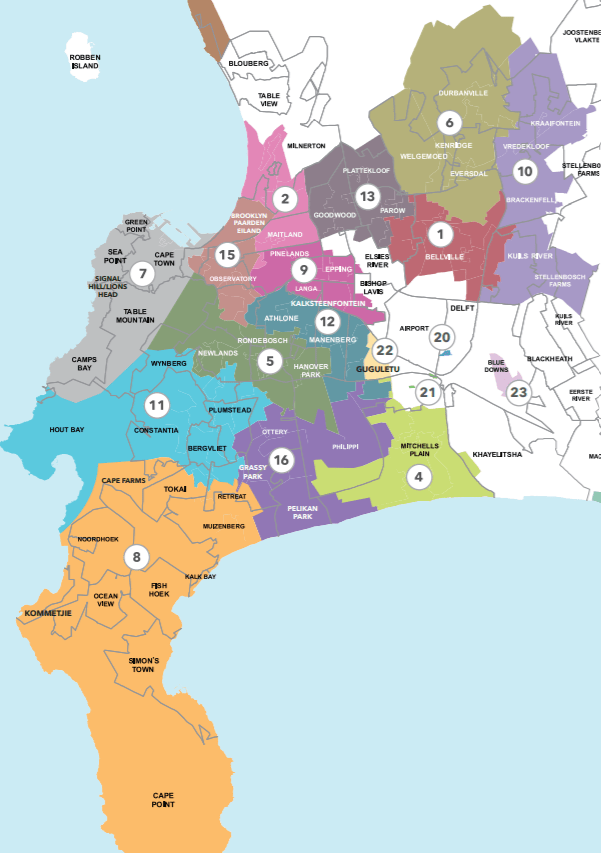
To manage the power cuts, the entire country is divided up into areas, as in the map showing the areas of Cape Town. We live in Green Point, in area 7.

Once you know your area number, you need to find the load-shedding stage. There are eight stages defined, ranging from minimal impact load shedding stage 1, through to stage 8, which would entail an almost complete black-out. The highest we have experienced so far was stage 6, in mid-December of 2019. Each increase in the stage, implies an additional 1000 MW needs to be removed from the system, so in the following example of stage 4, 4,000 MW will not be available.

Part of the load shedding schedule for stage 4

In the example I have given, if it is the first or seventeenth day of the month, then in area 7, stage 4 will mean that there will be no electricity during the hours 04:00-06:30, 12:00-14:30 and 20:00-22:30. It is important to be aware of the approximate scheduled times; it would not be much fun to be stuck in the dark in an elevator for two and a half hours. And be warned; never get in an elevator in South Africa with a full bladder when load shedding is imminent!

Of course, load shedding has a serious negative impact on the economy. To function, many larger businesses have had to install emergency power generators, but that increases their operational costs. Most small businesses cannot afford the extra cost of generators, so their income can be severely impacted.

ESKOM, known as the Electricity Supply Commission (ESCOM) is the utility that provides about almost all South Africa’s electricity. In Afrikaans it is also known as Elektrisiteitsvoorsieningskommissie (EVKOM). It was founded in 1932 and is the largest producer of electricity in Africa. It is the largest of South Africa’s state-owned enterprises and at one time South Africa had ample power.

But after ten years of government under the corrupt presidency of Jacob Zuma and his cronies – 2009-2017, ESKOM has become a financial and operational basket case. It has been saddled with excessive debt that it may never be able to repay. It is grossly overstaffed, yet the unions and the governing ANC refuse to allow sensible re-organization. The generating plant is constantly failing, mainly due to historic lack of maintenance, which is worrying, when one considers that ESKOM has Africa’s only nuclear power station, just along the coast from Cape Town. It could be a disaster waiting to happen.

Apart from about 5% of electricity being supplied by nuclear energy, South Africa’s energy needs depend on coal fired power stations. Despite being rich in sunshine and coastal wind, the ANC government has made no effort to allow the introduction of renewable energy. No doubt the coal mining unions will continue to resist any change to the status quo and coal fired power stations will continue to pollute the South African atmosphere.

Despite the long lull during most of last year, load shedding has again returned, with many power station failures. In addition, Covid-19 has been blamed, with many maintenance workers having been infected and repair work being impacted

So, with a continuing curfew from 21:00-06:00, a renewed ban on the purchase of alcohol for the third time, the closing of schools, no access to beaches or the sea etc., and now more load shedding, public fatigue and rejection of the imposed regulations is almost inevitable.

And with no sign of mass vaccination on the horizon, this year threatens to be a repeat of 2020.

Alesia

The A6 motorway leads south from Paris, past Auxerre and Beaune, where I used to turn east to take lesser roads to Pontarlier and the Swiss border. For ten years around the millennium, I was based for two years in Neuchâtel in Switzerland, and subsequently in Paris.

I often drove that route between Paris and Switzerland, and between Auxerre and Beaune, there was a sign pointing to Alesia. I never understood the significance of Alesia, until a French friend explained to me that Europe, as we know it today, resulted from a battle between the Gauls and the Romans, that had taken place there.

In that era BC, Gaul consisted of most of modern-day France, parts of Belgium, Western Germany and Northern Italy. But there were very many tribes and Vercingetorix, a young chieftain from Gergovia (present-day Gergovie) managed to unite many of them in resistance to the Romans.

In 52 BC, under the leadership of Vercingetorix, the Gauls had defeated the Romans, under Julius Caesar, at the battle of Gergovia, near Clermont-Ferrand. After indecisive skirmishes, Vercingetorix had moved his forces to Alesia.

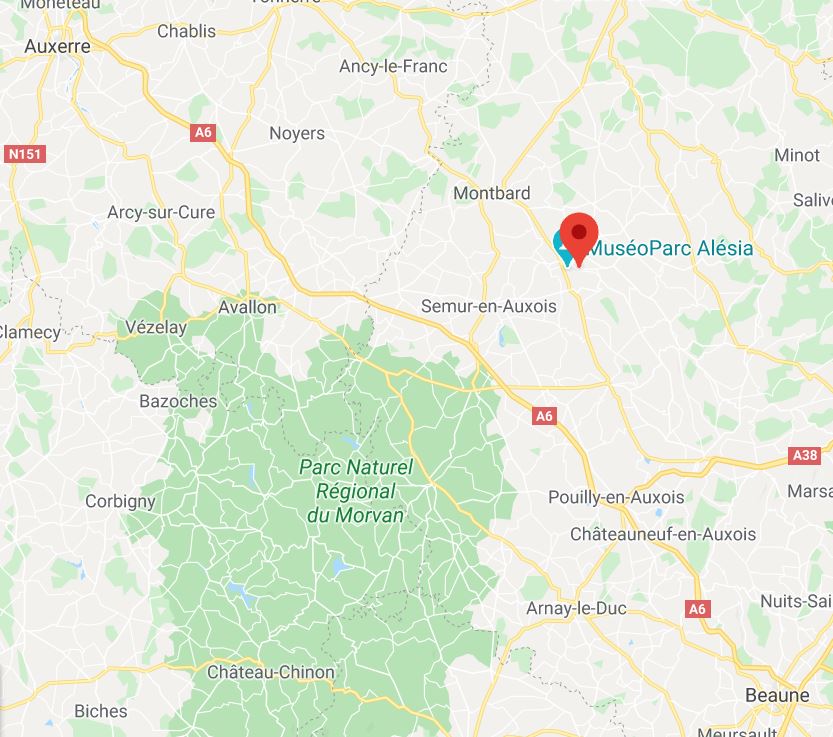
Alesia is just outside the present-day town of Alice-Sainte-Reine in Burgundy.  It is equidistant between Beaune and Chablis, a short distance from the A6. The site of Alesia was on a plateau about 200 m above the valley floor.  It was protected by cliffs and a wooden wall.  It is thought that there were 80,000 Gauls there at that time.

Location of Alice-Sainte-Reine

When the Romans arrived and laid siege to the city, in only a few weeks they build a 15 km ring of fortifications around the city, and outside it, an additional ring of 21 km, to defend from attempts to relieve the siege by reinforcements. The fortifications must have looked like a huge doughnut. It worked. The relief forces were unable to breach the outer defenses and the city forces were unable to break out.

To spare his men their inevitable defeat, Vercingetorix surrendered to Caesar, and he was eventually imprisoned in Rome. After one of Caesar’s ‘triumphs’, five years later Vercingetorix was paraded around Rome and then strangled in his prison cell.

Thought to be one of the only busts of Julius Caesar, made in his lifetime

The Vercingetorix monument at Alesia

In his Commentarii de Bello Galico, Caesar described the battle and the events leading up to it.  It is the only account of the battle that exists, for there has never been one written from the Gallic point of view.

Three years later, in 49 BC, having conquered Gaul, Caesar arrived at the Rubicon, a small river south of present-day Ravenna. It was the former border between Gaul and Italy.  He had been explicitly ordered not to lead his army across the river, but he ignored that. His action precipitated the Roman Civil War and he went on to defeat Pompey and become dictator of Rome.  He was assassinated in 44 BC.

How would Europe have looked today if Caesar had lost at Alesia and not eventually crossed the Rubicon?

Inés de Suárez

It was in the autumn of 2015 that we arrived in Cáceres, in western Spain. We had set out walking from Sevilla in the south, following the pilgrimage path to Santiago de Compostela, but the weather had turned quite cold and we were not adequately equipped for the conditions. We decided to take a break and return another day; the path would still be there.

But little did I know at the time, that if we had continued walking for another four days we would have reached Plasencia, the birth place of one of my heroines, Inés de Suárez.

‘Who on earth was she’, I can hear you thinking. So let me enlighten you.

Apart from being born in Plasencia in about 1507, as far as I know nothing more is known of her early life, until she married an adventurer, a Juan de Malaga, in about 1526.  Not long after, he left her to go with the Pizarro brothers on a speculative venture to South America.

I have no idea how she supported herself in the interim, but after some ten years of not receiving any contact from her husband, she decided to go to South America to find him, or at least to find out what had happened to him.  In that era, it was not acceptable for a Spanish woman to travel on her own, but she eventually received permission to go, providing she took a niece with her.  I don’t know who her niece was or what happened to her afterwards.

She never did find her husband. It appeared that he was dead, but I am not sure how.  One report was that he had died at sea, another that he was killed in the battle of Las Salinas near Cuzco, between the Pizarro brothers and a rival fighting for control of the city.  In any case, he was presumed dead and she applied for a grant as the widow of a Spanish soldier and was given a small plot of land in Cuzco.  And it was there that shortly after she became the mistress of Pedro de Valdivia.

Valdivia was a lieutenant of Francisco Pizarro and he was authorized to lead a small contingent of Spanish soldiers to establish a colony far to the south of present-day Lima.  Somehow, he managed to get permission to attach Inés to his expedition, as his domestic servant.  In 1539, he started with only eleven soldiers, but as they preceded south others joined.  At one time there were about 150 of them.

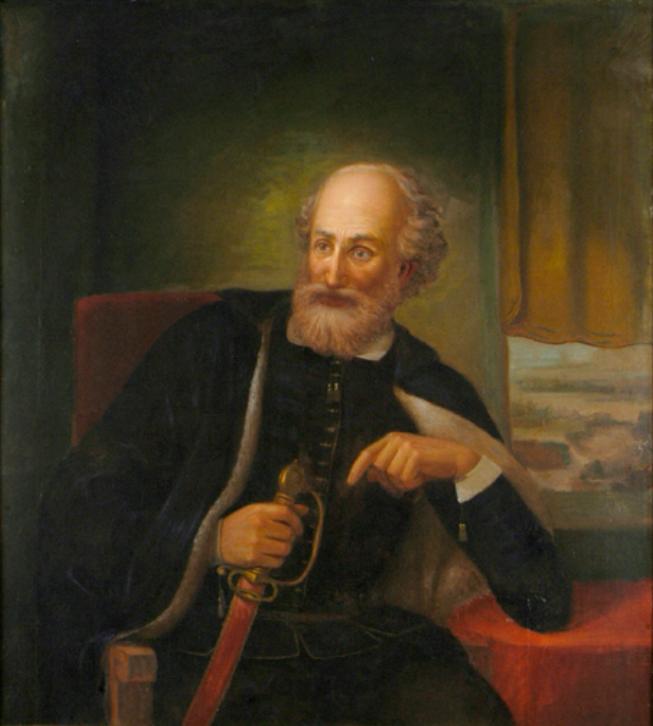
Pedro de Valdivia (photo from internet)

They travelled south for almost a year, until they reached the valley of the Mapocho River, the site of present-day Santiago de Chile, originally named Santiago de la Nueva Extremadura.   They suffered incredible hardships in travelling through some 1600 km of the Atacama Desert. In the chronicles that have survived the journey, Inés had a significant part in boosting the morale of the soldiers through caring for the sick and wounded.

The site that they eventually chose was already populated and and initially the natives were accepting of the newcomers, or at least they pretended to be.  But when Valdivia was absent on another expedition to the south, the local population revolted.

The Spanish were severely outnumbered, and it seemed inevitable that they would be wiped out.  From a previous negotiation for food supplies, they held seven of the Indian chiefs as hostages.  Inés advised the soldiers to execute them.  When the commander hesitated, Inés herself took a sword and decapitated the chiefs one by one, and had their bodies thrown over the wall.  Or at least that is how the legend recounts it.  In any case it appears that the Indians were so shocked and confused by the action that they withdrew.’

Perhaps it did not happen quite as I have described it, but there is no doubt that she was a heroine in the defense of the settlement.  At that time, she would have been the only woman.

When Valdivia finally returned, they continued to live together openly.  The hierarchy in Lima did not approve of this ‘illegitimate’ union and Valdivia was summoned to attend a hearing in Lima.  The issue was resolved by Valdivia agreeing to summon his wife from Spain and having Inés married off to his lieutenant, Rodrigo de Quiroga in 1549.

Rodrigo de Quiroga (photo from internet)

But all did not happily ever after. Valdivia died before his wife reached Santiago.  He was captured by Indians in a battle in the south and eventually executed. 

Inés settled down to a quiet life as wife of Rodrigo de Quiroga, who eventually became Governor of Chile, not once, but twice.  They died within a short time of each other in 1580 and were both buried in the Basicila de la Merced.

Inés survived all the original conquisadores.

It was not until 2015 that I finally visited Santiago de Chile. Of course the city today bears no resemblance to the original settlement that Inés would have known.

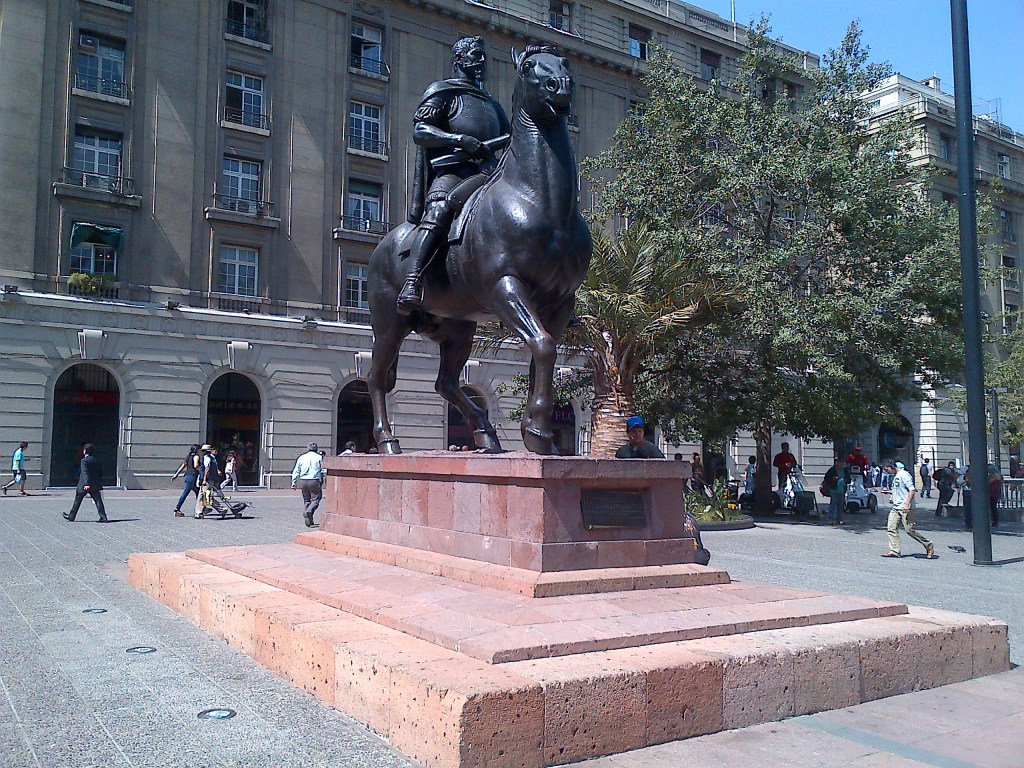
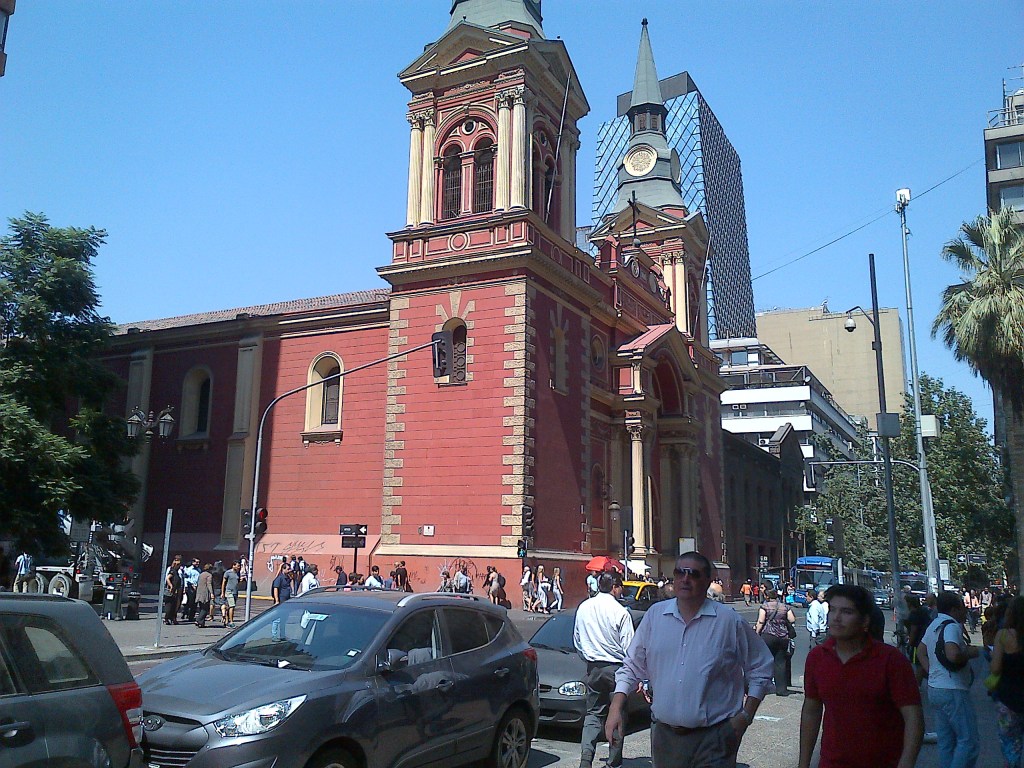
In the Plaza de Armas, there is a statue of Pedro de Valdivia, her old lover, and the church, La Basilica de la Merced, where she was buried, is but a short walk away.

Statue of Pedro de Valvidia in the Plaza de Armas
La Basilica de la Merced

For me, Inés mus have been a remarkable woman. Not only was she tenacious in seeking out her husband in what must have been frontier conditions, but for months on end she survived the crossing of the inhospitable Atacama desert. And shortly after she showed tremendous courage in the face of death. Her example is one for all women.

I don’t know when we will continue our pilgrimage north from Cáceres, but when we do, we will pass through Plasencia and walk in the footsteps of Inés.