The Ash Tree

My mother loved her garden.  Apart from a few essentials for herself, every spare penny she could save was invested in scrubs and plants.

When we moved into the new house in 1952, the site was covered in rubble, ashes from the burned out Irish cottage, that previously stood in one corner, weeds and nettles.  There was little or no topsoil.  It looked as if nothing would ever grow there.

Yet a few years later, it was a virtual ‘Garden of Eden’, with a variety of flowering shrubs, roses, various plants and bulbs.  My mother had a proverbial ‘green thumb’, and visitors to the farm used to marvel at the profusion of year-round colour.

In a secluded corner of the garden, where there was a small ash tree, my mother had one of the workers construct a seat under the tree, using a sheet of corrugated iron, backed with soil and topped with a layer of grass.

It was never a success.  It was too shaded, too damp and within a year the iron retainer started to rust.  Nobody ever sat there.

But I liked it, for it enabled me to climb onto the lower branch of the tree, and standing on the branch, I felt as if I was on a ship.  I used to spend many hours in that corner of the garden.  It does not take a lot to stir the fertile imagination of an eight-year-old.

On Friday, February 07, 1958, the BBC morning news announced that a plane carrying the Manchester United football team had crashed the previous evening, when attempting to take-off from Munich airport, and that 20 of the 44 passengers had been killed.  Later three more died of their injuries.

The team had been returning from a European Cup match in Belgrade and had landed at Munich to refuel.  The pilot had aborted take-off twice in a snow storm, due to poor runway conditions.  On the third attempt, the plane hit a thick layer of slush, careered off the runway through a fence, and one wing hit a house.

2bf71d69dce66e0ffaae0f1cadeabfe4
BEA Flight 609

One of the undoubted heroes on the night was Irish goalkeeper, Harry Gregg, from my home area.  He managed to carry and drag several of the injured from the burning plane, including Bobby Charlton, Jackie Blanchflower, Dennis Violett, the pregnant wife of a Yugoslav diplomat and her daughter, and his manager, Sir Matt Busby, who was twice given last rites, but survived.

harry-gregg
Harry Gregg in his playing days


harrygreggmanchesterunitedmark50thanniversarytszrkyp7g7ll
And at the 50-year memorial, with a candle for each of the victims


Like a great many people, I was very shaken by the news.  I went down to my secluded corner, climbed into the ash tree, and with my penknife I carved ‘Man U 1958‘ in the bark.

Several years later, when I returned on a visit, I could still vaguely make out the carving.

The garden has now long gone, but perhaps the ash tree is still there.
 

In case you wondered

I confess that the subject and content of some of my posts may seem random to the uninitiated. But there is a purpose to my ramblings.

Let me explain.

A few years ago I realized that I was the only one who knew the details of the history of my family.  Much of my insight results from thirty years of research in the archives in Belfast and Norwich, coupled with first-hand knowledge of three of my grandparents.

Some years ago I documented what I had discovered.  One evening during a skiing trip with my sons in Sweden, I read excerpts from my notes.  They listened with polite attention, but it was obvious that they were not easily enthused by ancient history; they wanted to know of my own travels and experiences.

But how to document it?

I have always had the view that autobiographies are usually an ego trip for the writer.  I did nothing further.

It was not until I recently read ‘La Colmena‘, by Camilo José Cela, that I found the inspiration and the technique to write up a series of seemingly random but ultimately connected events.

So one by one I am working though my long list.  And when I run out of inspiration, I will knit together the resultant product into a document that can hopefully be passed to my descendants.

And perhaps they will know me, although I may be long gone.

So wonder no more…

Fiftieth Anniversity

It was on this day – 8 July 1965, that I left Ireland and migrated to Canada.  Like several million Irish before me, I set off to travel and make my fortune.  I had just over £100 in my pocket and all my possessions fitted into a small suitcase, with plenty of room to spare.  I was just eighteen and still quite ‘wet behind the ears’.

Since then I have managed to see a great part of the world, but there are still many places in which I would like to spend some time.  I may need another fifty years of wandering.

 As for my fortune, it is still a work in progress.

And apart from a small collection of books, my few possessions still fit in a small backpack.

I could never be described as a conspicuous consumer…

Hot August Night

‘Eat, drink and love: the rest is not worth a fillip’ (Lord Byron)

The first time I came across that quotation was on a steamy summer’s early evening in a little Greek restaurant in London, in Soho, just down the street from the Palladium theater. The quote was incorporated in a large fresco of an idyllic Greek island scene. At the time I was insanely in love, but apart; she continued travelling around the US and I had to return to the UK to work. That quotation just about summed up my nascent attitude to life in that era.

Lord Byron (1788-1824)

After an early dinner, I went to the Palladium for a Manhattan Transfer concert and the next day I flew out to Nigeria to start a three month assignment with an multi-national oil company.

Manhattan Transfer

And today, sitting in the sun outside a bar in a little plaza in Leon, I came across that same quotation, and I recalled that night long ago. I don’t know if the restaurant still exists or if Manhattan Transfer still perform, and her path and mine only briefly crossed one more time. But I don’t believe that my attitude to life has changed much since that hot August night in 1978.

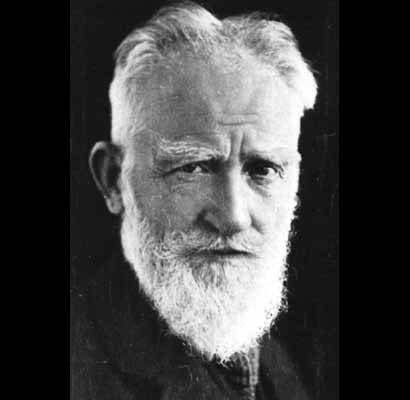
George Bernard Shaw

I am currently reading an autobiography of Gabriel García Márquez  – Vivir para contarla.  In it he quotes George Bernard Shaw – ‘Desde muy niño tuve que interrumpir mi educación para ir a la escuela’ ( ‘From childhood I had to interrupt my education to go to school’).

 George Bernard Shaw (1856-1950)

That also about sums up my attitude to formal education.

Over the years I tried very hard to shield my views from my sons.

I hope that I was not too successful.