Early Memories of Portrush

What is your earliest memory?

Are you certain that your earliest memories are genuinely your own memories, or are you remembering and imagining what your parents or others have told you?  I confess that I am never quite certain of the authenticity of mine.

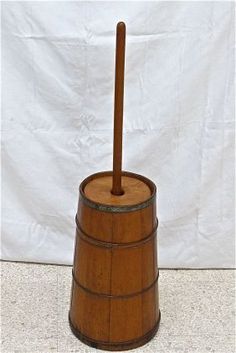
My early years were spent in Glenmanus, a small village now totally enclosed and obliterated by the relentless expansion of Portrush.  Until I was five years old, my parents lived in a small wooden hut, at least I recall it as being small and wooden.  It was just up the road from the farm of my great-uncle Bill Douglas, and great-aunt, Letitia.  I can clearly remember going down the steps to the stream that flowed in front of Bill’s farmhouse and falling in the water.  And in an out-building, Titia making butter in a large churn, paddling up and down. And offering me a ‘piece’, a thick slice of bread, coated in butter and jam.  Delicious it was.  The stream has long since been piped and covered over, and the farmhouse demolished and replaced with modern houses, owned by two of my cousins, Hughie and Brian Douglas.
ef2e7f3d2a249d7eeca776e10e459c69--vintage-antiques-butter
A butter churn, similar to that of Titia

And one freezing morning in winter, when the older boys came flying down Loquestown Hill on a sled, and one of them crashing into a hedge, and injuring his cheek.  I remember it as being Maurice Elliott who crashed, but he has no recall of it. One of us is correct…

My mother contracted TB when I was very young, and for some six months she was interned in a sanatorium in Derry.  It was Louise Wilson who looked after me, while my father worked on the farm during the day and played piano with his dance-band at Barry’s Ballroom at night. My only clear memory of that era was sitting at the table, having breakfast and my father telling me that a fox or a badger had broken into one of the hen-houses and killed all the hens.  He could probably have ill-afforded the loss, as he was just starting out on his new farming venture.

And there was the day when my mother took me down to Portrush, through the archway under the railway embankment, and we sat up on a sandhill, waiting for the ‘mock invasion’ to start.  In those days there was no seawall, only sand dunes leading down to the west strand.  Out in the bay there was a battleship and it began to fire its guns and then several landing craft were launched.  The troops were disgorged just offshore and there was lot of firing of machine gun blanks, as they charged up the beach.  Predictably the ‘enemy’ soon surrendered.  For many years after, until I was about 16, I dreamed of joining the military, despite my father’s lack of enthusiasm.  He had had enough of war after six years of fighting in WW2 and wanted me to join him on his farm.  I ended up doing neither farming nor military.

In those days there was a tram that ran from Portrush to the Giant’s Causeway and I remember seeing it setting out past the gasworks, down Causeway Street.  It was probably one of the last trips, as it stopped functioning at the end of the 1949 season.

In the late 1940s and early 1950s, my father’s dance band played every night in Barry’s Ballroom.  My mother took me to see him play one evening, and afterwards, we went outside, to an exhibit called ‘The Wall of Death’.  It consisted of a circular wooden tower, inside which a couple rode motorbikes.  We stood at the top of the tower and looked at the bikes going around and around, horizontal to the ground at dizzying speed.  I later learned that my mother knew the couple.  During the war, in the summer season, they used to board at my grandparent’s farm in Glenmanus.  I wish I could remember their names.

So few memories, but so vivid are the few.  I sometimes wonder which vivid memories of their early years my four sons will recall, when they are older.



Jonathan Livingstone Seagull

Cape Town, Saturday 5 May, 2018

Most Saturdays, after a long walk through Green Point park and along the promenade, we stop off at the Radisson Hotel (https://www.radissonblu.com/en/hotel-capetown) for a thirst-quenching beer.  We have become so well-known by the staff that we rarely have to order: they well know our preferences.  And even when busy, the regular staff drop by our table to quickly say hello.  We always feel most welcome there.

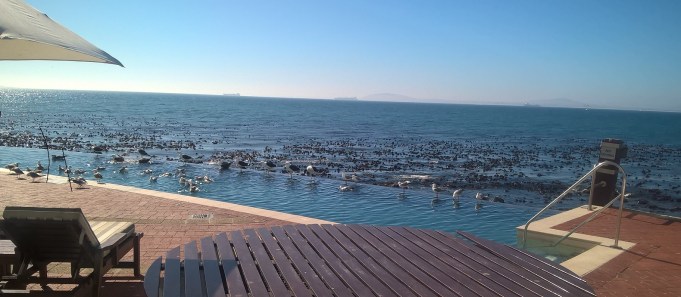
Unless all the tables are occupied, we normally sit close by the pool.  It is comical to watch the seagulls washing and drinking, when there are no bathers.  If somebody passes by, they reluctantly scatter, only to return seconds later.

Seagull pool
The Radisson pool and the seagulls, with the kelp forest beyond,  and the ships in the far distance

Today, watching the ever-present seagulls, I had a flash-back, to about 1973, in Australia.  With some friends, I had gone to a little cinema down George Street or nearby, not so far from Circular Quay, in Sydney.  Neil Diamond was all the rage at the time and a new film had been released, a relatively short film, with incredible scenery, a beautiful sound track, and the voice of Neil Diamond.  I remember sitting, thoroughly entranced with the story of a seagull, constantly challenging it’s boundaries and it’s capabilities.

For a short time after, I was that seagull.  I wanted to be proficient in Spanish, I craved the opportunity to explore and live in South and Central America, I wanted to spread my wings and reach heights that I had never before envisaged reaching.

That feeling never left me, and over the next few years, I progressed with my modest ambitions. It’s a work still in progress.

And today I was reminded of that era.

Are my ambitions now satiated?

Not a chance.  There are many more yet to come… 🙂


South African Sunset

As I sit at my desk in our apartment on the hill above Green Point, I can see over an apartment complex below. Further back is another slightly elevated building, which does nothing to intrude on my overall view.

To the right is the clock tower of Reddam House, a rather exclusive private school, the clock of which recently only told the time accurately twice a day. And slightly further to the right there are three elevated palm trees, whose fluttering of fronds would indicate to me the wind force I could expect on my daily walk through the park and along the coast. When the trunks of the palms thrash and bend, I know that I will have to brace myself.

Below, all day long pass huge tankers, container ships and smaller vessels, pass on their way to and from the Cape Town harbour and around the Cape of Good Hope. If they are early for their berthing, they anchor just off the coast.

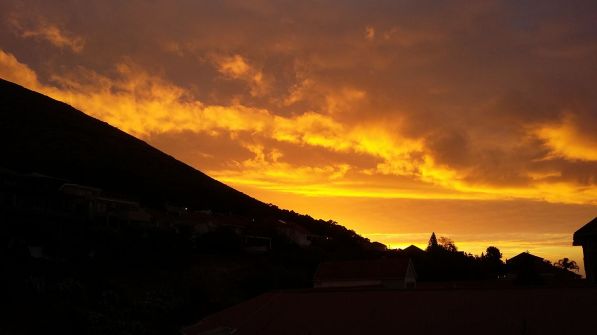
The sun sets to the left of the apartment complex, behind the steep slope of Signal Hill.

On a frequent clear day, the sky is a piercing blue. It reminds me very much of the sky that I used to experience in Sydney, so any years ago. It is a blue that one seldom, if ever, witnesses in Northern Europe.

I am usually at my desk in the early evening and I am a frequent witness of the setting of the sun. The line above the blue of the ocean first starts to turn a mellow yellow that gradually become more golden. And it spreads across the sky. When there are light clouds around, the sunset can become quite spectacular.

20170520_180056_resized
The sun setting behind the opposing building
17016777_1841104729473904_3812157141241568067_o
And further up the hill…

It is dark now and I draw the curtains on another beautiful African day.

111

I was 42 when my first son was born and six and a bit years later, my fourth son took his first breath.  I felt myself to be a very fortunate man, a feeling that persists to this day.

A few years ago, it occurred to me that if I ever had grandchildren, it was likely that they would not remember much, if anything, of me and my ancestry.  I decided to write down what I could remember of my parents and their history, of my own travels, of people that had been a great influence on me, of places where I had lived, of some of my experiences.

But how to go about publishing it without boring the pants off a poor reader.  I recall discussing my aspiration with my good and learned Chilean friend, Laín Burgos-Lovéce.  He suggested that I write it as a blog.

Do you know the meaning of the word ‘blog’?  I certainly did not, so I looked it up.  It turned out to be a web-log, or a form of shared on-line diary.  I learned something new, but I still did not have a clear idea of how to go about formally writing my memoirs.  My aspirations marked time.

It was later, when I read Camilo José Cela’s classic, ‘La Colmena’, that I realised that I could write my thoughts in stand-alone articles, and later piece them together in chronological order.  It is a lot like a seanchaí, a traditional Irish story teller, comfortably seated by the fireside, a drink in hand, entertaining his audience with his tales.

seamus-heaney (1)
Ireland’s greatest poet

Initially, I restricted publication to family and close friends, but eventually, I opened it up to the public; it was pointed out to me that somebody that I once knew, but with whom I had lost contact, might stumble upon my writings and contact me.

And that has now happened several times and I am so grateful for the opportunity for the renewed acquaintances.  With each has come a flood of nostalgia.

It has now been two years since I published my first article, and to date there have been 111 of them.  And there have been viewers from 46 countries.  It is humbling to evidence the power of the internet to connect people.

So what’s next?

Well, I still have more than 50 articles that I have yet to write and no doubt there are a plethora of others that have not yet surfaced.  Every time I finish writing one, I get at least two new ideas.  Sooner or later, I will put then into a book form, to gift to those of my relatives and some friends who have no access or no desire to access the internet.

So, now for number 112… 🙂

Hopefield

Hopefield Cottage Hospital was situated on the edge of Portrush.  It was one of the many rural hospitals that performed minor operations and provided for the chronically sick.  It enabled local patients to remain close to their families and the latter to avoid having to travel to a distant county facility.  In the years before and after the 1939-45 war, few local people had a car.  It was to Hopefield that I was taken when I was six years old, in 1953.

In my early years, I was a sickly child, repeatedly suffering from sore throats and fevers.  The medical verdict was that I had to have my tonsils removed.  I have only two vivid memories of Hopefield.  The first was of my lying on a bed beside a window, looking out across fields.  The other was that of a man in white, picking me up and carrying me to another room, laying me down on a table, and a black hissing thing that smelled strange, being placed over my face.  I have no recall of my mother or father being there at any time; I just remember feeling alone and scared.

Of course, I soon recovered, put on missing weight, and health-wise, I have never looked back.

It was in Hopefield that my grandmother, my father’s mother, died in 1958.  She already had had two strokes and had been bed-bound for several years.  She did not survive the third stroke.  I remember my father putting down the phone and saying, ‘She has gone’.  Before that I had never seen him cry.

Beside the hospital lay the fields of Caldwell’s farm, the fields that I looked out at from the hospital.  When I was young, during the summer season a small plane used to land on those fields, and for a fee the pilot used to fly tourists over Portrush, the Skerries and along the north coast.

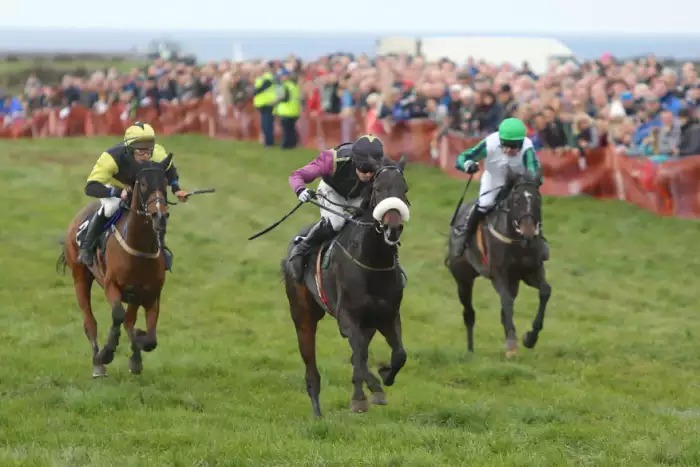
Every Easter Tuesday, always a public holiday in Ulster, those fields were the scene of the Glenvale point-to-point horse races.  It was a grand occasion and people drove, cycled or walked from a long way to be there.  The venue was only a mile from our farm, so I often went too.  It was exhilarating to be close to the horses as they galloped by, jumping the hurdles and hedges.

Access to the Glenvale races was along a lane beside John Rainey’s house and past Caldwell´s farm.  The entrance to the lane was off the Coleraine Road, opposite to the road that led into Glenmanus.  In those days Glenmanus village was on the edge of Portrush and on the road to Coleraine were just fields and the occasional house and farm buildings.

It was at the entrance of that lane that I had arranged to meet my first love.  We were too young to be seen alone together, so she brought along her best friend, as did I.  We slowly walked the length of that secluded lane to the far end and back.  We held hands and said little.  We were eleven years old.

For my part, my attraction to her remained intact.  We had little opportunity to meet.  She went to the grammar school in Bushmills and I went in the opposite direction, to that of the C.A.I. in Coleraine.  She lived in the town and I in the country.  Our paths sometimes crossed in church, but she was always with her parents.  It was only at the rare church or school social event that the flame was temporarily relit, only to be once more extinguished.  In 1965 I migrated to Canada and she finished school and moved away from the area.  We had no further contact.

Today, the Hospital at Hopefield no longer exists, and the Glenvale races ceased to be held around 1977.  For many years they continued at Myroe, near Limavady, before recently returning to the fields of the old Adams farm at Loquestown, just across from our farm at Islandflackey.

image
Action from the 1977 Loquestown races (photo from internet)

The former Caldwell fields are now under a maze of new houses and Portrush no longer ends at Glenmanus Road, but advances relentlessly towards Coleraine.  Soon there will be no fields left between the two towns.

The romantic lane of my youth still exists, albeit sandwiched on both sides between the rears of houses.

But my memory of how it used to be is indelible.


Omelettes

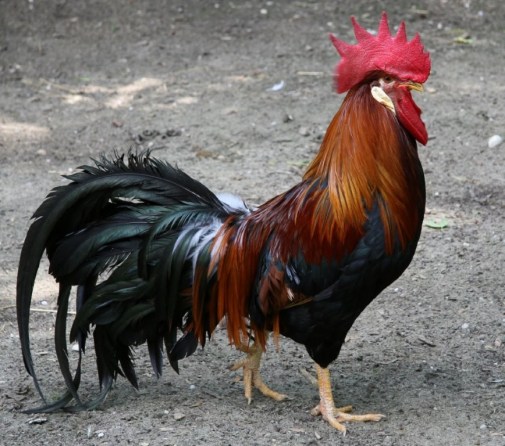
I grew up on a poultry farm.  My father was a specialist breeder of Light Sussex and Brown Leghorn stock.  I was raised on eggs, but I never ate chicken, at least not if I could avoid it.  I clearly remember when I was small and poked my head around my mother at the kitchen sink, just as she was up to her elbow in a chicken, removing its entrails, before she burned them on the kitchen fire, always causing quite a stink; that was the first of my many vegetarian moments on the farm.

light-sussex
Light Sussex hens (photo from internet)
istock_000008148786_medium
A Brown Leghorn rooster (photo from internet)

I never had an omelette when I lived at home.  They were not a part of my mother´s  standard cuisine; she was a traditional Irish woman who deferred to the narrow culinary demands of my very traditional English father.  Omelette would have been a bit too French for my father.  Six years of WW2 left him with some indelible prejudices.

I had my first omelette in Paris in 1969.  I was working with Singer Sewing Machines, installing a new computer system in their French head office.  My good friend and Australian colleague, Geoff Rich met me for breakfast.  He ordered an omelette with bread and coffee and so did I, not knowing what it was.  Delicious it turned out to be.  And he played ‘Lay, lady lay’ by Bob Dylan on the jukebox.  The haunting lyrics and melody still recall Paris to me. To others, it may seem rather corny today, but those were magic moments for me.

Some years later, in 1978, omelettes came back into my life in Nigeria. It was on my first day of a short-term contract in Lagos.  I went to the canteen, presented my plate and received what appeared to be the greater part of a goat, with a few steamed vegetables on the side.  The meat was not for me and for the rest of my stay in Nigeria, I lived on beer, cashew nuts, bought by the bottle from street vendors, and omelettes in a French restaurant near to the office, or in the Ikoyi club.

When I was later based in Paris in 1998-2007, I frequented a nearby bistro, La Frégate. The Maitre d´, Patrick, would always read out the short list of specials, ending with resignation, ‘omelette au fromage o salade mixte?‘.  I really liked Patrick and I miss his conversation .  A very good man and an enthusiastic rugby fan.  He always said that if he could not be French, he would elect to be Irish.

In recent years, I have spent a lot of time in Spain and South America.  There, the traditional omelette is called tortilla francesa to distinguish it from the Spanish version, tortilla española.  The latter is in a cake-form and includes potatoes, onions, garlic in the basic version and other ingredients in regional variations.  It can be served hot or cold and on cocktail sticks as tapas or in slices, usually accompanied with fresh bread.  With a glass of red wine, the latter usually serves as a meal for me.

375px-Tortilla_patatas
A typical porción or trozo of tortilla (photo from internet)

And here in Cape Town I have my local bistrôt, Cafe Extrablatt, that serves a generous omelette, french fries, toast and wine at any time of the day.  And super-friendly staff that never fail to feel one at totally home.

It is indeed a hard life that I lead… 🙂


Netcare911

4 March 2018

Cape Town

On Friday evening, there was something of a drama in our apartment building.  First an ambulance and then a doctor’s car outside the entrance, blocking the lane that leads down to High Level Road.  There are six apartments in our building and it was in our apartment that the event was taking place.  But let me start at the beginning…

While I worked at my pc, I had started to peck at the remains of a taco with spicy pulled pork, left over from one of Lotta’s working lunches..  After a couple of mouthfuls, I started to experience a nauseating sensation in my lower throat.  I stopped eating, but the sensation remained.  I went to the bathroom, but could not vomit.  I tried to drink some water, but my throat felt as if it was blocked and I could swallow nothing.

Lotta tried to intercede, but I told her to leave me alone; I would be fine.  In the few times that I have been ill, I have always wanted to be left alone.  I hate being mothered.  I have always been like a sick animal that crawls into the bushes and does not emerge until recovered.

But the discomfort became more acute.  I started to have hiccoughs, but soon they became quite extreme; my whole diaphragm shook with each occurrence.  Up to then I had stood in the bathroom, but my bad leg was quite uncomfortable with standing in one position.  I went out and returned with the chair from my desk and sat by the toilet.

Eventually the hiccoughs stopped, but I started to have spasms in my throat, followed my painful spasms lower down. I started to sweat and suddenly felt cold.  I started to shiver and I was struggling to breathe normally.  By this time Lotta had had enough of my  ‘I’ll be fine, leave me alone’ and was convinced that perhaps I was having a heart attack.  She offered to call for medical help and I reluctantly agreed.

She called her doctor’s out-of-hours telephone and was given the number of an ambulance service.  She gave all the details requested and a few minutes later she received an SMS to say that an ambulance had been dispatched and would arrive in ten minutes.

In the meantime, I was struggling with the increasingly strong spasms and trying hard to breathe.  Lotta said that when the ambulance arrived, I was shaking like a leaf and my face was completely drained of colour.

The ambulance was followed a few minutes later by a cardiologist.  When the doorbell rang, Lotta would not let him into the building, thinking him to be a local tramp trying to gain entrance in the confusion.  It was not until the ambulancemen assured her that it was their colleague, that she pressed the door release.

I really don’t remember accurately all that happened in the bathroom.  I was asked lots of questions, a device was clipped on my finger, presumably to monitor my heart beat, my blood pressure was taken and I was hooked up to a angiogram.  With all the equipment, Lotta said that the bathroom looked like a hospital emergency room.

It turned out that my heart was fine, which was a big relief and slowly I started to feel better.  The spasms stopped, my breathing eased and I was able to sip and swallow water for the first time in three hours.  The doctor said that it was possible that something had got stuck in my throat or perhaps I had had a reaction to a spice.  They offered to take me to a hospital for further tests, but I declined, as I was already feeling much better.

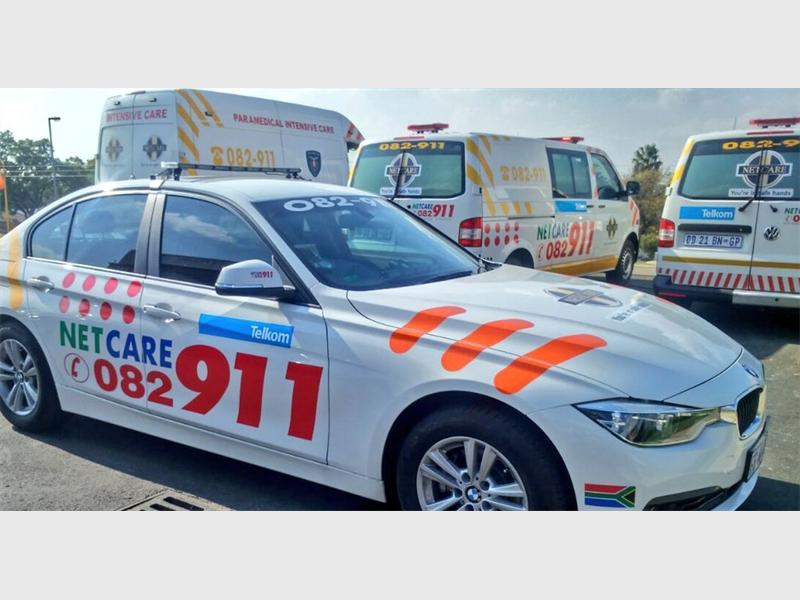
Lotta escorted the three medical staff back to their vehicles, apologizing profusely to the doctor for having mistaken him for a passing opportunist tramp.  I just wish that I had noted their names, for they deserve acknowledgement.  They came from Netcare911.

netcare911
A Netcare911 doctor’s car, with ambulances

So all’s well that ends well.  And we had another first hand experience of the quality of the South African medical profession and the speed of reaction of their emergency services.  Most impressive.

WP_20180304_18_17_33_Pro
And when I went to bed, I found these still stuck to my chest

As for spicy pulled pork, I will give it a miss in future.


Swimming

If foreigners were to be shown an aerial view of Portrush with calm ocean and relatively blue sky, peaceful harbour, small western and extensive eastern beaches, they would reasonably conclude that it was an idyllic location.  And on a rare perfect summer day, they would be partially correct.  But the water in the North Atlantic is never less than quite cold, there is a steep shelving beach and strong rip tides.  On a rare warm day, swimming in the harbour can be pleasant, albeit bracing.

I never learned to swim when I lived there.  My parents could not swim, few of their generation could, and of my age group only a handful, mostly those who had relatively prosperous parents, who took them away to more temperate climates on holidays.

When I was growing up, there was only one small indoor swimming pool in the area, that of the Northern Counties Hotel in Portrush.  I recall that a small group from my school used to go there for lessons on a Friday evening, mainly those who were from the rowing club; to participate in rowing, the oarsmen had to be capable of swimming a length of the pool, a not very challenging task.  The group was led by Dan Cunningham, our physics teacher, who, when a younger man, was reputed to once having swum from Portrush to the Skerries, a chain of islands off the coast.

Portrush c 1960
Portrush, circa 1960, with the Skerries to the north

When I first migrated to Canada, I stayed for a few days with my grandparents in Brampton, outside Toronto.  The first weekend, they arranged for some older university students, grandchildren of their friends, to take me out for the day.  Unfortunately, nobody told me that their idea of a day out meant a beach and swimming.  We went to a nearby lake, where they immediately plunged into the water, leaving me ‘on the beach’.  The students were quite incredulous that I could not swim and that I was not going to attend a university.

My day brightened up momentarily, when they offered me what I understood to be a beer.  It turned out to be a can of something called Root Beer, a disgusting soft drink.  When they told me that I had to be 21 before I could legally have a beer – I was 18 at the time, I felt quite discouraged.

It was when we were in Hawaii, on our way to Australia, that I decided that I had to learn to swim, at least well enough to survive.  I swore that I would not leave Hawaii until I could swim out to a raft anchored a short distance offshore from Waikiki Beach.

But for day after day, I struggled.  I had no problem with being under water, but I could not take my feet off the bottom.  Sandra, who swam like a fish, tried her very best to encourage me, but to no avail. Both the problem and the solution were in my head.

Finally, I set off for the raft, swimming backstroke, and with no problem, I made it.  And once there, I discovered that I could dive.  It was a new element for me.  Later, in Tahiti, I had the incredible experience of diving in the lagoon, and swimming among the multi-coloured fish.  An unforgettable experience.

HHV_images_tablet_1680x1080_Locations-Travel
Waikiki Beach, Honolulu (photo from internet)

In Australia, I frequently went to the beaches – Bondi, Coogee, Manly etc.  I even spent one Christmas Day on a beach.  And when the waves were relatively friendly, I often managed to bodysurf.  On one occasion I found myself caught in a riptide, and although I had no problem getting back to shore, it was a sobering experience.

Bondi_Beach_Sydney_Australia_7
Bondi Beach, Sydney (photo from internet)

When we lived in Kirribilli, across from the Opera House, we used to go to the nearby Olympic pool, just by the harbour.  In those days, there was a 10-metre high diving board, and from it I used to throw a coin in the water, dive in and retrieve in from the more than five-metre-deep pool.  I found that much more exhilarating than swimming length after boring length.

poolns
North Sydney swimming pool in recent years (photo from internet)

We only once owned a house with a pool, in Miami.  After the initial surge of  enthusiasm, the pool sat empty for month after month.  Sometimes I would jump in after a run or while working in the garden on a hot day; there is not much else an adult can do with a small pool.  I was left with the weekly chore of cleaning it and replenishing the copious expensive chemicals required to keep it relatively pristine.

I did once swim in the harbour at Portrush, during one of my fleeting visits.  I tried to go into the water at the Western Strand, but the water was so cold that my feet pained me within a short time, before it was up to my knees.  I went to the harbour and the water seemed to be more inviting, at least to tips of my fingers.  In those days there was still a diving board near the harbour mouth and from it I dived in.  I will never forget the shock of the cold water.  I got out as soon as I could, and I have never been back.

As with the weather, I don’t do cold.

That’s why I follow the sun…  🙂


The Butterfly

If I were to be asked, which of my travel experiences had made most impact on my life, without hesitation I would have said that it was my realisation that there are many caminos (paths) that lead to Santiago de Compostela.  From Saint-Jean-Pied-de-Port, Bayonne, Seville and Porto, I have walked the paths and there are so many more to discover: from Alicante, Valencia, Barcelona, Madrid, Paris, Geneva and further afield.  To exhaust the possibilities, I will need the longevity of the Le Juif Errant (The Wandering Jew).

I have copious memories of my various walks over the past few years, occasionally supported by notes and photos, but it is the seemingly insignificant events that stand out for me, such as the vulture hovering above me, the first time that I descended through the foothills of the Pyrenees.  Having previously had a serious stroke, at that time I was still not confident about being alone in remote country.  And yet I clearly remember starting to feel that I was not alone and that I was being watched over.  It is a feeling I have never since lost.

Then there was the long straight dirt road from Carrión de los Condes to Calzadilla de la Cueza.   I had started out quite early that morning and I could see no pilgrims on the path.  I was lost in my thoughts, when a little bird plopped onto the path, a few metres ahead of me.  I stopped and we looked at each other, neither of us moving.  It then flew a little further and stopped, as if waiting for me.  I followed and also stopped.  We soon developed a rhythm – I walked and the little bird kept ahead, always watching me, as if leading and encouraging me.  Suddenly there was the whoosh of a large phalanx of cyclists, arrogantly racing by, pedalling furiously and shouting to each other, as if they were on the Tour de France.  By the time the dust had settled, the little bird had disappeared.  The magic spell was broken.

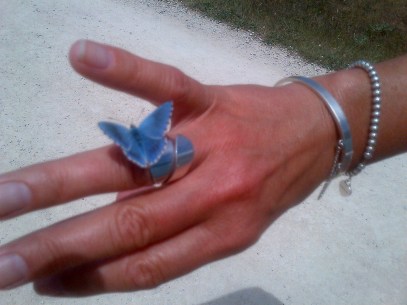
One of my favourite memories was that of the little blue butterfly that landed on the end of Lotta’s stick and refused to leave it.  When Lotta held out her finger, the butterfly popped onto it.

IMG-20140611-00929

It happened between Hornillos de Camino and Hontanas, in an area where there were a lot of intense-blue cornflowers by the path.  At one point, Lotta succeeded on depositing the little butterfly on a clump of cornflowers, but soon as she tried to leave, it flew back onto her stick.  Perhaps it thought that she was a giant cornflower, for she was wearing a blue shirt that day.

cornflowers
Cornflowers (photo from internet)

The little butterfly hitched a ride for about twenty minutes and then, as suddenly as it had appeared, it flew off into the field and disappeared.

It was another of those magic camino moments that will stay with me for ever.


Applying for South African Residency

It was on the morning of Saturday, 31 October 2015, that my erratic journey through life took yet another unexpected direction.  The previous evening, I had booked and paid for tickets back to Montevideo, to escape from the northern winter to the southern sun for the third year, but this time with a difference; once there, I intended to apply for permanent residency.  Now that should not surprise anyone who knew me well, for ever since I lived in Venezuela, Miami and Peru in 1978-1985, I have longed to return to South America and spend extended time there.

But when Lotta put down the phone that morning, it was ‘all change’.

‘Cape Town want to know if I would be prepared to take on a permanent role in their operations, at least for as long as I am willing.  What do you think?’

She had already completed two short assignments there, liked the environment and the people.  As for me, the challenge of a new country was too tempting to pass over.  Besides, South America would still be there.

It took me less that a millisecond to reply:

‘Go for it’.

It was not until we returned to Sweden the following May that she received a 90-day training visa, followed by four frustrating months of managing the operation by Skype and email from Uppsala.  Finally, in November 2016, she received a 4-year inter-company transfer visa.

For me, the only option was to travel back and forth from Europe on 90-day tourist visas.  After three such trips, I had enough of long-haul flights and decided to apply for a residency visa, permanent or temporary.

When it comes to dealing with government bureaucracy, I am not a ‘do-it-yourself’ person; if I want to get it right first time, I believe in getting professional advice.

I found several companies advertising their capabilities on the internet, two of which stood out from all the others, at least in my opinion.  But the first company wanted too much personal information before they would contact me, so late that evening, I submitted a basic query to the second, Intergate Immigration Services.

The next morning, at 06:28, I received a personal mail from Jaime Catala.  I was impressed with his prompt out-of-hours response, and after a couple of clarification meetings, I signed an agreement to have Intergate manage my temporary residence application.  Subsequently, I was assigned to a dedicated administrator, Leandra Bantom, with whom I liaised for the duration of the application process.

So, once armed with a long list of documents that I would be required to submit, I started obtaining them, one by one.  I started with the medical, in case there was a problem, in which case my application would probably be refused.  There was no issue, and at the same medical centre, a nurse gave me a yellow fever vaccination.  At the impressive new Christian Barnard hospital, I obtained an all-clear chest x-ray.

Then I started on the police reports.  I was required to obtain a police certification from every country in which I had lived for more than a year.  Although I would claim to have ‘lived’ in eleven countries, two of them were for less than one year, and with a generous helping of ‘poetic licence’, I ended up with four that I could not deny – Canada, Australia, US and England.

Canada, Australia and England were no problem; all three submissions were on-line, albeit with widely varying requirements.  I obtained approval from Canada the same evening, from Australia overnight and from England within one week.  The certifications followed in surface mail.

But the US was a ‘pain in the ass’.  I had to print off two forms and fill them in by hand, using a black ink pen.  The forms looked like they had been badly designed by a primary school pupil and included irrelevant details such as hair and eye colour, height, weight etc.  Then I had to have a printer produce a finger print card on the correct specification card stock, otherwise the US internet site said that it could be rejected.  Finally, a trip to a police station to have my finger prints recorded.  To be sure of having a receipt, I couriered the forms and finger prints to an address in the US.  Then I had to settle down for a long wait, as their website stated that their (lack of) service delivery was 10-12 weeks.

One would have thought that a simple query on the FBI databases would have shown that there was no record of a Leonard Douglas Blackwood, British/Irish citizen, of birth date of 05 November 1946, having ever committed a crime.  Or perhaps the US is gathering details of every one that crosses its path, in the event they might one day commit a crime.

In the meantime, I obtained a copy of my birth certificate and, together with my divorce certificate, had them apostilled, a certification process that only applies to official UK documents.

And lastly, with the assistance of the consultants, I submitted copious evidence of my capital investments in the UK and US and obtained an accountant’s certificate declaring that I had sufficient capital to provide me with a monthly income after tax of at least ZAR 34k per month.

The US police certificate finally arrived after more than three months wait, I obtained an appointment for an interview at the South Africa visa centre in London and on 29 November I submitted my application.  I was informed that the visa, if approved would tentatively be available by January 10.

Following is a summary of the expenses I incurred in the application process:Residency

Having settled down to another long wait, I was delighted to learn that the visa was issued on 15 December and, after a short delay in arranging for receipt of the courier, was available to me on Christmas Eve.  It was a most welcome Christmas present.

Of course, without the need to obtain US police certification, the whole process could have taken 3-4 months less time.

Was the cost of using an immigration consultant justified?

In my case, it certainly was, especially when it involved proving capital and income requirements.

Would I recommend Intergate Immigration Services for a similar assignment?

Definitely.