First Taste of Freedom

I never much enjoyed my grammar school days, and when the opportunity came to escape the drudgery, I grabbed it with both hands; I was like a thirsty man being offered a cold pint of Guinness on a hot summer day. My new-found freedom was delicious.

Before long, I started to study towards an initial Quantity Surveyor qualification, via a correspondence course with the Royal Institute of Chartered Surveyors (RICS). I was enthusiastic about the subjects and I was free to proceed at my own pace. If I was not ready to take the exam the next year, then the year after or whenever. And in the meantime, I was supporting myself and contributing something to my parent’s household. I was quite content.

And my evenings and weekends were filled with sports, music and girls.

At work, my colleagues rented the gymnasium at the Intermediate School in Coleraine for one night a week, to play indoor football. And in the summer months, we participated in a team in the local works league. Through the winter months, I played rugby with the Coleraine II team, and in my last summer, with the Coleraine Cricket Club.

Soon after finishing school, I joined Bill McKeown’s group, playing drums. We were five – piano, saxophone, guitar, drums and singer. We played at hotels around the north Antrim coast and even had a six week summer season at the Lismara hotel in Portrush, playing six nights a week. I earned much more drumming than at Quantity Surveying, but unless one has real talent, music was not steady work.

When I could, I used to go to one of the local dance halls on a Saturday night: to the Arcadia in Portrush, the Strand in Portstewart, the Boat House in Coleraine and sometimes further afield. If a girl let me walk her back to her house, I almost always managed to miss the last bus, and had a long walk home, often in diabolic weather. It once happened to me in Ballymena, some thirty miles away. I walked several miles before I managed to thumb a lift home.

The last time I saw my mother, not long before she died, she told me that she had never fallen asleep until she knew that I was safely home. I was never aware of my having caused her sleepless nights.

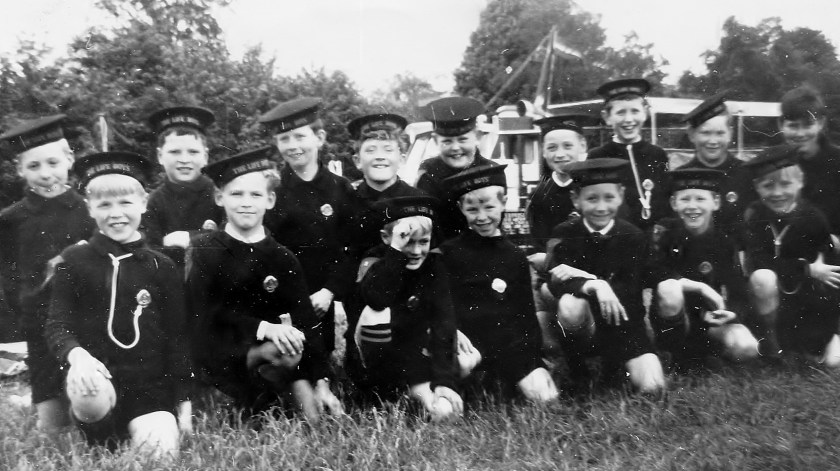
It was Raymond de Zeeuw who had given me the idea of a career in Quantity Surveying. Knowing that he was the leader of the Ballywillan Lifeboys, I offered to help him in any way that I could. They met every Saturday morning. The Lifeboys were the junior branch of the Boy’s Brigade, as the Cub Scouts were the junior branch of the Boy Scouts.

So I taught the boys much of the military discipline that I had learned at Army Cadets. And at the end of the year, they demonstrated their coordinated marching capability in front of their parents and friends at the annual ‘demonstration’. They were brilliant.

I organized football games outside the Church Hall, before and after the formal Lifeboy agenda. We even had a ‘match’ with Portrush Primary School. We lost, but it was great fun.

Raymond once organized an early-summer cruise on Lough Neagh and many of the boys came along.
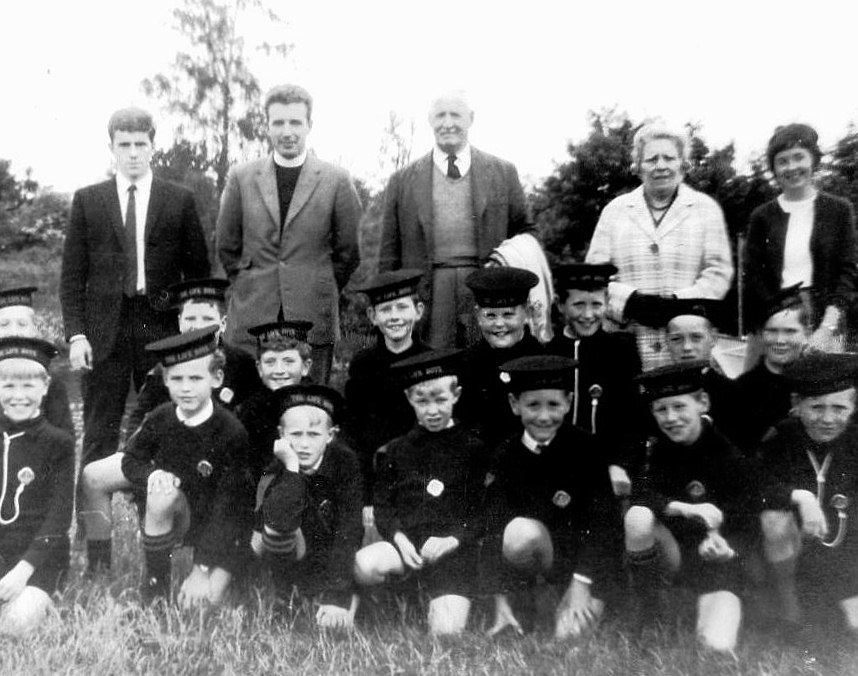
The Lifeboys, later to be known as the Junior Boys Brigade, on the outing to Lough Neagh in the summer of 1963. In the back row – Yours truly, Rev. Jim Frazer, Brigadier W. W. Boggs, Mrs. T. Stewart (pianist) and Josephine Dallas
And the boys. In the back row – Ian King, Stephen Wilson, Colin Stewart, Nigel Stewart, Victor Sinclair, Alan Cunningham, Ivan Adams. Trevor Martin, Milton Stewart. And in the front row- Archie McNeill, Raymond McNeill, Brian Caldwell, John McNeill, Norman Adams, Peter Stewart and Norman Brewster

The photographs were taken by Raymond de Zeeuw, the leader, and it was Josephine Dallas who recently sent them to me, along with the names of the boys.

By now, most, if not all of the boys will be collecting their pensions, some with families and some perhaps with grandchildren. Sadly, two of them have passed on: Alan Cunningham some years ago, and Archie McNeill, within the past two weeks. They have passed much too soon.

In a field beside Ballywillan Church, one beautiful mid-summer evening, I organized an extra-curricular football game. As usual, Raymond led one side and I led the other. Somehow, I managed to slice my knee open on a sharp stone or a piece of glass and ended up needing several stitches. I still have the scar.

That proved to be my last involvement with the Lifeboys, for soon after, I left for Canada on what has turned out to be the first stage of a journey without end.

I have never lost my taste of freedom.
The Palladium

Portrush

circa June 1965

If you are ever in Portrush, on the north Irish coast, and you head down Causeway Street from the town centre, just before the Catholic church you will see St. Patrick’s Hall.  Now the building was not always connected with the church.  In my day, in the 1950s and 1960s, it was called The Palladium and it was a theatre, putting on variety shows during the brief holiday seasons of Easter and summer, when the resort used to be a tourist destination, before the tour companies started offering cheap holiday flights and hotels in the more reliable southern European sunshine.  For most of the year The Palladium was shuttered.

Before its transformation to a variety theatre, the Palladium was a ballroom, with a resident orchestra.  There was also Barry’s Ballroom.  With thousands of soldiers stationed in north Ulster, training for the eventual invasion of mainland Europe, there must have been plenty of trade for the ballrooms and the local girls were very much in demand.  That was how my mother met my father in 1942.

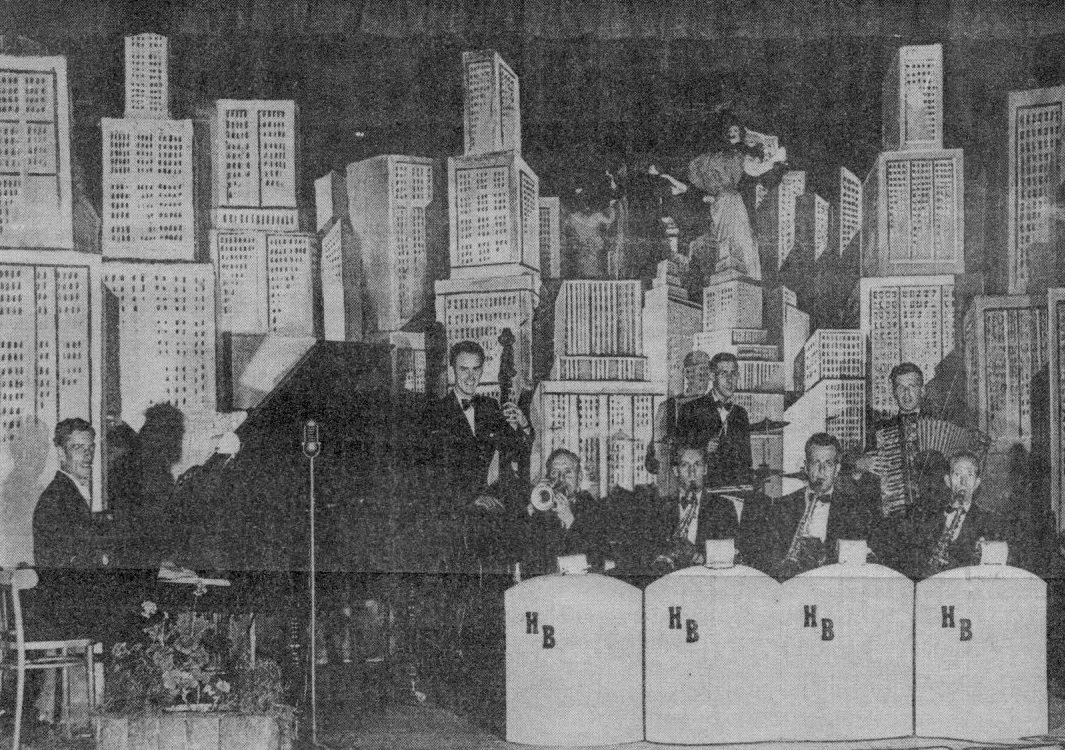
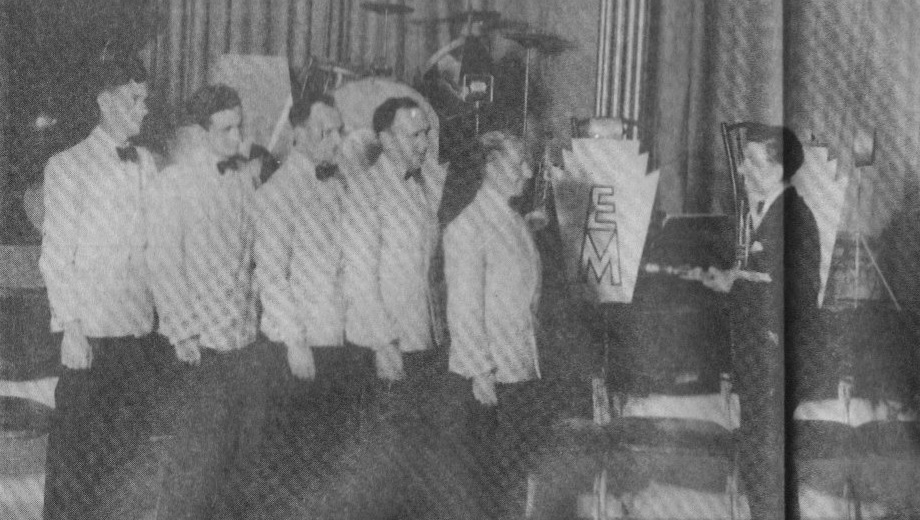
I never heard my father speaking of playing at the Palladium.  He ended his military service in January of 1946 in Lübeck on the Baltic, having been involved in the fighting from the invasion of Normandy through Belgium, The Netherlands and Germany.   When he returned to Portrush, he got his professional opportunity as pianist with Ernie Mann’s band, then resident in Barry’s Ballroom.  When Ernie was forced to retire, due to ill- health, my father took over leadership of the band.

Ernie Mann band 1949
My father on the left, with the Ernie Mann Band in 1949

BBC broadcast July 1951
And at the piano with his own band during a BBC Radio broadcast in 1951

But by the early 1950’s, musical tastes were changing, with Bill Haley and His Comets and the jive displacing the formal quickstep and waltz and orchestras.  And then came Elvis Presley, Cliff Richard and the Shadows, the Beatles and the avalanche of groups with singer, lead, rhythm and bass guitars and drums.  In Portrush, the Arcadia Ballroom opened in 1953 and Barry’s Ballroom closed around that time.  I don’t know what happened to the Palladium Ballroom, but I suspect that it had already ceased to operate.  My father moved his band to the Northern Counties hotel, and for many years they continued there.  He became very well-known and many times over the years, when they have heard my name, strangers have said to me, ‘you wouldn’t be Harry Blackwood’s son, would you now?’

03c500ad6097bb0abebae58ab4eda57d
The Arcadia, on what looks like a bleak stormy day (photo from internet)

I only ever once went to a show at the Palladium.  I think it was in the early summer of 1965, but I am not sure.  Neither can I remember clearly who I went with.  It may have been Trevor Gaston and Martin Williamson, but again it is all a blur.  You see, we went to a performance of Edwin Heath. the well-renowned hypnotist, and I fell asleep in the first few minutes of the show, when he was introducing his act and the entrancing music was playing in the background.  I was not the only one; those of us who succumbed were led up to the stage and we were the show for the next hour or so.

Edwin Heath
Edwin Heath, the hypnotist

I recall nothing.  Afterwards I learned that the ‘victims’ were commanded to react to many different out-of-character situations: acting as we were different animals, believing that a glass of water tasted foul or another strongly alcoholic etc., and in my case to imitate a well-known singer, singing a hit song.

Now singing in front of an audience, hypnotised or not, for me was nothing unusual; I was the drummer in Bill McKeown’s Group, appearing at various local hotels in the area and further afield in Belfast, Red Bay and the Giant’s Causeway.  We even had a six-week, Monday through Saturday, summer booking in a local hotel.  In addition to a full-time day job, it was hard work, playing from 20:00 to midnight and often much later. We were ‘cheap and cheerful’ and there was little competition in those days.  Bill was a talented pianist and saxophonist, his wife had a beautiful voice, his son was competent on the guitar.  In addition to drumming, I sang ballads.  When the client had sufficient budget, we included a bass guitar and trumpet, the latter being Tommy Tinkler, who was formerly in my father’s band and is in both photos above.

And in the Edwin Heath show, I sang the Jim Reeves hit song, ‘I love you because’, as I had many times before.

Today Portrush is but a shadow of what it was in its heyday in the 1950s and 1960s, when the holiday crowds filled the hotels and boarding houses, staying for a week or more, when the beaches were crowded in the rare good weather, the amusement arcades were full and in the evening the centre of the tiny town was one big traffic jam and the pavements crowded.  These days, many of the former boarding houses have shut or have been converted into flats for the students from the nearby university.  And the steam trains that used to shuttle back and forth from Belfast, have long been retired and replaced by a tiny local commuter train, carrying students to their classes at the university in Coleraine.

c5811d6d2e0891c56eabedbf6a01b41d
One of the steam trains leaving Portrush, just as I remember them (photo from internet)

And all the former ballrooms have disappeared; Barry’s Ballroom was demolished and the area converted to more amusement machines; the Northern Counties Hotel was burned down in an arson attack and eventually replaced by a Ramada Inn; the Arcadia was largely demolished and only a part of the original building remains.

The Palladium
The former Palladium, as it is today


Of the four, only the Palladium still functions, albeit in its new role as a church hall.