
Caracas, 1978
Until I moved to Caracas in 1978, I had never lived anywhere within easy access to mountains.
The landscape around where I grew up on the north coast of Ulster, could be described as ‘gently undulating’, and it would be an exaggeration to describe the ‘mountains’ in the north of Ireland as anything more than ‘cuddly little hills’.
Likewise, Toronto and London are as vertically challenged as a slightly creased table cloth. There are small mountains inland from Sydney, but they are at least a two-hour drive away. On a rare day, clear of smog, from Los Angeles, with binoculars one can sometimes see the Rockies, but again a long drive. And Lagos is on the vast delta of the river Niger.
So, on that morning in November 1978, when I was shown to my new office on the seventh floor of Maraven, in Caracas, and I looked across the adjacent city airport and saw that massive green wall rising from the northern suburbs, I felt so fortunate to have the opportunity to be there.

The mountain at which I was looking, was the western end of El Parque Nacional El Ávila, that stretches for 80 km along the north coast, and is about 16 km wide. The highest point is Pico Naiguatá at 2765 m, with Caracas at about 1000 m.
For quite a while, the mountains were ever present in my mind, but by necessity they were in the background; I was busy settling in, getting my bearings, coping with the challenges of a new job, and above all, wrestling with the Spanish language.
But eventually the urge to climb that mountain and walk along the ridge was irresistible. I asked around the office, but nobody seemed to have ever climbed the mountain, nor did they seem to know anything about the access paths.
It was my new friend and eventually my constant companion, Ivonne, who inquired at an information office somewhere in the city, and obtained some documentation. So, one Saturday morning we set off to climb Pico Oriental.
There was nothing technically challenging about the climb; it was like going up steep stairs for 2-3 hours. And it was a very warm day. But the views from the top were incredible, with Caracas on one side, and the Caribbean far below on the other. And we could see planes flying below, and landing at the city airport, and on the other side, at the international airport of Maiquetía.
Over the next year on several weekends, we explored most of the paths on the mountain, accompanied by various permutations of Ivonne’s younger sisters – Maureen, Vilma and Dayra, and two of our colleagues from Maraven – Aiden Lehane and Laín Burgos-Lovece.
We went along the ridge as far as the Humbolt Hotel, at 2015 m, then deserted and decayed. It had been built in 1956, with a cable car climbing from Caracas in the valley and then down the other side to Macuto, at the coast. It was shut down in the early 1970’s, due to operational and technical issues with the cable car system. It was reopened in the late 1980’s as a School of Tourism.


Ivonne somehow obtained a faded copy of a document that gave the history of the ascent of Naiguatá, so one weekend we set off from Petare, in the eastern suburbs of Caracas.

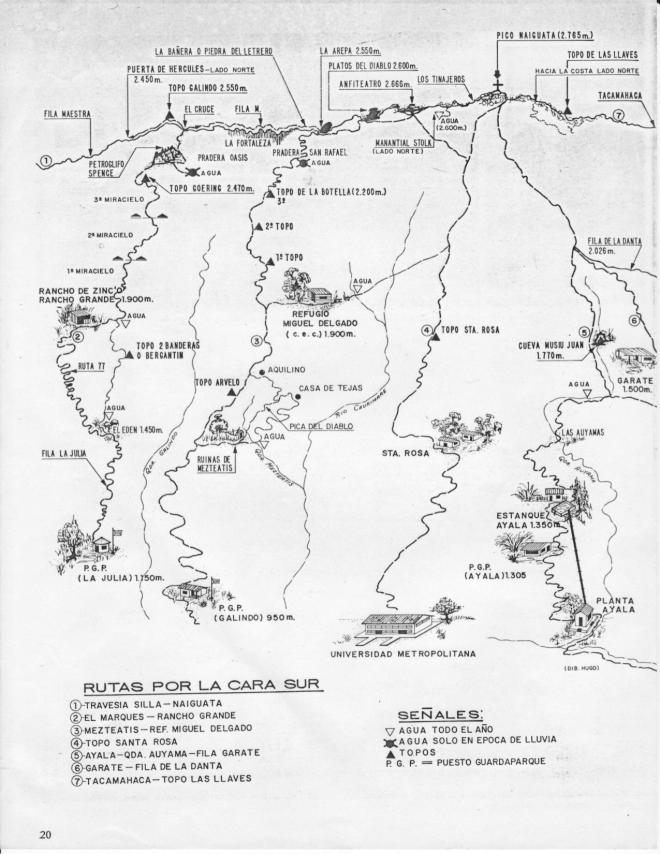
Once more there was nothing technical about the climb, it was just long, and in the valley, the weather was hot that day. And once again the views were stunning.


Although there were several paths up the south side of Ávila, I never found one descending from the ridge on the north side, down to the Caribbean. The north side was reputed to be a naturalist’s paradise, with many different species of flora and fauna.
There was no road along the coast for the length of the park. The road ended at a beach club on the western end of the park, and just outside Higuerote on the eastern end. In between, there was about 50 km of a rough track, only suitable for a 4-wheel drive.
One day I decided that I was going to run and walk the 50 km. Ivonne drove me to Higuerote, and I started out just after the sunrise. We agreed to meet at the other end at 18:00, around sunset.
As crazy as it may seem today, I took nothing with me: no pack, no food, no water. I had just my running gear. And of course there were no mobile phones in those days.
But the distance for me, was a little more than that of a marathon, of which I had already done several. And a few weeks earlier I had run and walked 80 km in training in Caracas, so I was not in awe of the distance.
The going was rough in parts, particularly in the middle third, and it was hot and very humid in the sun. I drank from streams and surprisingly, I found several banana plants, with ripe fruit, possible descended from a long-vanished subsistence plot.
I had no concept of distance covered, but I had calculated on it taking no more than ten hours. When ten hours had elapsed and there was still no sign of civilisation, I started to feel a little uneasy, especially when it looked like it would not be long until the sun set. I began to regret the time had spent on those idyllic breaks that I had taken, sitting on the beach, or cooling my feet in the streams.
It was quite dark when I finally emerged from the bushes to find myself in the car park of the club at Naiguata. And there was Ivonne with one of her sisters, patiently waiting for me in my car.
Mission accomplished.
Since Caracas, I have had several opportunities to live close to mountains, and I have never lost my fascination for them.
But my memories of Ávila stand out above all others.


 The Irish Rover