
Vega de Valcarce to Sarria

Vega de Valcarce to Biduelo (26km)

Saturday, 29 September, 2012

I set off that morning in idyllic conditions; blue sky, no wind and early morning birdsong.  I was very fortunate with the weather.  I had been advised that there was not much accommodation between Vega de Valcarce and Triacastela at 33 km and most of the route was at over 1200 m and quite exposed to the elements.

The path ran parallel to the road and wound steadily up the valley, until there was no more valley, and then started the ascent to O Cebreiro at 1500 m. Once up on the ridge, the path climbed gradually, until O Cebreiro appeared.

It was much smaller than I had imagined, and very touristy.  And being a Saturday, the tiny village was quite crowded, with the car park overflowing.

O Cebreiro has been inhabited continuously since pre-Roman times.  In the 1960s, it was largely renovated, many of the buildings having fallen into disuse.
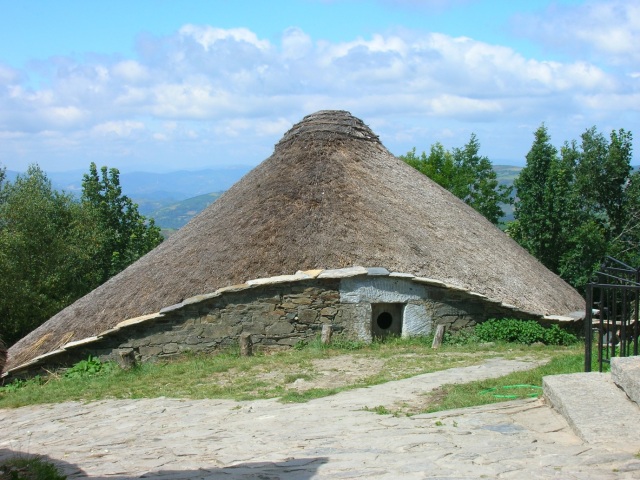
clip_image004
A pallaza of pre-Roman origin and Celtic design, in O Cebreiro

For the next 3-4 hours the path steeply ascended and descended many times, until I was starting to get quite tired; the constant treading on rocks and stones had left my bad foot quite numb.

But suddenly, without any prior warning, there was a hostal with a bar in the middle of nowhere, outside a tiny village, that consisted solely of a few farm buildings. And they had a vacancy; a comfortable room, with stone walls and heating.  We were still at over 1200 m in late September, and it could get quite cold at night.
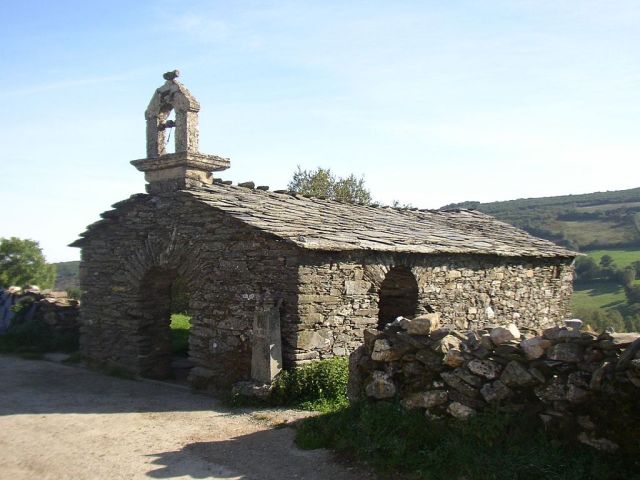
clip_image005
Ermita de San Pedro in Biduelo

After a hot shower and a meal, I felt much better.  And I had the luxury of being able to wash my clothes and have them dried before the morning.

It does not take much to make a pilgrim’s day… 🙂


Biduelo to Sarria (26km)

Sunday, 30 September, 2012

I experienced a beautiful start to the day; fresh cold mountain air, blue sky, and no sound but birdsong and the occasional bark of a distant farm dog, or the clang of a cow bell.
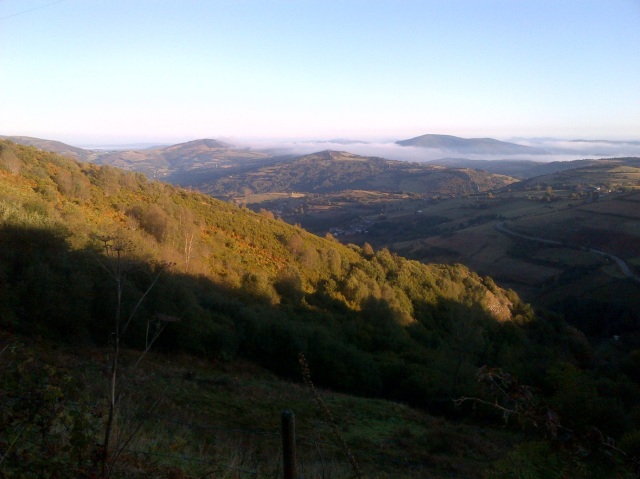
clip_image006
The view across the Galician hills in the early morning sun


All morning the path descended gradually, with the occasional climb out of a valley to attain a ridge, and then the slow descent re-established itself. At intervals a village appeared, mostly with only a handful of farm dwellings and occasional a small bar. It was a warm day, but I did not stop; I was comfortable at my pace and I did not want to break it

On the outskirts, leaving Triacastela, I had a choice to make.  On the left was the longer flat route to Sarria, via Samos, with its famous sixth century monastery, and on the right the much shorter route, via San Xil, albeit with some steep ascents on dirt paths.
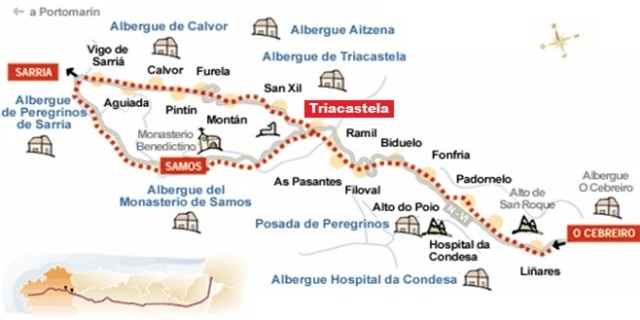
slideplayer-2

I choose the elevated route and for the rest of the day I never saw a single pilgrim. Most of them probably had stayed in Triacastela and were far ahead, or they stayed in O Cebreiro and were still behind me.

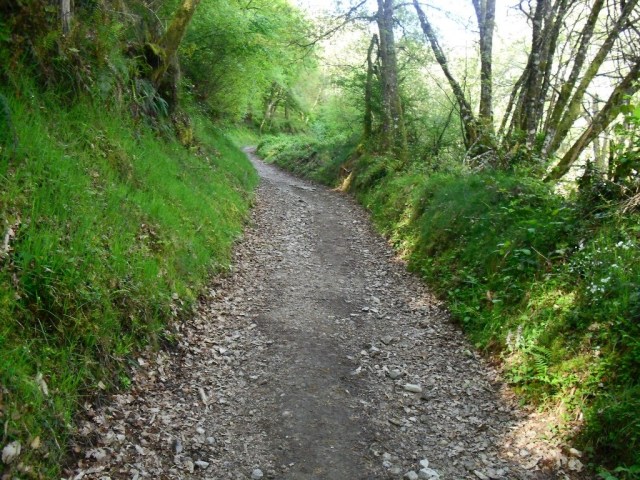
The route was beautiful, climbing through lush green woods and when it emerged on the plateau, one could see for a long way.  Of course on a day of heavy rain and strong cold winds, it would not have been so pleasant.
cimg1099-medium
The path on a dry day

From the plateau, the route was gently downhill, until it reached the main road that led eventually into Sarria.
Ponferada to Vega de Valcarce

Ponferrada to Villafranca del Bierzo (23 km)

Thursday, 27 September, 2012

The Camino de Santiago is normally so well-marked with yellow arrows that it is almost impossible to get lost.  But when one leaves the Camino to find accommodation, it is sometimes not so easy to find one’s way back, especially in winding streets and bad weather.

When I left the hostel that morning, I was quite disoriented.

Asking younger people or obvious immigrants the way to the Camino, is usually a waste of time; they normally never seem to know.  It is the older people who are usually most helpful, and I soon found an old lady who pointed me to the Calle Camino de Santiago.  I saw no yellow arrow markings, but in towns and cities they are often not so obvious.  After ten minutes I checked directions with an old man, and he assured me that I going the right way to Villafranca.

But I still did not see any yellow arrows, and after half-an-hour I stopped in a bar to have a coffee and a croissant.  Customers in the bar assured me that I was going in the right direction, but that I was not on the historic route, which followed a path in the countryside.  They suggested that I should follow the road that I was on and that the two routes intersected in about another eight kilometres.

So I was destined to two more hours of heavy traffic through rather grotty industrial suburbs.

Not long after leaving the bar, I came across a young, very attractive pilgrim, looking quite lost and confused.  She had made the same mistake like me, so I explained what we had to do to get back on the historic path.

It turned out that she was Italian, on a break from her university, and was walking from León to Santiago, like me.  She spoke no English, or none that she would admit to, but she spoke some Spanish, and we chatted quite freely as we walked along.

But when she eventually pulled out a packet of cigarettes, the pretty girl attraction evaporated, and I made an excuse to stop for a while, and let her get well ahead.  I never saw her again.

Once back in the countryside, the route undulated through seemingly endless vineyards. But they were vineyards unlike any I had previously come across. There were none of the tidy posts and wires that I was used to seeing. The method of cultivation seemed to let the vines grow wild as a bush, with little or no pruning. But they were heavy with huge bunches of purple grapes, so the method obviously works well.

And at the end of that day’s path, Villafranca del Bierzo, one of the most attractive little towns I had so far come across.

121-villafranca-del-bierzo
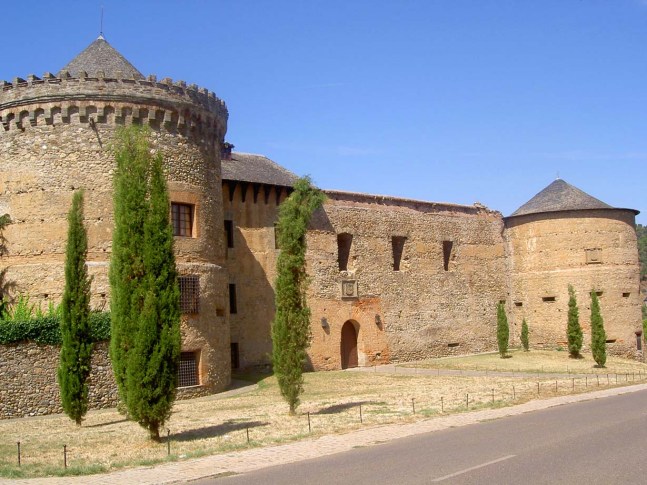
The Palace of the Marquisses of Villafranca

There was a settlement on the site since before the Romans arrived, but it was when the pilgrims started arriving in the Middle Ages, that it flourished.  A Cluniac monastery was founded in the eleventh century and it was from the French pilgrims that settled there, that the town obtained its name – ‘French Town’.

parroquias_colegiata-santa-maria-villafranca-del-bierzo_colegiata-villafranca-del-bierzo_villafranca-del-bierzo-38_831_1394971312
Iglesia de Santa María, formerly the Monesterio de Cluny

And once checked into a room, I spent the rest of the afternoon sitting in the warm sun, drinking beer, and watching old men playing ‘boules‘.


Villafranca del Bierzo to Vega de Valcarce (16 km)

Friday, 28 September, 2012

The weather forecast for Spain showed heavy rain almost everywhere, except for Galicia.  Given the damp reputation of Galicia, it seemed almost too good to be true, but once the early cloud dispersed, the sun did indeed shine warmly.

The road from Villafranca led gradually up a narrow valley, winding through the hills, following the course of the Rio Valcarce.  Gradually the valley became narrower and narrower, until there was barely room for the river, the footpath and the road.  Where there was a village, it was limited to a row of houses on each side of the road. And all one could hear were an occasional passing car, the sound of rushing water and the chatter of birds.

The road ran alongside the river and occasionally it looped under the road and back again a hundred metres later.  From one of the bridges I could see large dark trout, seemingly motionless in the current, except for an occasional movement of their tail.

At the village of Trabadelo, I stopped at the bar to have a coffee and a sandwich.  The walls of the bar were made of blocks of stone and on every joint and anywhere the stone projected, there were coins, from floor to ceiling.  I tried to leave one too, but I could not find a single uncovered spot.

In Vega de Valcarce I had difficulty finding a room.  In the end I had to settle for a very basic room in a dilapidated house beside a bar that had seen better days.  When I went in, the owner and one of the staff were smoking and playing cards.  The ashtray in front of them was filled with cigarette butts.

But the room did not cost me very much.

Sometimes beggars have to take what they can get… 🙂

clip_image020
Harvesting potatoes in Vega del Valcarce


clip_image003
And beans drying in the sun