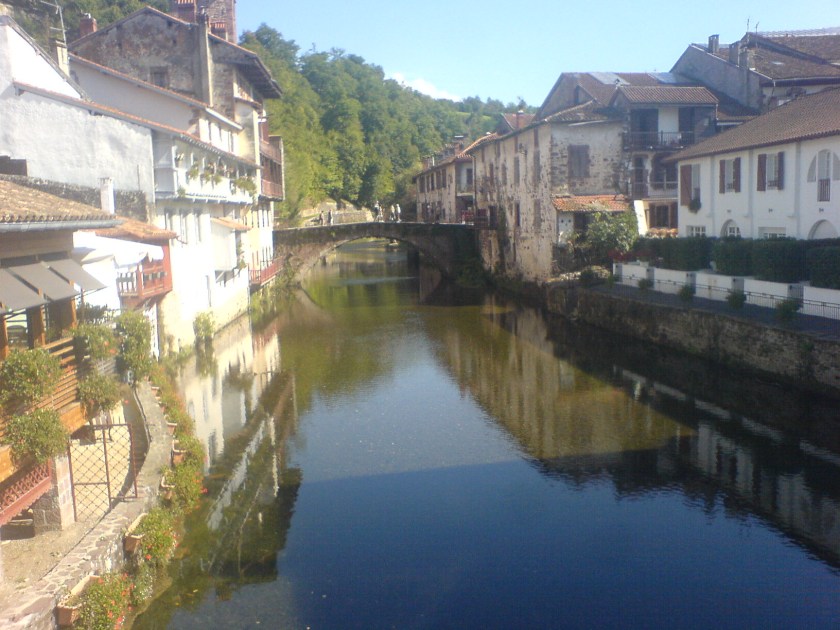
Urdax

Cambo-les-Bains to Urdax (28 km)

Friday, 30 September, 2016

After my experience of walking from Ustaritz to Cambo-les-Bains, I did not expect there to be a convenient path or a quiet country road to Espelette.  So for five kilometres I walked along a very busy main road, frequently stepping well back and holding on to my hat every time a monstrous truck came hurtling by.  And I lost count of how many drivers I saw talking on, or fiddling with, their phones.  It was a relief to get off the race track and into Espelette.

Espelette is an attractive town, famous for its production of dried and powdered red peppers.  Apparently they are sold at a covered market every Wednesday.  As it was Friday, I was quite happy to have missed the market, as I am not a great enthusiast of crowds.
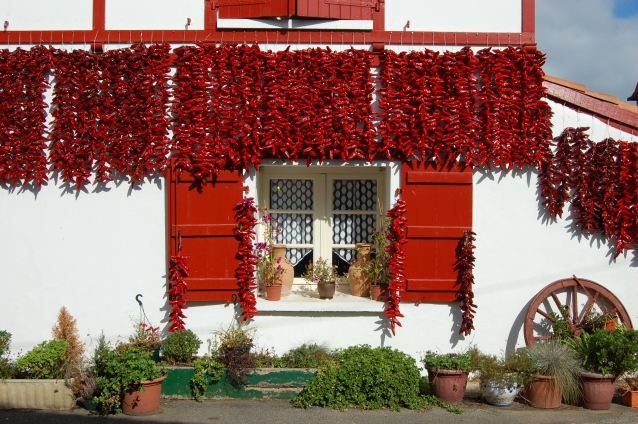
17dd1c1198d989e46897e9584bf428d0
Red pepper drying (photo from interet)

But my objective in going to Espelette was not to go shopping, it was to pick up the Camino de Santiago, which would lead me up the Baztan valley, over the Pyrenees and on to Pamplona.  I spotted the typical yellow arrow marking near the church, but I was not able to find a second.

img-20160930-01205
The church of Saint-Etienne in Espelette

I asked several people for directions, but without luck.  Even in a busy bar nobody seemed to know anything of it. Eventually I found a second and subsequent yellow arrow marks at the edge of the town, and started off in what I believed to be the direction of the next village, Ainhoa, which was about 6 km away.

But after ninety minutes of following the yellow arrows, of toiling up and down steep rocky paths, seeing only deserted farm buildings, and not a soul in sight, I started to feel uneasy.  In the distance I saw a couple of modern looking houses on the other side of a valley, one with a car parked outside.  So I set off down another steep rocky path, across a stream and up the other side.  By the time I got to the houses, nearly two hours had elapsed since I left Espelette.

A woman answered my knock.  She informed me that she knew nothing of a path to Ainhoa or a Camino de Santiago, but she could direct me to the main road, which involved retracing much of the way I had already come, and following another country road.  I was quite lost.  I eventually came to the main road from Espelette, with four kilometres to go to Ainhoa.  In three hours I had progressed two kilometres towards Ainhoa.

The rest of the ‘hike’ along the main roads, through Ainhoa and on to the Spanish border at Dantxarinea, was relatively uneventful, but quite tiring, as it was a hot day.

Dantxarinea was something of a surprise to me.  I expected a small run-down border town, no longer with a function, since the abolition of EU borders.  Instead it turned out to be a bustling modern commercial centre stretching along both sides of the main road, with five service stations and very many large stores plus bars and restaurants.

Once across the border, the route was clearly marked, and more than once I was greeted with the traditional – buen camino.  It felt as if I had come home.  The road gently descended, until 45 minutes later I was in Urdax.

urdax
Urdax with its monastery (photo from internet)

Why did I become so lost earlier in the day?

Until I go back and retrace my steps, I will not know.  But I did receive something of a consolation in being told that evening, by my host, that it was quite a common experience among pilgrims starting in France.

And what had intended to be a walk of about 18 km, for me ended up as 28 km.
 

Cambo-les-Bains

Bayonne to Cambo-les-Bains (25 km)

Wednesday-Thursday, 28-29 September, 2016

In former times, those who landed in the port of Bayonne to travel on to Pamplona or further, would go by the Baztan valley across the Atlantic Pyrenees. It was also the oldest path to Pamplona and on to Santiago de Compostella, pre-dating that of the Camino Francés from Saint-Jean-Pied-de-Port.

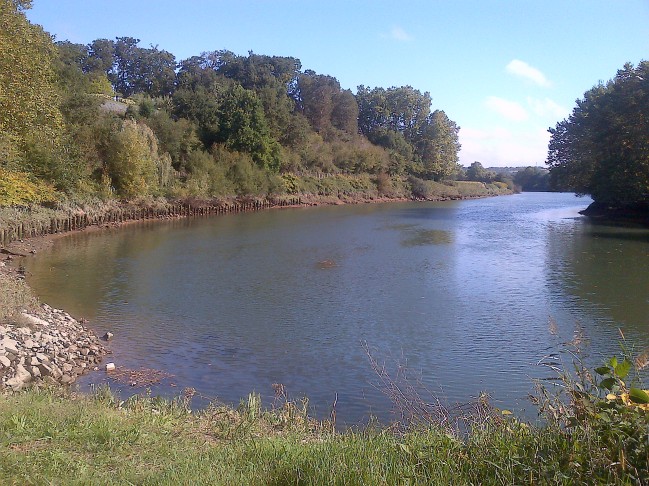
So it was on a perfect early autumn day I set off from Bayonne, following the path along the banks of the River Nive.  I saw very few people; an occasional runner, cyclist or a local, walking their dog.  It was extremely peaceful; only the sound of birds or the buzzing of a bee.

img-20160928-01195
The river Nive

But after 15 km the peaceful walk ended at Ustaritz with the constant roar of trucks and cars hurtling through the narrow streets of the town.  I felt sure that there must have been a path or quiet road to Cambo-les-Bains, but according to the locals who I quizzed, the answer was a shrug of indifference.

So with no better alternative, I set off to walk the remaining 8 km to Cambo, along a noisy and heavily traveled road.

But eventually I arrived in Cambo, a delightful little town, and I put my ‘not-so-pleasant’ experience of French traffic behind me.

And the hotel was perfect.  The owner, Laurent Rodriguez, his wife and beautiful daughter, made my stay most pleasant and nothing was too much trouble for them.  I forgot to ask Laurent if he had played rugby, for he was built like a prop forward, with huge shoulders, massive arms and a neck like a tree trunk.

He was not someone that I would have relished having to tackle.

img-20160929-01197
Hotel Laurent Rodriguez


Roncesvalles

Tuesday September 27, 2011

Saint-Jean-Pied-de-Port to Roncesvalles (27 km)

I had breakfast soon after the hotel opened and was on the road by shortly before 08:00. There was no traffic in the town and there were no clouds in the sky. It was already quite warm.

Apart from the first 100 m, the road climbed quite steeply. Within fifteen minutes I caught up with a couple moving very slowly; much slower and they would have been going backwards. He was a big robust man a bit younger than me, carrying the largest backpack I have ever seen, with camping gear strapped on top and a large sleeping bag below. It was no wonder he was already sweating profusely. In contrast she was young, very attractive and carrying nothing.  Was she his daughter?  I didn’t think so.

The road wound steadily upward, occasionally passing farm houses, and then branched off onto a steeper dirt path. Ahead and above me, I could see a very extremely large obese man in very tight shorts, with inflated and unhealthy looking legs. He was very pale, like Nordic people are after a long winter.  When I caught up with him, he asked in a very strong native Irish accent ‘how much f——g further do we have to go to Roncesvalles’. When I said that we had covered about a quarter of the distance, he swore in apparent frustration, using expletives that would have an army sergeant-major blush.  He said that he would never make it and that he had not realized how hard it was going to be. I suggested that it was not much further to accommodation and that if they had room, he could stay there and carry on the next day.

I hoped that they had a vacancy and that he took my advice, for he was not in good shape.

When I reached the crest of the current climb, I could see the Auberge d’Orrison quite a way below at the foot of a valley and the road climbing steeply up the opposite side. My total estimated ascent for the day had just increased by another 100 m.

ASuberge d'Orrison

Auberge d’Orrison

I stopped at the auberge and had a beer in the welcome shade of the patio. There were quite a few guests and they all seemed to be staying there for the night. The view down the valley was sublime and on a clear night with no light pollution the stars would have been spectacular.

The road out of the valley initially climbed steeply, but soon became more gradual, and for the next three hours it gently crawled up to the highest point, the Col Lepoeder. Everywhere there were huge flocks of sheep. I had never seen such clean sheep; they all looked as if they had just had a shampoo and blow job. There were herds of equally pristine tan-coloured cattle and now and then a band of horses would gallop across the slopes. There were no obvious fences; they all seemed to be free to go wherever they wished.

At some point on this stage of the walk I became conscious of my heart missing beats. It has happened before but not in recent times.  Even without taking my pulse,  I could feel the missing beats in my forehead. At times it was one in eight or ten beats and sometimes in every three or four. I felt well in myself, so there was nothing I could do except to relax and take it slowly.

Finally I reached the Col Lepoeder, and from there, there were two routes down to Roncesvalles; by road or straight down on a steep path through the trees, the ground strewn with early autumn leaves. I chose the latter and descended slowly and very carefully.  Ninety minutes later I was in my room in the albergue.

Roncesvalles
Roncesvalles

After a shower I felt somewhat revived, although my legs throbbed as if they had been beaten with a club. On the stairs I passed a Canadian woman, walking down backwards.  I was not the only one feeling a bit sore.

A short stroll did not help much, so I went to dinner. And what a bargain that that was – a fixed menu with three generous courses and as much wine as one desired, all for nine Euros.

Afterwards I sat in the bar with a glass of Rioja. As I was about to leave to go to bed, in walked the guy that I had seen earlier that morning, complete with his enormous burden. The walk had taken them fourteen hours and he was drenched in sweat and looked totally exhausted. In contrast his partner/daughter looked quite fresh and relaxed.

I bumped into them again in the morning, as I was leaving.  They told me that they were from Barcelona and that they were heading home from a camping holiday in France. The walk from Saint-Jean-Pied-de-Port had been a last minute decision that they had almost regretted, especially when they had to make the steep descent through the woods in the dark.  They caught the morning bus to Pamplona.

But all’s well that ends well, and happily my heart was beating normally once more.

Saint-Jean-Pied-de-Port

Monday, September 26, 2011

Bayonne to Saint-Jean-Pied-de-Port

The first day of the ‘The Way of Saint James’ is reputed to be the most arduous – 27km and 1100 m of ascent to the pass, with 500 m of descent to Roncesvalles.  And apart from a refugio after 10 km, there is nothing until one reaches Roncesvalles.  Given that I had not done anything approaching that in the six years since my illness, it is not surprising that I started feeling some flutters of apprehension.  And of course I was not accustomed to carrying all my worldly goods on my back.

There were four trains each day from Bayonne to Saint-Jean-Pied-de-Port and I decided to take that of late morning.  It turned out to be a local train that stopped at every station. In the names of the little villages, it was obvious that we were in Basque country – Vasco in Spanish, the language being shared across the border with Spain.  En route I spotted many Basque names such as Ustaritz, Jatxou and Itxassou.

The train trundled along a narrow wooded valley, alongside the rapidly flowing river Nive until it arrived at the end of the line, outside Saint-Jean-Pied-de-Port.  From the station it was about a kilometer to the centre of the town.  I arrived to crowded streets and packed restaurants – it was Monday and the weekly market day.

The first hotel I tried was closed for the winter, the second was much too grand for me, in the third the door was locked and the reception closed for lunch and then I stumbled upon a bar with rooms above and it was perfect for my needs and inexpensive.  I checked in, left my backpack in the room and went off to explore the town.

DSC00002
The steep main street with the foothills of the Pyrenees in the background

The name of the town means ‘Saint John at the foot of the pass’ and it has a permanent population of about 2000.  It is a well preserved walled town with one narrow cobbled street rising steeply to a citadel.  The view from the walls was impressive and everywhere there seemed to be flower boxes in full bloom.  From the bridge over the river one could see that the water was sparkling clean and thick with trout.

DSC00001
The bridge crossed by pilgrims as they set off on the path over the Pyrenees

The original town was razed in 1177 by Richard I, also known as Richard the Lionheart, the English King.  It was rebuilt on the present site by the Kings of Navarre.

I found the pilgrim’s office at the top of the steep main street and obtained my pilgrim passport – it is needed to stay at any of the official refugios.

Later I went into the old church by the pilgrims’ gate.  It was empty except for an old lady, on her knees with head down, and seemingly deep in prayer. It was cool and serene.  Periodically someone would enter, have a quick look around and leave.

I stayed there for a long time.  I was not praying like the old lady, but I have no clear recollection of my thoughts at that time.  I imagine that I was very focused on the physical struggle I anticipated having the next day and hoping that my crap leg would get me over the mountain and down to Roncesvalles without having to seek help.

DSC00003 (1)
Looking back at the church and Pilgrim’s Gate

Eventually I left the church to find a restaurant.  When I looked back, the old lady was still there.

Bayonne

Bayonne, Friday, September 23, 2011

At the end of September 1968, Biarritz was paradise, at least it was for me; the sky was blue, the air was warm, the water was temperate, the sand was clean, the surf was friendly and the town was quiet, almost devoid of visitors. I had a comfortable room one block from the beach.  I was young and I felt as if I was in heaven; I had never experienced anywhere like it before.

And on Thursday when my flight from Stansted passed low over the town on its final descent, memories of that long past era came flooding back. Above all I recalled the light and the vivid colours of the houses and the landscape, so much appreciated by artists.

download (5)
Biaritz with its red roofs and red walls

The little modern airport is located between Biarritz and Bayonne. Once the two towns were quite separate, but today it is not obvious where the suburbs of one ends and the other begins.

From the airport a thirty minute ride costing one euro on a suburban bus delivered me to the Bayonne railway station. And from there most pilgrims, and there were several on my flight, make the ninety minute rail journey to Saint-Jean-Pied-de-Port, the last French town before the Spanish border, and the recognized start of the ‘Camino francés’.

But I did not set off straight away; I checked in at a nearby hotel, to ensure that I could see the several games of the Rugby World Cup that I knew were being carried on the French networks that weekend.  I felt it unlikely that they would be shown on Spanish television.  So my pilgrimage would not start until the following Monday.

Bayonne-France
Aerial view of Bayonne

Bayonnne is situated at the SW corner of the French hexagon and is centred on the confluence of the rivers Nive and Adour. It originated in a Roman settlement, Lapurdum. In 842 the Vikings invaded the area and eventually settled. From 1152 to 1452, until the end of the 100 year war, it was ruled by England. Today it is a relatively sleepy backwater town.  It is also the birthplace of Didier Deschamps of the World cup winning French football team, and Imanol Harimdorquy, the highly-rated French international rugby union star.

fetes-bayonne-crowd-day
France’s wildest party – the Bayonne festival in August

So for the next three days I lazed around; late breakfast of café au lait and croissant each day in the same little hole-in-the-wall bistro, reading the papers from cover to cover and chatting rugby to the friendly proprietor; wandering around the town exploring the battlements and the picturesque narrow streets of the old town; browsing in the bookshops and reading a new book in the sun in the square, accompanied by a beer or glass of wine; eating dinner outside by the river; and of course all  interspersed with returning to my hotel room in time to watch the next game.

Life was feeling pretty good to me.

Guard Dogs and Tadpoles

One of our regular valley floor walks follows the river Aveyron to the north-east of Chamonix, as far as the furthest bridge and back along the other bank.  The rapids are fed by the melting ice from Mer de Glace, the largest European glacier. 

At regular intervals along the river are warnings to the public not to venture near the river bed, as the water level can rapidly change when water is released from the dam further upstream.  When that happens the current through the rapids is so powerful that small rocks the size of a fist are spat into the air.  Despite the warnings of the danger being in French, German, English and Italian, many people wandering on the riverbed or sunbathing on the rocks appear to believe that they are immortal. 

Or perhaps just plain stupid.

At the upper end of the valley is a small subsistence farm, with herd of goats and their accompanying guard dogs.   Their enclosure fencing is moved most days and it meanders up and down the valley, the goats consuming anything that is edible.

Initially the huge guard dogs used to growl and snarl if we got too close, but now they ignore us.  Apparently they have got accustomed to both our smell and voices and no longer view us as a threat to their charges.

 Near the farm is a small pool beside the road, host to a multitude of tiny tadpoles. They must have ‘hatched’ out in the last few days.  It will be interesting to follow their life cycle.

 And guarding the farm is a sleepy old Basset hound that has seen better days.