Sevilla to Guillena

Sevilla to Guillena (23 km)

Thursday, 1 October, 2015

We set out early, before dawn, and took the metro to close by the cathedral.  From there our camino began.  We walked along the river and when we reached the Puente de Triana, the sun was rising; the buildings to the east were in silhouette and those on the west were bathed in rose light.
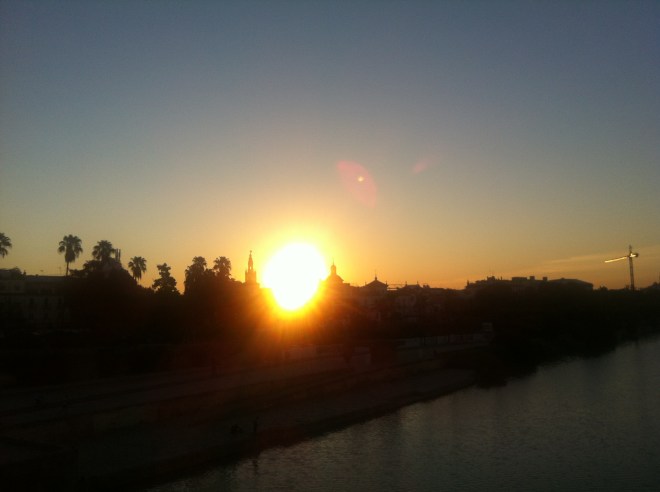
img_2713
Looking back across the river from the Puente de Triana
img_2714
And looking forward to the Castillo de San Jorge, with the moon clearly visible

The route took us through typical industrial suburbs and abandoned lots, rather depressing, but typical of large cities anywhere in the world.

About 10km from the centre of Sevilla, we passed through the small town of Santiponce, largely built on the former Roman city of Italica, founded in 206 BC.  One can visit the amphitheatre that once held 25,000 spectators.

italica
The amphitheatre of Italica (photo from internet)

Two of the best known of the ‘good’ Roman emperors – Trajan and Hadrian, were born in Italica.  Trajan was known for his public works and his expanding Rome to its maximum territorial extent.  Hadrian followed Trajan and is best known for the wall he had built across northern England to keep out the Scots.  Ironically these days, many Scots would like to have the wall rebuilt to keep out the English.

When we finally reached the end of the industrial zone, at a large roundabout, we were confronted by two attractive women, bent over and baring their bottoms to passing cars and trucks.  Until I greeted them with ‘Buenos días señoritas‘, they were not aware of our passing presence.  Sevilla has its unique way of welcoming visitors to its city.

From close to that roundabout a long straight undulating dirt road led to Guillena.  From the top of each incline one could see the town in the far distance, but after each hour of walking, we scarcely seemed to be any closer.

img_2717
The long straight road to Guillena

We passed the hollow, where two years previously the road had been waist deep in flood water, and where I had slipped and got very muddy and wet.  It was bone-dry, with no hint that a stream had ever existed.
img_2718
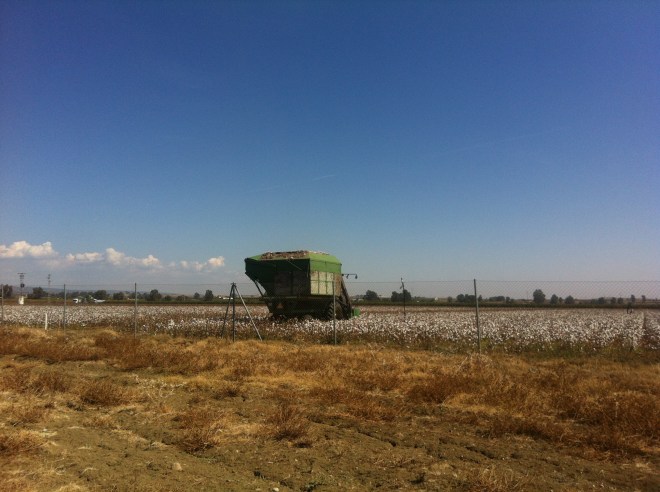
Harvesting cotton outside Guillena

Later, when we had checked into the only hostel in the village, and were having a beer in the bar downstairs, we witnessed a strange couple enter and inquire about a room.  He was tall and very thin and she was short and quite plump, and neither of them spoke Spanish.  They were both heavily dressed, considering that it was a warm day, and he was strapped around the waist to the handles of a cart, which was piled with bags and camping gear.  It was almost comical to witness the two of them hauling the cart up the stairs to their room.  I would have loved to have captured the incredulous looks on the faces of the locals in the bar.

Every day brings a new experience on the camino.

Next: Castilblanco de los Arroyos

Sevilla

Sevilla

29-30 September, 2015

We were not long back from our four months in Chamonix, when I started to plan our next long hike along one of the pilgrimage paths that eventually arrive in Santiago de Compostela.  My mind was set on walking across France, from Geneva to Saint-Jean-Pied-de-Port, via Puy-en-Velay.  I booked flights from Stockholm for 28 September and started to plan the stages of the walk.

But I had nor progressed very far in my planning, before I realised my potential mistake; we would be crossing the Massif Central, the mountainous south-central part of France, in late October, when the weather could be quite cold.  And as I don’t ‘do’ cold, I switched my attention to the Vía de la Plata, that starts from a much more temperate Sevilla.  And conveniently there was a low-cost morning flight from Geneva to Sevilla on 29 September.

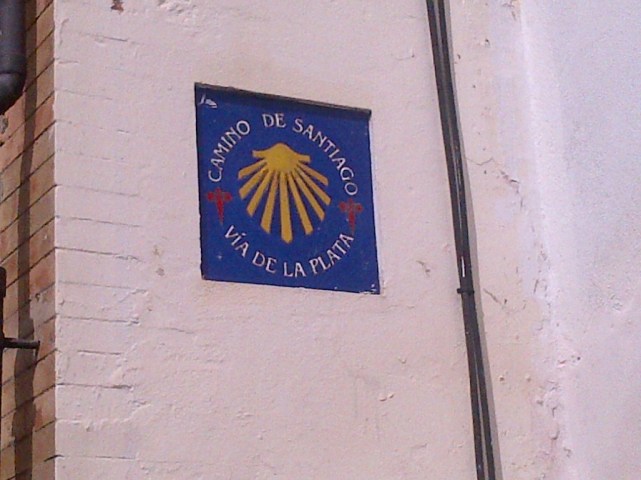
The Vía de la Plata is the longest of the pilgrimage routes in Spain, heading north from Sevilla to Zamora, then north-west to Santiago, a total distance of about 1000 km.  Much of the route is on ancient Roman roads.  The route was also known as the Camino Mozárabe, originally followed by the Christians of North Africa.

img_2725
Vía de la Plata

I was no stranger to the route from Sevilla.  In mid-February of 2015, I had set out to walk from Sevilla.  The temperature was perfect for hiking, but my start was delayed for nearly a week by torrential rain.  When I eventually got going, I found low-lying areas to be flooded, streams with stepping stones to be deep under water, and mountain paths washed out.  Twice I slipped and fell in the water, and when I reached Villafranca de los Arroyos, the heavy rains started again.  The forecast was for rain, rain and even more rain for the week ahead and extensive flooding.  I decided to abandon the walk and return another time.

My second attempt was in late September of the same year, but this time it was in soaring temperatures and with little or no shade.  When I walked into Mérida the temperature was 42 °c.  The heatwave showed no sign of abating, so I once more stopped.

But ‘Stubborn’ is my middle name and back to Sevilla I went once more, this time with Lotta.  It was her first time in Sevilla, so we spent the first day seeing some of the sights.

The central core of Sevilla is a labyrinth of narrow streets branching out from the massive cathedral.  Some of the lanes are so narrow that one can stretch out ones’ arms and almost touch the walls on each side.  The lanes twist and turn, and despite being close to the cathedral, one cannot see it until one exits the maze.

The cathedral is the third-largest church in the world and is the burial site of the alleged bones of Christopher Columbus.  It has fifteen doors on its four facades.  It is so extensive that it can only be seen in its totality from the air.

img_2686
Part of one of the facades of the cathedral

Sevilla is a popular tourist destination, for it is an interesting scenic and historic city.  But one of the downsides of exploring the tourist area is being the constant target of touts trying to entice one into restaurants, sell tickets to flamenco shows, rides in a carriage etc.

img_2667
Coches de Caballo – Rather expensive tourist traps

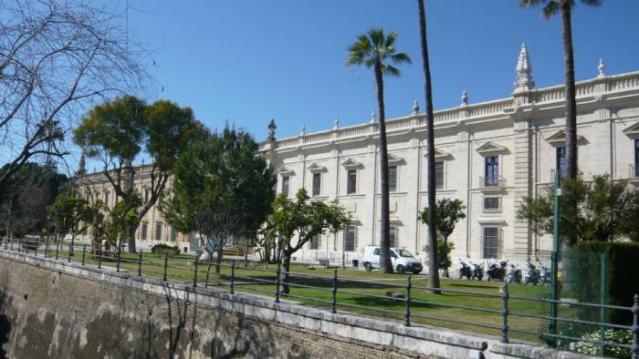
One of the largest buildings ever constructed in Europe was the Royal Tobacco Factory.  It measures 250 m by 180 m and was built in the mid-eighteenth century.  It was the first tobacco factory in Europe.  Since the 1950s, it has housed part of the University of Seville.


02_big
The Royal Tobacco Factory (picture from internet)

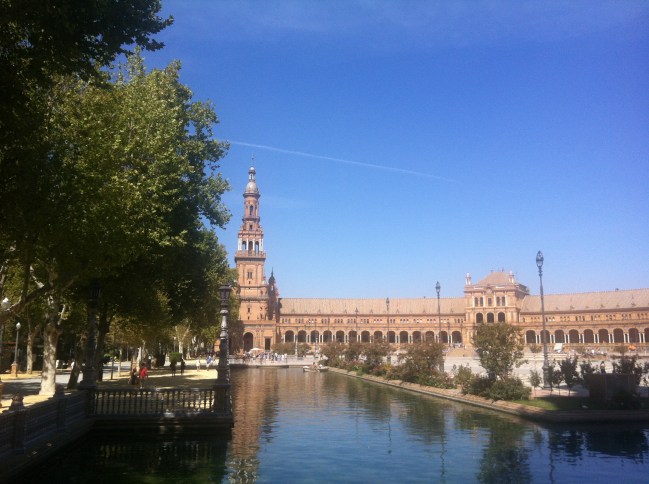
The magnificent Plaza de España was built in 1929 and was the central feature of the Ibero-American Exposition, held to strengthen the ties between Spain, Portugal and their former colonies.  The building is semi-circular and features a canal crossed by several ornate bridges.

img_2696
A view of one of the symetric ends of the building


img-20130220-00441
And one of the pairs of bridges crossing the canal


The building has 58 pairs of benches, each one representing a province of Spain, with a typical scene from the province and a map, all surfaced in painted ceramic tiles.

img_2698

And at the end of the day, a timely reminder of why we were in Sevilla…

img-20130222-00455


Next: Seville to Castilblanco de los Arroyos