That previous evening in Villava, it struck me that I had not seen one single pilgrim in six days of walking on the Camino de Baztan, from Bayonne. Considering how difficult it is to find solitude in this crowded world, I over-achieved.
The next day I set off to stroll the remaining six kilometres into Pamplona, and true to recent form, I got rather lost. I was standing at an intersection, probably looking bemused, when a man came up to me and, without any questions on his part, said that if I was a pilgrim looking for the path, he would show me the way.
We walked together for more than an hour. He said that he was taking food to his daughter and grandchild. He noticed my limp and I told him of my stroke ten years previously.
It turned out that he had had an identical stroke to mine, a cerebral haemorrhage. His was in August 2005, mine in November of that year.
He lost memory and speech, as did I, and his sight was affected, as was mine. At the time he had his stroke he was still quite fit, running marathons and cycling. My story is similar.
The big difference between his experience and mine was that he was operated on twice to remove the blood clot, and he subsequently made a full recovery.
While we walked, we talked about a wide range of subjects – children, love, religion, nature, food, wine and many more. It was like talking to a twin brother.
And he even has a small vegetable plot in Asturias, similar to mine in Uppsala.
When we arrived at the Magdalena bridge, the ancient bridge over the river into historic Pamplona, he shook my hand and left me without a further word, apart from ‘buen camino’.
While I having breakfast, my hostess told me that the rest of the way to Pamplona was gently downhill, at least compared to my previous day in the mountains, and that it was about 20 km to Pamplona. So mentally I expected 15 km, as I intended to spend the night in Villava. I set out at a leisurely pace, for what I perceived to be a relatively easy walk.
Leaving Lantz with the mountains in the background
The route followed farm paths, heavily covered with smooth stones, that I found rather uncomfortable on my injured toe, ankles and knees.
I passed through a couple of tiny villages, each with a large closed-up church. At one time there must have been a much larger population, for today each village had only a handful of houses, no bar or shop and little sign of life.
There was eventually a long stretch of narrow path, high up on the hillside, alternating between forest and meadow, following the contours of the land and avoiding the busy road below. It seemed endless, but finally it descended to the river and Sorauren. There two old ladies told me that I had about six kilometres to go to Villava. My original estimate of 15 km was now looking more like 28 km.
The path was now concrete and followed the banks of the river. There was no breeze and it was hot.
But my day was made when a huge flock of sheep came along the path toward me. Without any outward sign and without looking back, the shepherd moved over into the field and the leading sheep followed him. One little sheepdog raced around like crazy, rounding up the laggards and moving the whole flock across into the field.
I always find it impressive to witness a working dog. And with all under control, the dog ignored me as he passed.
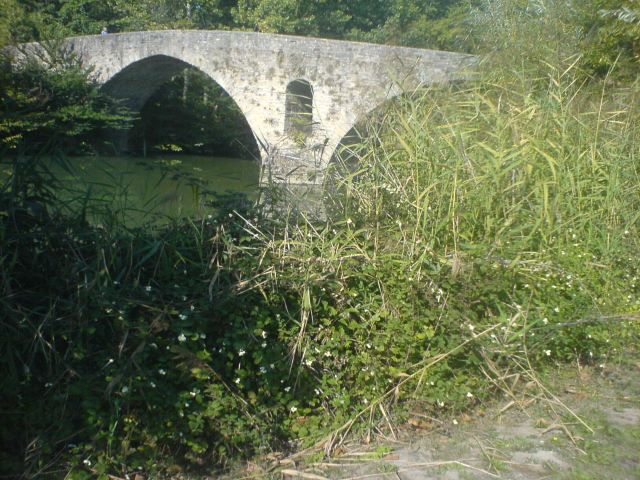
About an hour later I crossed the bridge over the Río Ulzama into La Trinidad de Arre and Villava on the outskirts of Pamplona, where the Camino Baztan joined up with the Camino Francés.
The bridge into La Trinidad de Arre and Villava (from internet)
I was now on familiar territory and mission accomplished… 🙂
When I awoke, my left buttock was very tight and sore, and it felt as if it would tear at the slightest exertion. Descending the stairs was a challenge. I decided to have a leisurely breakfast and walk only as far as I felt comfortable, even if that meant just to the next village.
In the center of the small lobby there was a huge pile of luggage. It turned out that the bags belonged to the Belgian women from the restaurant the previous evening. Their agency had booked all their accommodation in advance and each day a local taxi would transport their bags to their next accommodation. That explained how they had managed to look so fresh and well-dressed at dinner, after a day of hiking.
Before I left, the owner told me that there was no hotel accommodation before Villava, about fifteen kilometers from Zubiri and six kilometers from Pamplona. He assured me that it was an easy walk, with just a few short climbs in the last section.
So off I set, back across the stone bridge and up a quite steep hill. After fifteen minutes I recalled that the hotel owner had made no mention of the hill, and I also realised that I had seen no signs. I had taken a wrong turn somewhere. So back down to the bridge where an old man, sitting on a bench, put me on the right path.
After ten minutes I came upon a sight that I had not expected to see in the sparsely populated and scenic foothills of the Pyrenees – a massive mining and refining complex. It is owned by Magnesites Navarras, mining magnesite and refining it into products for the steel and agricultural fertilizer industries. It stretched alongside the path for nearly two kilometers.
Magnesias Navarras
By the time I arrived at the bridge over the river to Larrasoaña, my injury was starting to ache and throb, and I was feeling some discomfort. I decided to cross the bridge and see if I could find somewhere where I could stay for a couple of days and rest my butt, before continuing. But alas, the village seemed deserted. The only possibility was the public albergue, but it was closed until 15:00. Besides I did not fancy sleeping in a dormitory with a lot of snoring, farting pilgrims, flushing toilets in the middle of the night, and switching on lights at some unearthly hour, to get an early start .
Magnesias Navarras
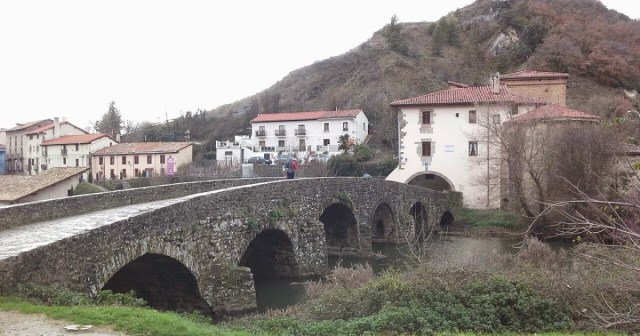
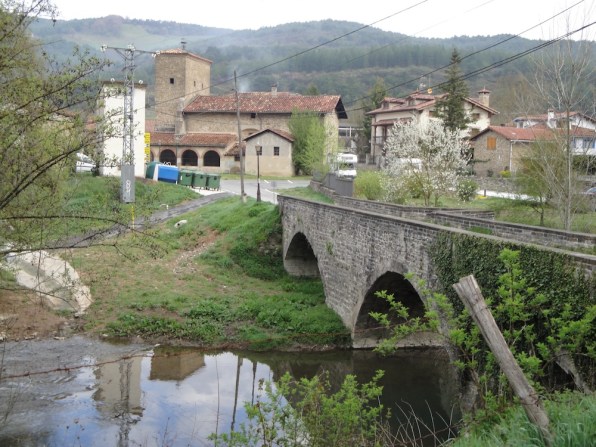
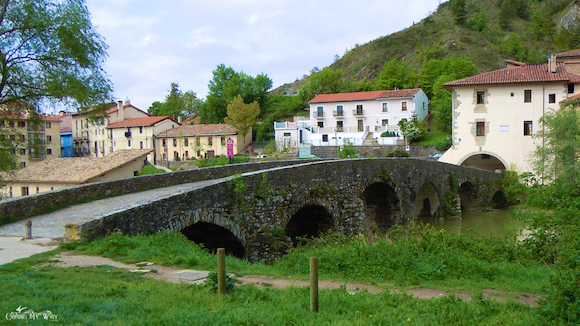
So step by step, village by village, through beautiful countryside, I slowly made my way for the next four hours, until I finally arrived at the bridge over the Río Ulzama, and crossed over into Villava.
The bridge over the Río Ulzama, leading into Villava
I stopped at the first decent accommodation that I could find. It turned out to be a very comfortable modern hotel, and remarkably quite inexpensive. After a shower and a couple of cold beers, I felt much better, although sitting proved to be rather uncomfortable.
By the time the restaurant opened at 20:00, I was ravenous, for I had eaten nothing since breakfast. And once again, the 3-course pilgrim menu was a bargain at nine euros. And to my delight, the first course was one of my favourite dishes – garbanzos con chorizo, chick peas with spicy sausage, followed by lamb cutlets and a desert.
The service was rapid, and in no time my waitress placed a huge container of garbanzos on my table, together with enough bread to feed a family of four and a bottle of red wine. I asked her if I was to help myself and she said that it was all for me.
I had several bowls of garbanzos before I remembered that that was only the first course. I struggled through the lamb and I skipped the desert. I was satiated.
While I was eating, the four friendly Guatemaltecos joined me at the next table. What delightful people they proved to be, and such excellent company. It was the first time in years that I had been able to speak Spanish socially and I was relieved to find that I had not lost the ability.
I went to bed that night feeling quite content, if sore. And I slept soundly, without once waking.
Friday, September 9, 2011
Villava to Pamplona (6km)
But next morning I could barely move. My buttock was painful and inflexible and of course, predictably, the garbanzos had worked their magic. I was reminded of the children’s rhyme:
‘Beans, beans are good for your heart
The more you eat, the more you f—t
And I had eaten an awful lot…
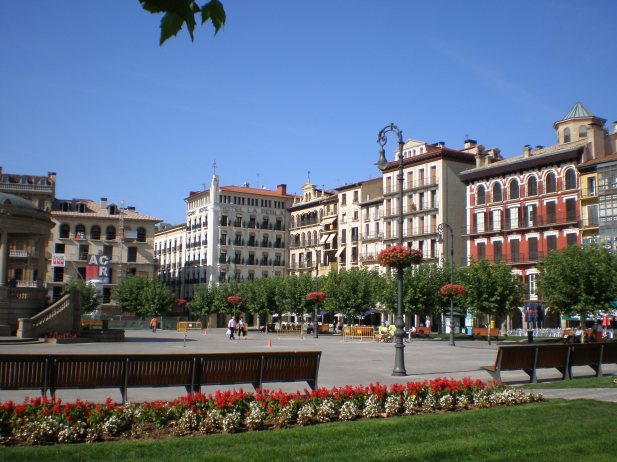
After a late breakfast, I checked out of the hotel and slowly made my way through the suburbs into Pamplona, over the Puente Magdalena, up through the castle grounds and finally to the central Plaza del Castillo. Just off the plaza I found a room in a beautiful little hotel, with a small balcony that overlooked the street through which the bulls run during the Festival de Fermín.
Puente Magdelana
I reserved the room for three days, hoping that my injury would heal enough to allow me to continue. So for three days I hobbled around the plaza and in the side streets as far as the cathedral, eating tapas, drinking beer and wine, reading newspapers, chatting to waiters, and sitting in the sun. A nice life, if you can find it.
Plaza Castillo
Ernest Hemingway seems to have been well respected in Pamplona. There are several reminders in plaques, for he always stayed in one of the hotels on the Plaza, ate and drank and fought in the bars and bistros, and frequented the bullring. There is a street named after him and his statue stands outside the bullring.
After three days my injury was no better, and knowing that the next stage in the camino, after Pamplona, involved a long climb to the Alto del Perdón, followed by a steep rock-strewn descent on the other side, I decided that ‘discretion was the better part of valour’ and made arrangements to return home.
So a bus to San Sebastián, a suburban train to Irun, an SNCF to Bayonne and a couple of days later, a flight back to Sweden.
Naturally I was very disappointed to have to abandon the hike, but as I have often said after having to turn back on a climb, due to bad weather or injury, ‘the mountain will still be there for another day’.





 The Irish Rover