The Causeway Way

The Causeway Way is a long distance path of some 50 km, that starts near Portstewart, at the mouth of the river Bann, and ends at Ballycastle.  It passes through Portrush, Dunluce, Bushmills, the Giants Causeway, White Park Bay and the famous Carrick-a-Rede rope bridge.

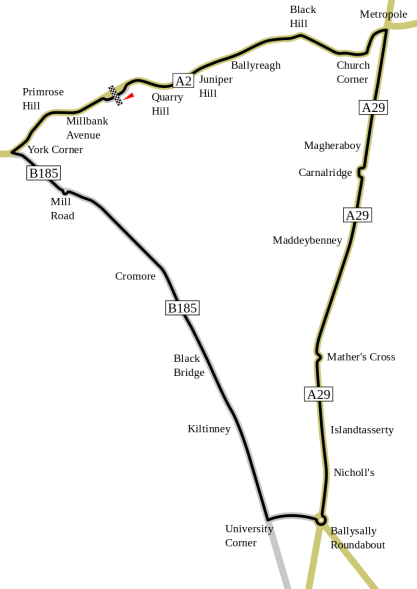
The North West 200 is a motorcycle race meeting held each May.  It is run over public roads between the towns of PortstewartColeraine and Portrush (the Triangle)  and is one of the fastest in the world, with speeds in excess of 200 mph (320 km/h).  In practice for the 2012 event Martin Jessop was clocked at 208 mph (335 km/h).  The first meeting was held in 1929.  It is the largest annual sporting event in Ireland, attracting over 150,000 visitors for the weekend.

There have been 16 deaths since the event was first held, with three in one day in 1979.
clip_image001

The path of the Causeway Way follows the northern leg of the NW200.  My father’s farm was on the road,  just south of Carnalridge.

At the edge of the headland at Portrush, between the port and the recreation grounds is a disused quarry, in which is today located a water amusement park.  Originally it is believed that this was the site of Portrush castle which, together with the church, was ransacked and destroyed by the army of General Munroe in the late 1600s.  It was later demolished to create the walls of the harbour.

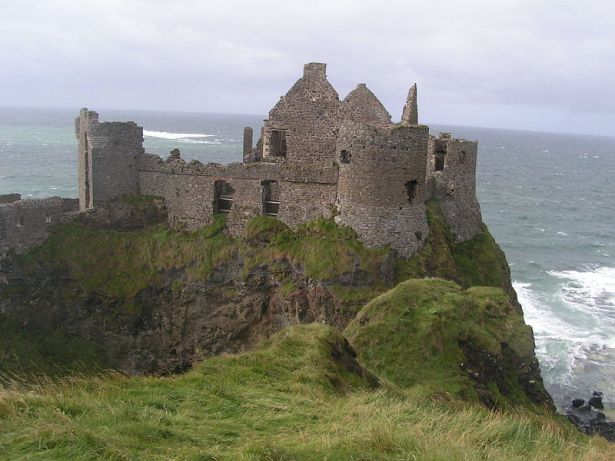
It was Richard Óg de Burgh who built the first castle at Dunluce, on the cliffs adjacent to the White Rocks, near Portrush.  The castle was first documented in 1513, as being in the hands of the McQillan family. They were Lords of Route from the late 13th century, until they were displaced by the McDonnells in the late 15th century.

In 1588 the Girona, a galleass from the Spanish Armada, was wrecked on nearby rocks in a storm. Of the 1300 men on board, only nine survived, and were eventually transferred to relative safety in Scotland. About 260 bodies were washed ashore.  In 1967-8 a team of divers located the wreck and much treasure and other valuable items were recovered and are currently held at the Ulster Museum in Belfast.

Following the Battle of the Boyne and the defeat of James I in 1690, the McDonnells were impoverished, and since that time the castle deteriorated and parts were scavenged to serve as materials for nearby buildings.
clip_image001

In 2011, major archaeological excavations found significant remains of the “lost town of Dunluce”, which was razed to the ground in the Irish uprising of 1641. Lying adjacent to Dunluce Castle, the town was built around 1608 by Randall MacDonnell, the first Earl of Antrim, and pre-dates the official Plantation of Ulster.  It may have contained the most revolutionary housing in Europe when it was built in the early 17th century, including indoor toilets which had only started to be introduced around Europe at the time, and a complex street network based on a grid system.  95% of the town is still to be discovered.

Bushmills is a village some 8 km east of Portrush, along the coastal road.  The river Bush passes through the village.  It is home of the world-famous Bushmills Whiskey.  There used to be five distilleries in the region, but only one now survives.  The distillery draws its water not from the river Bush, but from one of its tributaries, Saint Columb’s Rill.

clip_image002

King James I granted a licence to distil in the area in 1608 and Bushmills claims to be the oldest licenced in the world.  In 2005 the company was acquired by Diageo, but now is in the process of changing ownership with José Cuervo.

clip_image003

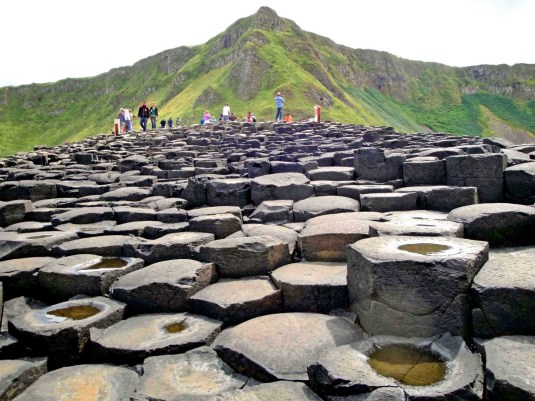
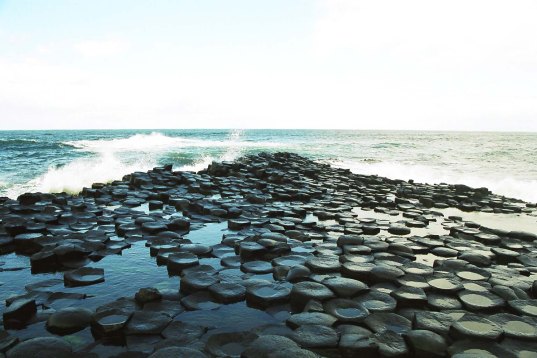
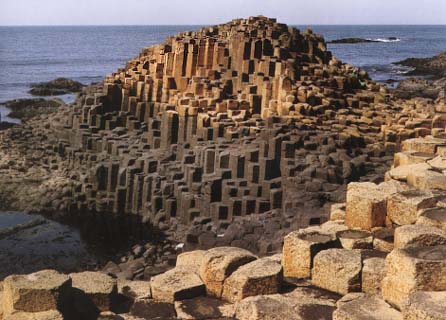
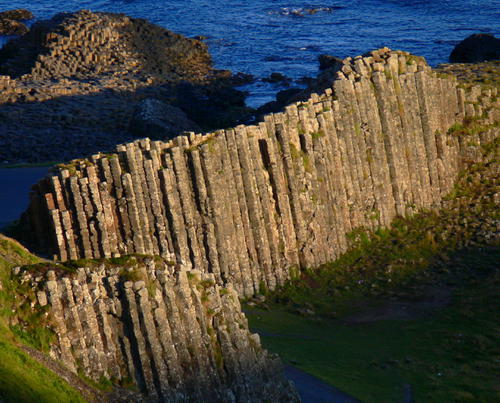
Close to Bushmills is the Giant’s Causeway, an area of basalt columns that descend into the sea.  The Scottish island of Staffa has similar rock formations.  There are approximately 40,000 columns, typically with five to seven sides and measuring up to 25m in height.
clip_image004

When we moved in to the new house at Islandflackey in the early 1950s, my mother bought a load of five-sided causeway stones, to use in her garden as borders.  I cannot imagine that today that they are quarried in the same manner.
clip_image005

The Portrush to Bushmills tramline was the first in the world to be powered by hydroelectricity, by water turbines installed in a generating plant at Wakemill Falls outside nearby Bushmills.  The service started in 1883, with an extension to the Giant’s Causeway in 1887.  The line ran from Eglinton Street, beside Portrush railway station and the distance to the Giant’s Causeway was about 15 km.

Initially there was considerable mineral traffic from quarries along the line to shipping in Portrush harbour and there was goods traffic to Bushmills.  By 1900 this business deteriorated and the line relied on tourist traffic, supplemented by military operations during WW2.clip_image007

In late 1949, operations ceased, and the line was dismantled.  The section from Bushmills to the Giant’s Causeway was reconstructed and opened at Easter 2002.

From the Giants Causeway, the path follows the cliffs until one arrives at White Park Bay, and a little further on, the Carrick-a-Rede rope bridge.

Untitled picture

There has been a rope bridge there for more than 250 years.  It was used by fisherman laying their nets to catch salmon that used to pass by there, on their way to their spawning rivers.

Untitled picture 2

The Causeway Path ends at Ballycastle, the port for access to Rathlin Island.  Ballycastle is known for its Ould Llamas Fair, held every year on the last Monday and Tuesday of August.  The fair has been held for at least 400 years and it probably started as a market at the end of the harvest season  These days there are more than 400 stalls and traffic is grid-locked for miles around.

When I was young, I recall being given a packet of dulse from the fair.  Dulse is a reddish edible seaweed, very salty, but allegedly quite nutritious.

I have a long-held ambition to walk around Ireland.  When I finally set out, the first stage will be on the Causeway Path.


My Home Town

Portrush is on the north Antrim coast of Ulster, close to the county Derry border.  It was originally a small fishing village built around the port, on a peninsula.  The town was recorded as having been granted to Richard de Burgo in 1305.  There are many spellings of the name of the town – Portros, Portross, Portrossce – all meaning Port on the headland.

Shortly after the ice age, some ten thousand years ago, the headland was an island surrounded by bog land.  Evidence of the bog can at times be found exposed on the West Strand.  Evidence of early settlements have been found where the East Strand car park and Causeway Street are now situated.

Above the Harbour next to Ramore head there used to stand the taller Crannagh Hill but it was quarried away to provide the rock to create the harbour’s pier.  Also around here used to stand a castle known as Castle an Teenie (Castle of Fire), because a light was shone from it on stormy nights to warn sailors of the rocks all around.

clip_image001
Portrush in the late 1960s

The village of Glenmanus, where I spent my first five years, is less than a mile from Portrush harbour, and just off the road to Coleraine.  Originally Glenmanus would have consisted of a small cluster of houses, surrounded by farm land.  When I was young, Glenmanus was on the edge of Portrush, but today it has been swallowed up by the expansion of the town and the old traditional Irish houses have been demolished and replaced by humdrum modern bungalows.

Portrush remained little more than a fishing village, until the railway between Belfast and Londonderry, via Coleraine, was completed in 1855, with a branch line connecting the latter to Portrush.  With easy access from the industrial cities, Portrush was eventually transformed into a fashionable seaside resort, complete with hotels, boarding houses, golf course, boating, cinemas, amusement arcades, bowling green, tennis courts etc.

Untitled picture
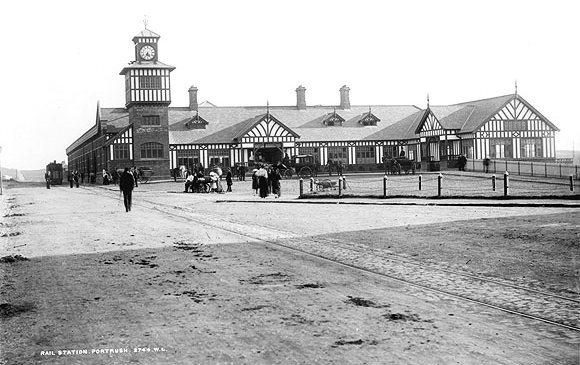
Portrush railway station in the late 1800s

In 1870 the Belfast and Northern Counties Railway purchased the already established Antrim Arms Hotel and renamed it as the Northern Counties Hotel in 1883.  With over 100 rooms overlooking the Atlantic, both at the front and back, it provided luxury accommodation for wealthy tourists visiting the Giant’s Causeway.  It even had an indoor swimming pool in an era when few, if any, existed within many miles   For many years in the late 1940s and 1950s, my father’s dance band played at night in the ballroom during the summer season, as well as the Easter and Christmas holidays, often with an additional session in the afternoon.

clip_image002
The Northern Counties hotel

An ancient abbey formerly stood on the site of the hotel and its lawn. It was mentioned in a document from 1262. In 1884 portions of the walls were unearthed, with quantities of human bones.

The hotel was destroyed by arson in 1990 and the owner and two others were eventually charged with paying terrorists to burn it down, in order to claim the insurance money.  The owner was Roy Crawford, with whom I used to work at Dalzell & Campbell in Coleraine.

East Strand lies between Portrush and the White Rocks.  In calm weather the water looks inviting, but it is both very cold and dangerous, with strong currents and steeply shelving shore.  Behind the East Strand lies an extensive area of sand dunes.

clip_image003
The East Strand

About halfway along the strand there is a deep hollow in the sand dunes, between the Strand and the golf course.  Here it is believed took place the Battle of the War Hollow in 1103, in which the King of Norway, Magnus Barefoot, was killed along with many of his supporters.

clip_image004
The War Hollow

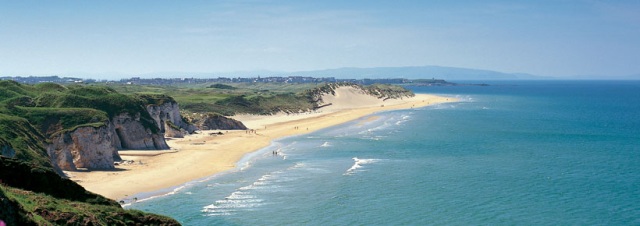
At the eastern strand are the White Rocks, an area of chalk cliffs, with caves, arches and freestanding pillars.

clip_image005
The White Rocks

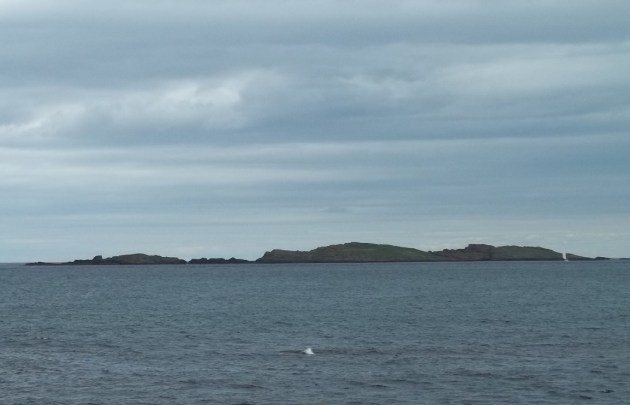
North of the East Strand, between one and four kilometres off shore, are the Skerries, a group of seventeen islets which help create a natural breakwater. There is vegetation on four of them. The islet furthest east is called Island Dubh. It is probable that it was named after Tavish Dubh, a pirate, who once frequented the Skerries, and died in his ship there, and was buried on the island.  The place of his grave is unknown. It is said that Tavish Dubh, in 1310, when Edward Bruce invaded North Antrim with the object of winning Ulster, waylaid four English ships bound with provisions for Coleraine, held by an English army, and took their provisions up the river Bann to Bruce, who was in sore straits.  Soon after, Bruce abandoned his attempt.

clip_image006
The Skerries

On the east side of the largest of these islands there is good shelter, with an anchorage of six fathoms, a place often made use of in later times by smugglers.

In my time, there was a boat that took occasional visitors around the islands, when the sea was relatively placid, but I personally never knew anybody who had ever set a foot on them.

For most of us, they were so near, yet so far away…

Benandonner’s stone

I have vivid memories of some incidences in my early childhood: falling into the stream at uncle Bill’s farm in Glenmanus; aunt Tisha making butter in a wooden churn; Maurice Elliott crashing into the bushes on his sled on Loquestown hill on a bitterly icy winter morning; my father telling me at breakfast that a fox had got into one of his hen houses during the night.

I have no memory of my mother in that era.  For part of the time she was in the sanatorium in Derry, diagnosed as having tuberculosis, and I was cared for by our next door neighbour, Louise Wilson.

LDB in stroller in Glenmanus
One of only two pictures I have of me as a baby

For my first five years, we lived in a little wooden house in Glenmanus, on the edge of Portrush, one of many basic dwellings around a field, most occupied by destitute families with no work and few prospects.  In Ireland, the years immediately after the war were not easy years.  By day, my father worked on his fledging poultry farm raising a few chickens, and by night he was pianist and leader of a Portrush dance band.

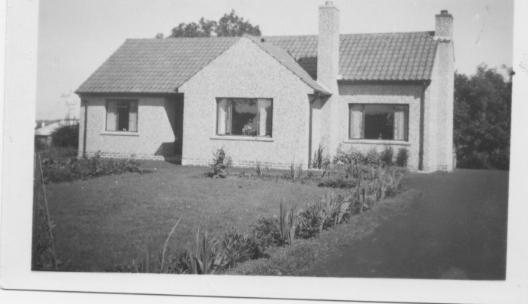
But my mother’s uncle Bill believed in my father’s farming vision and leased him some of his land at Islandflackey, at a nominal rent, a mile from the village, and helped him to obtain a mortgage to build a new house. It cost just over £1,000.

Greenacres
The original house at Islandflackey circa 1954

And so the poultry farm of ‘Greenacres’ was born.

DYZ 638
The house and farm buildings circa 1960

There was already a ruined Irish cottage on the site, close to the road.  It had been burned down at some time in the past. It was demolished and a new ‘bungalow’ built a little further back, on a freshly levelled site.

Initially there was no electricity, no running water, and only an outside toilet.  At night we used a paraffin lamp, drinking water came from a neighbouring well, washing water from the constant supply from the roof, and the toilet was a tin can in an outhouse, that my father periodically emptied on the midden.  And the sole heat was from the coal fireplace in the kitchen, and on special occasions, a fireplace in the living room.

Although one could tolerate the inconveniences, with livestock, the lack of running water was a major problem.

My father employed a water diviner to see if he could find a source.  I remember the man walking back and forth over the fields, with a forked sapling in his hands, but the only possibility he came up with was just behind the house.

So they started digging a well about 1.50 m in diameter.  When they were about 2 m deep, with no evidence of water, the attempt was abandoned.

I don’t remember how long it took, but finally we were connected to the water and electricity services.  The indoor bathroom took much longer.  I suspect that my father could not afford the expense.  But eventually a cess pool was built, pipes laid and the storeroom was converted into a bathroom.

The other ‘luxuries’ took a little longer; the first television rented when I was perhaps 11, a little second-hand car bought when I was about eighteen, and a rudimentary shower and central heating many years later, long after I had migrated.

My mother never did have a fridge, washing machine or drier.  Her life was never an easy one.

Behind the house, just above where the failed well was abandoned, there was a huge boulder, at least as a child I remember it as being very big.  It was circular and smooth all over, like a massive pebble.  I did not know where it came from, but it must have been in the vicinity when the new house was built.

I used to imagine that it had been thrown by the Scottish giant, Benandonner, missing Finn McCool, the Irish giant, at the Giant’s Causeway, during one of their fights, and ending up on our land.  The Giant’s Causeway is connected to Scotland, and as a child,  I believed that there must have been some basis to the legend. The Giant’s Causeway was not  far from our farm.

Giants-Causeway-United-Kingdom
The Giant´s Causeway, looking inland
Giants Causeway 4
And looking across the sea to Scotland

When I was still young, I clearly remember a passing visit from Sam Wilson.  It was his wife who looked me when I was very young.  According to my mother he was a remote relation, but to this day I have never discovered the link.  When he saw the stone, he asked my father to fetch his heaviest hammer and he would break it up for him.

Now Sam was a powerfully built man and the heavy hammer was but a toy in his hands.  He swung and struck the rock with all his power, but the hammer just bounced off it.  He winged and whanged and the sparks flew, but to no avail.  Not even a small chip of the rock yielded.

Sweating profusely and red in the face, Sam eventually capitulated.

Not so long later, when I had just turned 11, Sam dropped dead of coronary thrombosis at the age of 47.

And somewhere on the former ‘Greenacres’, I suspect that Benandonner’s stone still stands intact.

Old Joe and Young Joey

Old Joe Collins owned the farm opposite ours in Islandflackey.  He was known as ‘Old Joe’ to distinguish him from ‘Young Joey’, his son.  For generations in Ireland, most eldest sons were named after their fathers and likewise eldest daughters after their mothers.  I was one of the exceptions, having been named after my father’s father.

When we moved from Glenmanus to Islandflackey in about 1952, Old Joe was still working his farm, with his cows, plough horse, orchard and vegetable garden.  Small holders could never have afforded to own a tractor.

When I was young, probably no more than six or seven, I can clearly recall one day seeing Old Joe across the road, walking up and down in one of his fields sowing seed using a violin-like instrument with a bow and a hopper, which he had to regularly stop to refill from a sack that he had brought to the field in a wheelbarrow.  Not long after that that Old Joe retired from active farming, his animals gone and the farmyard silent.

An example of sewing seed

 Like most Irish farming families, the Collins had been almost self-sufficient.  They had their cows for their milk and they made their own butter.  They had chickens for their meat and eggs, and next to the southern sheltered side of the house, they had a vegetable garden and an orchard.  And potatoes were plentiful and present at almost every meal.

But Old Joe had more.  He had an area planted in gooseberry bushes and in addition he had three greenhouses in which he grew tomatoes and that were heated by means of a central boiler and pipework.  And the gooseberries and tomatoes he supplied to local greengrocers.  When he had enough to fill a couple of baskets, he would catch the bus to the town to sell them.

My father’s parents moved over from Norfolk when my brother was born, in 1953.  The rented the big house at the end of the lane that passed the Collins farm.  Old Joe was the caretaker of the house.  I never did know if he owned it or whether he had been looking after it for an absentee landlord.

The ‘Pink House’ which my grandparents rented

If ‘Young Joey’ had been interested, he would have continued to work the farm, but it was never big enough to support him too, and he got a job with the local electricity company.  Farming is a hard life and once sons escape to a relatively cushy nine-to-five job, not many want to return.

I never ever saw Joey walk anywhere.  He always left the farm in his little car, even to attend Sunday worship at Ballywillan church, which was about 200 metres away.  As the minister came out from his room and made his way to the pulpit and as one of the elders went to close the church doors, one could hear Joey’s car screeching to a halt and the bang as he slammed the door and his hurried footsteps as he rushed in.  He always just made it on time.  Nobody ever entered the church after the doors were shut.  That was simply unheard of.  And when the service ended, Joey was always the first one out.

Ballywillan Church

Joey eventually married a nurse and she moved in to the farmhouse.  I don’t remember her name for they married after I left home.  She had a severe back problem.  I don’t know the cause, but she became more and more bent over as time passed and she could not straighten up.  Her life must have been difficult.

Of course all are now long dead and the properties have been renovated, extended or demolished and replaced by something more modern.  I still remember as it was more than sixty years ago.

But I am quite sure that one thing has not changed in the neighbourhood with the passage of time and that is the unwritten rule that one does not enter Ballywillan church once the service has started.

Stuart McCloskey

One of the rising stars of Irish rugby, Stuart McCloskey plays in the centre for Ulster, and at the age of 23, has already been selected for Ireland this year, when Jared Payne was injured.

I have seen him play many times and have often wondered if he and I were related.  My mother’s mother was a McCloskey from near Coleraine.

Stuart was included in the training camp for the 2016 South African tour, but was not included in the final selection.  But I have no doubt that his turn will come.

Over the past few months I have been focussing on my Irish ancestry, with the invaluable help of a fellow amateur genealogist, Norman Calvin, from Coleraine.  Norman has discovered that I am indeed related to Stuart McCloskey.  We are 3rd cousins 1x removed.  Our common ancestor was James McCloskey (1808-1890), my 2nd great grandfather, and the line of descent is as follows:

James McCloskey (1808-1890)

->William McCloskey (1861-1927)

-> William McCloskey (1891-1957)

-> William McCloskey (c1920-)

-> Wilson Moore McCloskey

-> Stuart Matthew McCloskey (1992-)

So now I know… 🙂

Old Man Watton

Old man Watton was a very old man, at least as I remember him when I was young.  He was grizzled and grey and said very little.  But he was so strong.  In his hands the heavy hammers and pliers of his blacksmith’s trade were like a child’s toys.

When I close my eyes I can still recall the sound of the hammer striking iron, the huge black bellows that he operated with his foot, the intense heat from the coals and the fierce hissing when he dipped the red-hot metal in the water.  I went to the forge may times as a child, usually delivering eggs to old Mrs Watton, sometimes taking a piece of metal thatmy father needed reshaped for the farm.

A typical country smithy

 The forge was on the way from my parent’s farm towards Portrush, past the headmaster’s house and Carnalridge Primary School and just after the honeysuckle bush that my mother loved so much.  When I was young she used to take me there of a warm summer evening to experience that heavenly scent.  When the air was still, one could smell it from quite far away.

A honeysucle bush in full bloom

The smithy was at the end of a narrow lane.  It overlooked the town and was not far, probably no more than ten minutes walk from our farm.  On the right of the entrance was the tiny cottage of the Dallas family with their beautiful vegetable garden and opposite there was a spring, with a metal cup hanging from a hook.  That water was so pure, so cold and refreshing.  And at the end of the lane was the smithy.

But progress and modernization have marched on.  The spring had been covered over and the lane turned into an asphalt road.  The old Irish cottage of the Dallas family has been replaced by a tasteless modern bungalow and the vegetable garden is now a car park.  The smithy has disappeared and the honeysuckle bush has long gone.

These days I know more people in the graveyard than in the street.

And sometimes I feel that it would be better never to return again, just to remember it as it was.