That previous evening in Villava, it struck me that I had not seen one single pilgrim in six days of walking on the Camino de Baztan, from Bayonne. Considering how difficult it is to find solitude in this crowded world, I over-achieved.
The next day I set off to stroll the remaining six kilometres into Pamplona, and true to recent form, I got rather lost. I was standing at an intersection, probably looking bemused, when a man came up to me and, without any questions on his part, said that if I was a pilgrim looking for the path, he would show me the way.
We walked together for more than an hour. He said that he was taking food to his daughter and grandchild. He noticed my limp and I told him of my stroke ten years previously.
It turned out that he had had an identical stroke to mine, a cerebral haemorrhage. His was in August 2005, mine in November of that year.
He lost memory and speech, as did I, and his sight was affected, as was mine. At the time he had his stroke he was still quite fit, running marathons and cycling. My story is similar.
The big difference between his experience and mine was that he was operated on twice to remove the blood clot, and he subsequently made a full recovery.
While we walked, we talked about a wide range of subjects – children, love, religion, nature, food, wine and many more. It was like talking to a twin brother.
And he even has a small vegetable plot in Asturias, similar to mine in Uppsala.
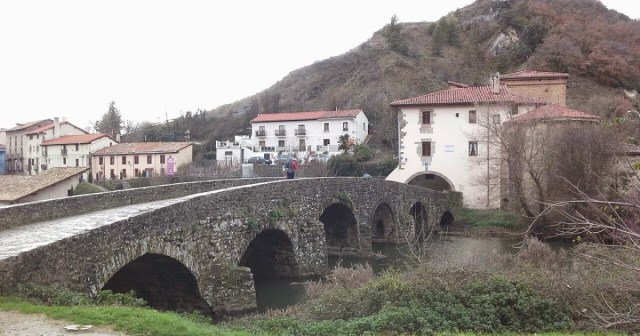
When we arrived at the Magdalena bridge, the ancient bridge over the river into historic Pamplona, he shook my hand and left me without a further word, apart from ‘buen camino’.
While I having breakfast, my hostess told me that the rest of the way to Pamplona was gently downhill, at least compared to my previous day in the mountains, and that it was about 20 km to Pamplona. So mentally I expected 15 km, as I intended to spend the night in Villava. I set out at a leisurely pace, for what I perceived to be a relatively easy walk.
Leaving Lantz with the mountains in the background
The route followed farm paths, heavily covered with smooth stones, that I found rather uncomfortable on my injured toe, ankles and knees.
I passed through a couple of tiny villages, each with a large closed-up church. At one time there must have been a much larger population, for today each village had only a handful of houses, no bar or shop and little sign of life.
There was eventually a long stretch of narrow path, high up on the hillside, alternating between forest and meadow, following the contours of the land and avoiding the busy road below. It seemed endless, but finally it descended to the river and Sorauren. There two old ladies told me that I had about six kilometres to go to Villava. My original estimate of 15 km was now looking more like 28 km.
The path was now concrete and followed the banks of the river. There was no breeze and it was hot.
But my day was made when a huge flock of sheep came along the path toward me. Without any outward sign and without looking back, the shepherd moved over into the field and the leading sheep followed him. One little sheepdog raced around like crazy, rounding up the laggards and moving the whole flock across into the field.
I always find it impressive to witness a working dog. And with all under control, the dog ignored me as he passed.
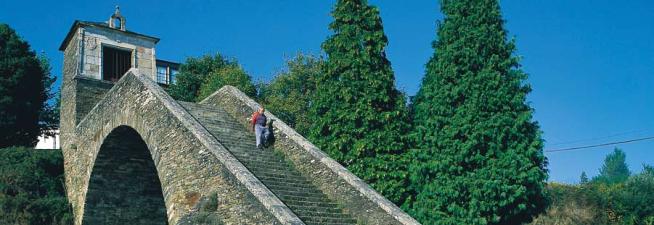
About an hour later I crossed the bridge over the Río Ulzama into La Trinidad de Arre and Villava on the outskirts of Pamplona, where the Camino Baztan joined up with the Camino Francés.
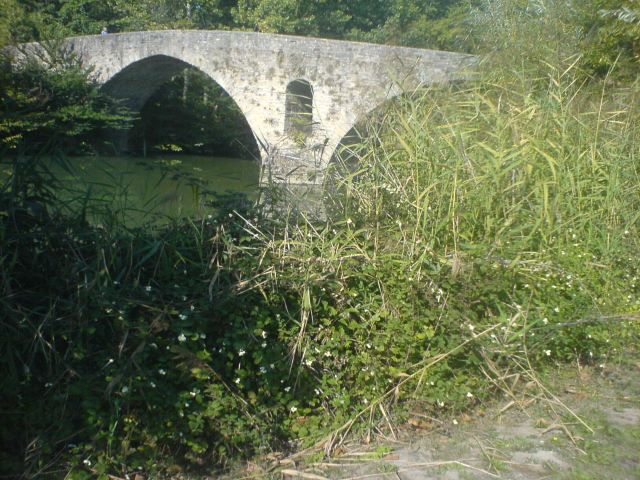
The bridge into La Trinidad de Arre and Villava (from internet)
I was now on familiar territory and mission accomplished… 🙂
When the church bells woke me that morning at 07:00, I was so comfortable in bed that I was sorely tempted to roll over and stay for another hour. But the nagging ache in my big toe reminded that all was not well. The nail had gone brown and black and had started to pull away from the flesh. It was bothering me the previous evening, and I must have caught it on the sheets when turning over during the night.
My hostess told me that there was no pharmacy between Ziga and Pamplona, some 50 km away, but she supplied me with some gauze and sticky tape, and I was able to carefully wrap the toe, hopefully avoiding further damage.
So off I set to cover the 25 km to Lantz, via a 600 m ascent over the mountain.
The road from Ziga climbed steadily, passing through the little neighbouring villages of Berroeta and Almándoz. At Venta San Blas I left the road behind and the path zig-zagged up through the forest. Everywhere the ground was covered with a thick layer of autumn leaves, and the sky was a piercing blue. It was a glorious autumn day.
In the entire day, the only people I saw were two men hunting for mushrooms. They told me that I had a long way to go to Lantz. I did not need reminding of that fact. They also said that the markings were quite faded and to watch out for false paths.
There were two high points with a significant dip between them. That part was very wet, the rocks were slimy and very slippery, and all was coated in a thick layer of leaves and mud. It seemed that the sun never reaches that area and I made very slow progress, trying to ensure that I did not once more sprain my ankle.
When I finally emerged from the marshy area and passed over the second high point into warm sunshine, the going came suddenly easier, for the ground was dry and the views were stunning.
A few minutes later I passed the newly built Ermita de Santiago.
Ermita de Santiago at 911 m
At the end of the valley below was the XII century pilgrim hospital of Santa Maria de Belate.
Ermita de Belate (photograph from internet)
At this point the normal pilgrim route through the forest was closed, due to forestry work, and a temporary route had been marked, following the busy main road for about four km, until it re-joined the historic path. The deviation added another three km to my total hike for the day.
I was footsore and quite weary when I finally reached Lantz. Once more the accommodation was excellent, the hostess extremely hospitable and helpful.
And that first beer went down without touching the sides.
When I finally took off my boots and socks, I found that my injured toe had come through the day surprisingly well.
As I set out that morning from Urdax in the rain, my host cautioned me that the path started 300 m from his door, just before the monastery, and that it was quite steep for the first part. He advised me to take it slowly and eventually it would ease, but that it would continue ascending for quite a way.
He was not exaggerating. And the smooth rounded stones of the path were extremely slippery, which made my progress even slower than normal. I had spent most of the last twelve months in Montevideo, Cape Town (Green Point) and Uppsala, none of which are vertically challenged, so my body did not quite know what had hit it.
But eventually the incline did indeed ease and the thumping of my heart reduced to a less noticeable level. I sometimes forget that carrying a relatively heavy backpack has its physical cost, and that I have been on the wrong side of 50 for a few years now.
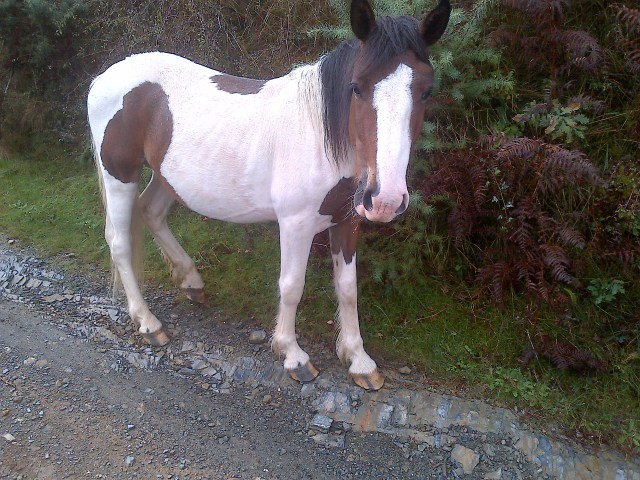
At one point in the ascent, I came around a corner to be confronted by a small herd of horses, five in all. They looked extremely healthy and fit, although very wet, and they paid little attention to me. As the path was narrow and steeply wooded on both sides, I had no alternative but to walk among them. One of them, a quite young horse, was very curious, and came up and nuzzled me.
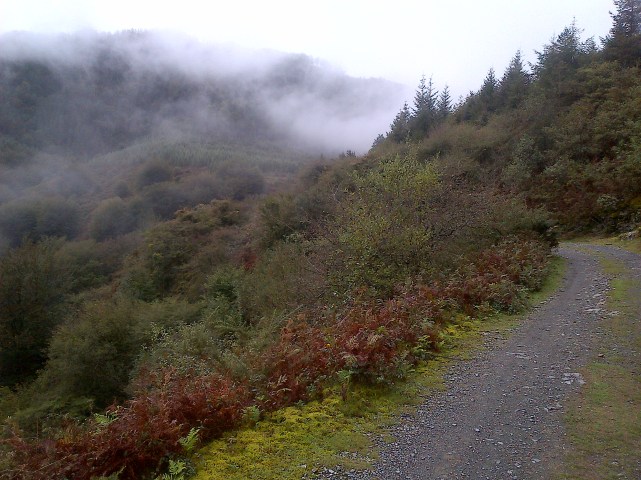
Eventually the path started to descend and much of the descent was in cloud, with a light drizzle.
The going was much easier in the descent and before I knew it, I was in the village of Amaiur or Maya in the Vasco language.
I had to go through the village and back along the main road for twenty minutes to find the Casa Rural, where I had booked a room for the night.
Amaiur to Ziga (18 km)
Sunday, 2 October, 2016
To avoid having to walk back along the main road, my host showed me a path which he said was a shortcut back to the village. Unfortunately, he omitted to check whether I had a brought a machete with me, for in parts the ‘path’ was overgrown with brambles and nettles. I eventually emerged in the middle of the village with some scratches and stings, quite convinced that my host had not used that path in recent years, if ever.
Looking back at Amaiur
For the rest of the day the going was relatively easy, at least when compared to the previous day. Lots of descending and ascending, always ending up higher than the last ascent.
‘Tomb-stone’ fencing
The route passed through Arizkun, Elizondo – the largest town in the Baztan valley, and Irurita.
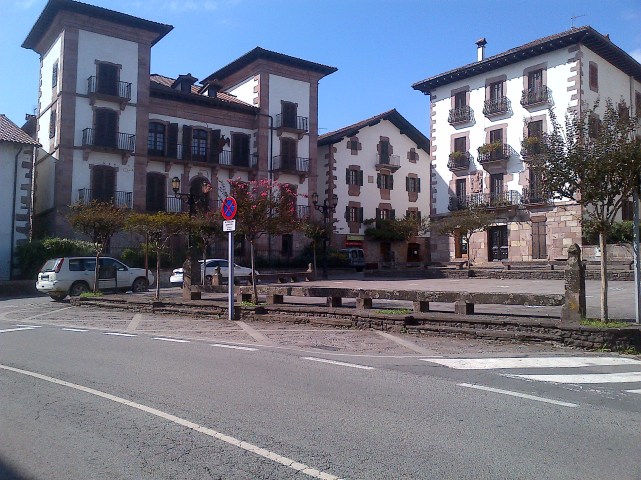
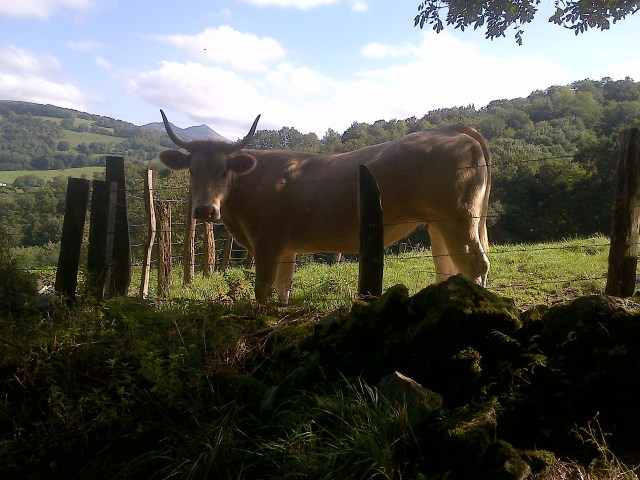
The central plaza of IruritaA curious horny cow
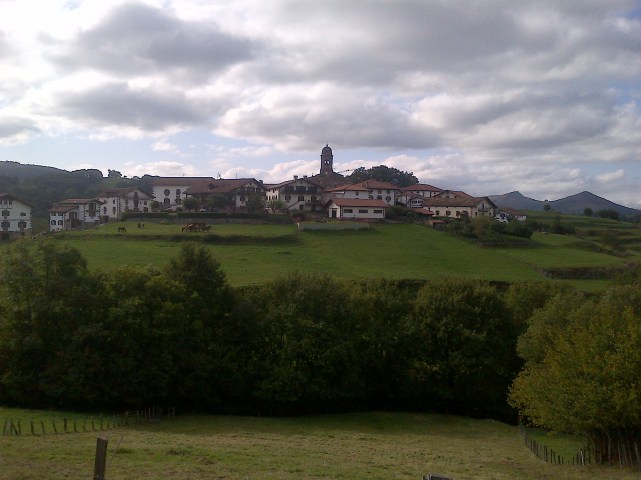
Finally, after a last ascent, the village of Ziga came into view.
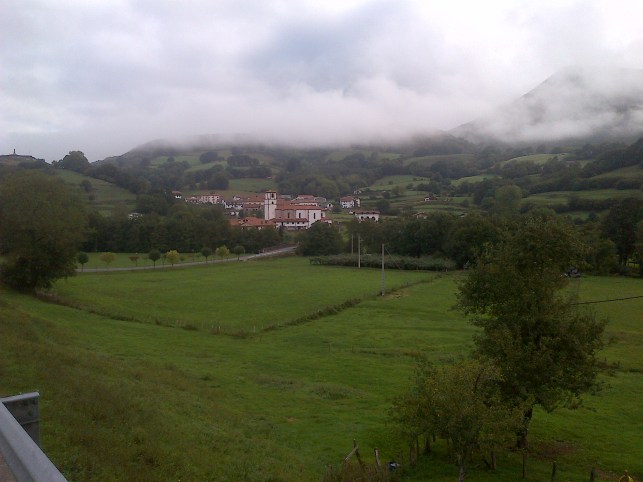
Ziga
Once again I had a room in a beautiful Casa Rural, run by a charming couple. There was no restaurant in the village, but the woman made me a baguette filled with cheese and ham and included a bottle of local wine.
Never has such simple food tasted so good.
And I slept through until dawn, and the ringing of the church bells.
After my experience of walking from Ustaritz to Cambo-les-Bains, I did not expect there to be a convenient path or a quiet country road to Espelette. So for five kilometres I walked along a very busy main road, frequently stepping well back and holding on to my hat every time a monstrous truck came hurtling by. And I lost count of how many drivers I saw talking on, or fiddling with, their phones. It was a relief to get off the race track and into Espelette.
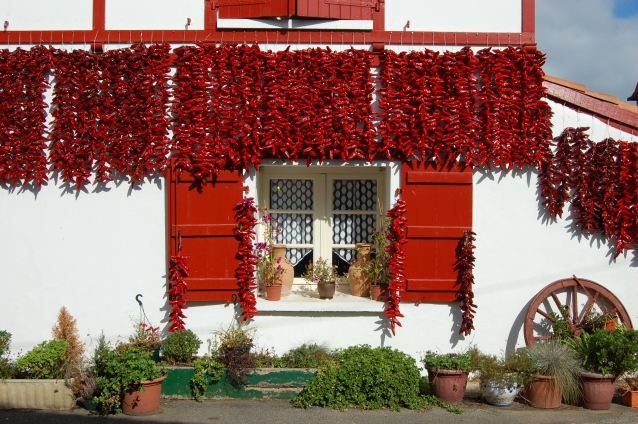
Espelette is an attractive town, famous for its production of dried and powdered red peppers. Apparently they are sold at a covered market every Wednesday. As it was Friday, I was quite happy to have missed the market, as I am not a great enthusiast of crowds.
Red pepper drying (photo from interet)
But my objective in going to Espelette was not to go shopping, it was to pick up the Camino de Santiago, which would lead me up the Baztan valley, over the Pyrenees and on to Pamplona. I spotted the typical yellow arrow marking near the church, but I was not able to find a second.
The church of Saint-Etienne in Espelette
I asked several people for directions, but without luck. Even in a busy bar nobody seemed to know anything of it. Eventually I found a second and subsequent yellow arrow marks at the edge of the town, and started off in what I believed to be the direction of the next village, Ainhoa, which was about 6 km away.
But after ninety minutes of following the yellow arrows, of toiling up and down steep rocky paths, seeing only deserted farm buildings, and not a soul in sight, I started to feel uneasy. In the distance I saw a couple of modern looking houses on the other side of a valley, one with a car parked outside. So I set off down another steep rocky path, across a stream and up the other side. By the time I got to the houses, nearly two hours had elapsed since I left Espelette.
A woman answered my knock. She informed me that she knew nothing of a path to Ainhoa or a Camino de Santiago, but she could direct me to the main road, which involved retracing much of the way I had already come, and following another country road. I was quite lost. I eventually came to the main road from Espelette, with four kilometres to go to Ainhoa. In three hours I had progressed two kilometres towards Ainhoa.
The rest of the ‘hike’ along the main roads, through Ainhoa and on to the Spanish border at Dantxarinea, was relatively uneventful, but quite tiring, as it was a hot day.
Dantxarinea was something of a surprise to me. I expected a small run-down border town, no longer with a function, since the abolition of EU borders. Instead it turned out to be a bustling modern commercial centre stretching along both sides of the main road, with five service stations and very many large stores plus bars and restaurants.
Once across the border, the route was clearly marked, and more than once I was greeted with the traditional – buen camino. It felt as if I had come home. The road gently descended, until 45 minutes later I was in Urdax.
Urdax with its monastery (photo from internet)
Why did I become so lost earlier in the day?
Until I go back and retrace my steps, I will not know. But I did receive something of a consolation in being told that evening, by my host, that it was quite a common experience among pilgrims starting in France.
And what had intended to be a walk of about 18 km, for me ended up as 28 km.
When I set out on this walk from France, I had the intention of continuing from Santiago to Fisterra on the Atlantic. But the weather changed for the worst, and after three days of waiting for the torrential rain to ease, I decided that ‘discretion was the greater part of valour’, and I caught a bus for the last 90 km to Fisterra.
The Galician name Fisterra was derived from the Latin – finis terrae, meaning ‘end of the earth’. In Spanish it is known as Finisterre and in French, Finistère. For anyone who remembers the Shipping Forecast that used to precede the one o’clock news on BBC Radio One, Finisterre was one of the shipping areas.
Fisterra is in fact not the westernmost point of continental Europe; that honour lies in Portugal, with Cabo da Roca, which is about 16.5 km further west.
All the way to Fisterra the rain continued to pour down. Luckily there was a hotel just 100 m from the bus terminal, and I had no problem in getting a room, as there was only one other guest.
For the next twenty-four hours the rain did not cease and the street beside my hotel resembled an Amazonian river in full flood. At least I was dry and comfortable. I did not venture out that day.
In late morning of the next day the sky brightened and the sun shone, albeit only between heavy showers. I decided to set off for the short one hour walk to the Cape. Half-way there the sky suddenly darkened, and the rain fell in buckets. I sheltered successfully in a grove of trees until it passed.
In the far distance one can see the lighthouse
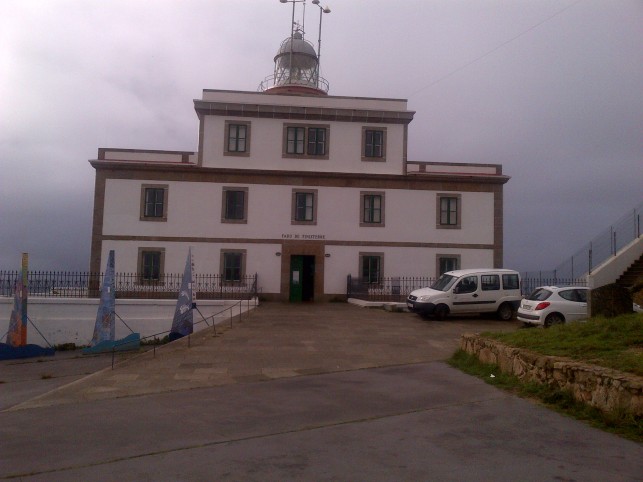
The cape with its lighthouse was bleak, with a strong wind not encouraging hanging around for very long.
The lighthouse at the Cape
Far out in the Atlantic I spotted a large black blob, that I realised was a rain storm, and it was heading directly for the cape. I found a building behind which I could shelter and watched it approach. And for the next thirty minutes it lashed down and visibility was close to zero.
It is not surprising that the area is known as ‘La Costa da Morte‘. In 1596 twenty-five boats sank in a storm off the cape, with over 1700 drowned. Few years have ever gone by without a sinking, even in modern times.
But as suddenly as the squall hit and dissipated its energy, it gradually eased and visibility and the sun slowly came back.
I wandered back down to the village and a leisurely lunch with Caldo Gallego, a chunk of bread and a bottle of wine.
That morning I ended up a little lost. I was going in the right direction, but not on the pilgrim’s path. I stopped at a bar and had some breakfast, and was directed to where I wanted to be.
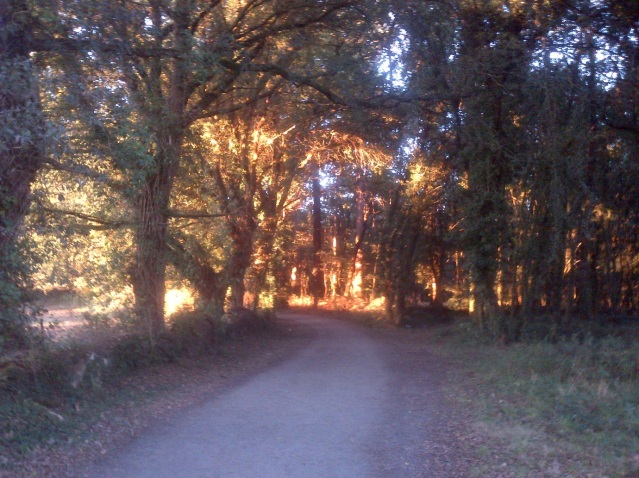
I had not gone more than 200 m along the correct path when I came across an incredibly beautiful sunrise through the trees. I shall never forget it as long as I live. It was as if heaven was lighting my way.
Lighting my way in the early morning
Much of the previous two days had been spent walking on paths through forests; the scent of clean air and wood has been almost intoxicating. I have never before smelled anything so saturated with purity.
And the path wound steeply up and down, through small villages with ancient churches, and hamlets with only a handful of houses.
I spent the night in O Pedrouzo.
O Pedrouzo to Santiago de Compostela (20km)
Saturday, 6 October, 2012
For the previous day the weather had been perfect; not too hot and certainly never cool. And yet that next morning all was changed; the sky was grey and threatening. I envisaged a depressing six hour walk, arriving in Santiago, soaked and cold, with a room yet to be found.
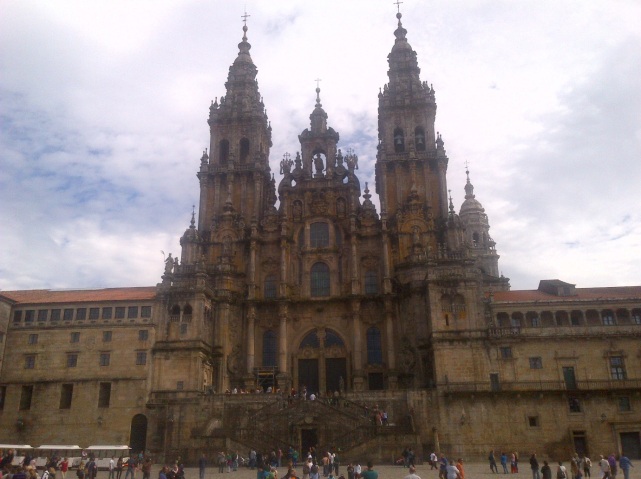
But the rain held off, and after a long walk through the hilly outskirts of the city, wondering how much further could it possibly be, there it was, down a steep and narrow street: the cathedral.
The cathedral of Santiago de Compostela
With the downpour now seeming imminent, I decided that my priority was to find shelter. With a map from a very helpful girl in a tourist office, I found a room close by, and just in time; the heavens opened to welcome me to Santiago de Compostela.
I decided to leave the sanctuary to the next day.
Santiago de Compostela
Sunday, 7 October, 1912
It felt strange that morning to not pack up and head out to spend the day walking to the next overnight stop. I spent most of the morning having a lazy breakfast, washing some clothes and generally wondering what to do next.
At lunchtime I wandered down to the cathedral. It took me quite a few minutes to get up the steep stone steps and in the main door; a mass had apparently just finished and the participants were in mass exodus. I found an empty pew to the right of the altar and sat quietly watching people and letting my mind wander.
It was not long before another mass started and the pews around me quickly filled; it seems that the masses were almost continuous throughout the day. Two nuns and a woman in normal street clothes led most of service, joined by an old priest who mumbled for what seemed like an eternity.
The ritual seemed unchanged from my previous experiences of mass; the same standing, sitting, responding, crossings. It left me feeling quite uninspired; it was about as motivating as watching a tap drip. I suspect that if Jesus and his disciples returned that day, they would not have felt inspired either.
After the mass finished and the aisles cleared, I left the church by the side door and went back around to the main square. As I turned the last corner, I heard beautiful singing; it sounded very similar to the melody of ‘Danny Boy’. It was coming from an archway by the corner of the cathedral and the acoustics were projecting the notes across the huge square.
And as I got closer, I realised that it was indeed ‘Danny Boy’, in heavily accented English, sung by two young tenors. When sung well, the song can bring tears to the eyes of a statue.
It’s the melody and lyrics that mean a lot to me, and in his time, to my father too; he played it at almost every performance he gave.
The singers were very talented, and when they hit the high note at the end of the last verse, I felt a wave of intense emotion surging through me, like an electric current.
It was the feeling that I so much wanted to experience inside the cathedral, at the end of my Camino. But the dogma and the ritual and the old mumbling monotone priest left me completely empty.
Was it just a coincidence that I walked into the square just as the two tenors started singing ‘Danny Boy’, and ending my Camino on a high note?
The objective of most pilgrims on the Camino is to reach Santiago and obtain a Compostela, a certificate stating that the holder has completed at least the last 100 km on foot or 200 km on bicycle.
The evidence for the claim is the credencia or passport, which should contain stamps from at least each place where one has spent the night. For those who declare that they completed the camino for religious or spiritual reasons, the Compostela is in Latin, and it has somewhat different wording in Spanish, for those who completed it for cultural or historic reasons.
The Compostela is not an indulgence, nor is it a pardon for sins, nor is it a pass to heaven. It is just a certificate.
So given that Sarria is the first town just beyond 100 km from Santiago, I expected to find a horde of ‘tourist pilgrims’ when I set out the next day.
I saw almost none. I suspect that I had started out in advance of the crowds.
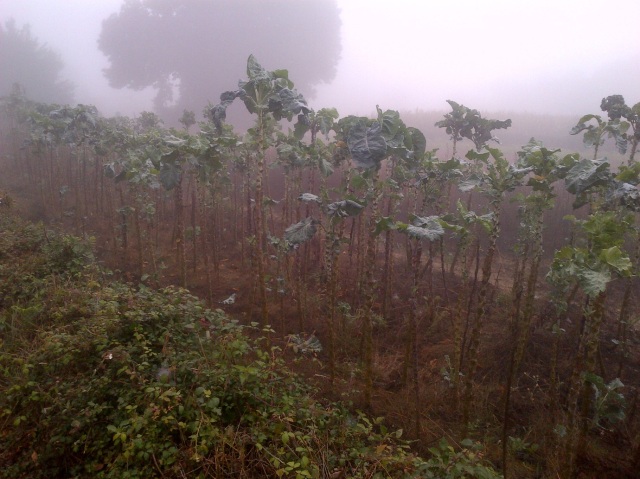
For the first time on my Camino I had emerged to thick fog. It was not an impenetrable ‘pea-souper’ of my 1960’s days in London, but thick nevertheless.
Once in the countryside, one could see barely twenty metres and one had to be aware of the markings on the walls and on rocks displaying the path. There was a blanket of silence laid over the countryside and the air was dripping with moisture. The birds were silent.
Almost above the fog
But as the path ascended, the fog gradually thinned, and suddenly one was clear, and in a most beautiful countryside. It reminded me so much of my native Ireland; emerald green, rolling hills, small fields fenced with stone walls and scattered stone farm houses and outbuildings, all looking as if they had emerged out of the land.
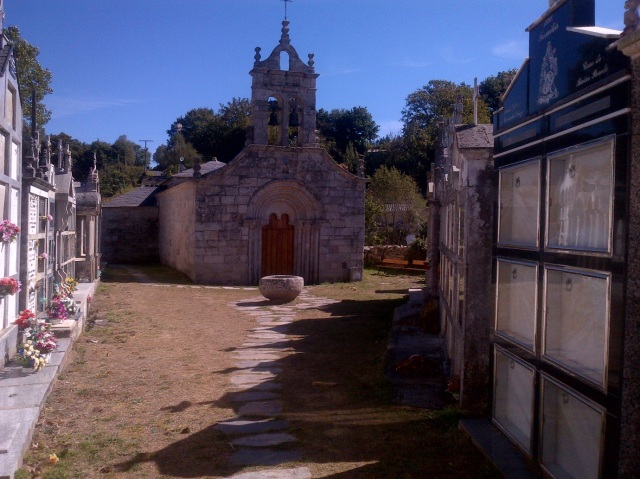
The church and walled graveyard of the Iglesia de Santa María de Ferreiros
All day I walked through similar country, until later in the afternoon the path descended to a deep and wide river valley, and across a huge bridge. On the other side, up a long series of stone steps and a steep road, lay the attractive town of Portomarín.
.
Portomarín to Palace do Rei (26km)
Tuesday, 2 October, 2012
I set out at about 08:30 and soon realised that something had changed; where I would normally see a handful of other pilgrims, there were now dozens and dozens of them, and they kept coming; they seemed to be deserting Portomarín like rich French fleeing from M. Hollande’s tax collectors.
Looking back up a deserted street in Portomarín
And because I walk rather slowly, I was being constantly passed, and just about everyone said ‘Buen camino‘, ‘Hola‘, ‘Buenos dias‘ etc. After a while responding politely every few minutes started to become irritating and I took to saying nothing and just raising my hand. Before the morning was far gone I just was plain rude and ignored them.
And so many, seeing me limp, wanted to offer me advice and administer first aid and would not accept my response of ‘No es nada’ or when quite frustrated ‘Déjeme tranquilo por favor’. So many did not seem to understand my rule of the road; that one does not offer help, unless asked. The discomfort and pain are an integral part of the penance.
Almost as irritating were those who carried on a conversation in loud booming or quack-quack voices and moved along only marginally faster than I was able to. I could not escape their inane chatter; what a load of utter crap seems to constitute the conservation of so many people.
And to top off my irritation along came a big black guy with a huge device on his shoulder, playing rap music at discotheque decibels. It was all becoming too much for me and I was being quite unpleasant.
But by then I had realised where all those people had come from; they were the ‘Tourist Pilgrims’ who walk the last 100km to get their Compostela, whatever that may mean to them. They start at Sarria, most on Saturday or Sunday and take five days to get to Santiago and then back to work the following Monday. I had unwittingly caught up with the hordes.
I suspected that my last few days to Santiago would be less aggravated if I slowed down and let them get well ahead, for I was rich in time.
Of course I realized that I was being rather arrogant and was feeling superior to the ‘virgin pilgrims’. My reaction was similar to that which I have when on a train and stuck close to someone talking on a telephone in a loud voice and making call after call.
It seemed that here was not likely to be much peace and solitude during the last kilometers to Santiago.
But it occurred to me that the noisy pilgrims needed to pay a little more penance, rather than just strolling along in beautiful weather, having a social fun week. What was required was a thorough drenching for a few hours with strong cold winds; that would soon quieten them down.
And behold, my unspoken thought was soon a reality; within ten minutes the sky darkened and the rain started, gentle at first but soon more penetrating. The raucous laughter and inane conversations ceased and the heads dropped.
And when I went to bed that night it was still raining heavily.
Welcome to a pilgrimage.
Palace do Rei to Melide (15km)
Wednesday, 3 October, 2012
When I left Palacio do Rei, it was not yet light. It was still raining steadily and the air was quite cold. I reasoned that the tourist pilgrims would not leave before they had finished their breakfast, and in northern Spain there are not many bars or restaurants that open much before 08:00. So I had at least two hours’ head start and I only intended to walk half the distance to Arzúa.
Once up and over the ridge, the rain stopped, and shortly after the sun appeared. The undulating walk to Melide was pleasant and I did not stop, nor did I see many people. My plan of avoiding crowds had worked well.
In front of a house, a store for drying maize
I arrived in Melide around lunchtime and a very helpful local directed me to a comfortable hotel within sight of the pilgrim path. Later I watched the hordes struggling up the hill, with another 15 km to go.
I had a good dinner, watched Real Madrid thrash Ajax, and slept like a log.
Melide to Arzúa (15km)
Thursday, 4 October, 2012
That morning I left the hotel feeling so completely relaxed, and I had a perfect five-hour walk through priceless country. I even had two stops for coffee and croissant. I saw nobody on the path for the first three hours, and after that only a handful of pilgrims.
Not far from Arzúa I stopped for a drink of water. Just as I put down my pack there was a loud crack, and a branch came crashing down on the path, no more than five metres away from me. I pulled the branch to the side of the road and continued the rest of the way to Arzúa.
Hmm, five more steps and that would have hit me
Later in the afternoon I was in Arzúa, sitting in the sun outside a little bar, having a cold beer. On a pharmacy sign I could see that it was 20°C and the time was 18:30. The bells of the church across the road had just tolled for the half-hour.
Compared to the cold dank morning of the previous day, it felt positively idyllic.
I set off that morning in idyllic conditions; blue sky, no wind and early morning birdsong. I was very fortunate with the weather. I had been advised that there was not much accommodation between Vega de Valcarce and Triacastela at 33 km and most of the route was at over 1200 m and quite exposed to the elements.
The path ran parallel to the road and wound steadily up the valley, until there was no more valley, and then started the ascent to O Cebreiro at 1500 m. Once up on the ridge, the path climbed gradually, until O Cebreiro appeared.
It was much smaller than I had imagined, and very touristy. And being a Saturday, the tiny village was quite crowded, with the car park overflowing.
O Cebreiro has been inhabited continuously since pre-Roman times. In the 1960s, it was largely renovated, many of the buildings having fallen into disuse.
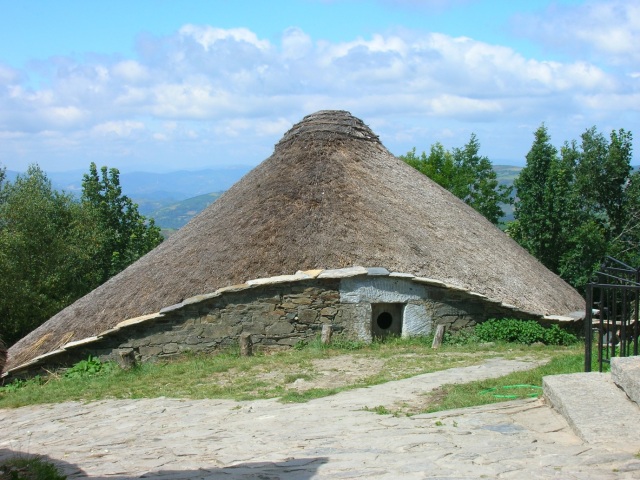
A pallaza of pre-Roman origin and Celtic design, in O Cebreiro
For the next 3-4 hours the path steeply ascended and descended many times, until I was starting to get quite tired; the constant treading on rocks and stones had left my bad foot quite numb.
But suddenly, without any prior warning, there was a hostal with a bar in the middle of nowhere, outside a tiny village, that consisted solely of a few farm buildings. And they had a vacancy; a comfortable room, with stone walls and heating. We were still at over 1200 m in late September, and it could get quite cold at night.
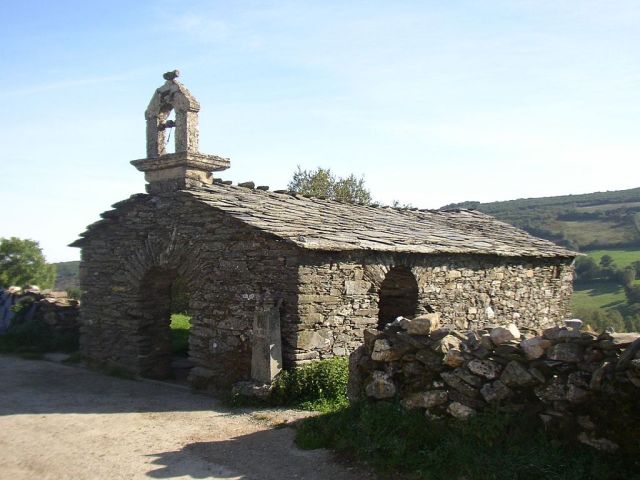
Ermita de San Pedro in Biduelo
After a hot shower and a meal, I felt much better. And I had the luxury of being able to wash my clothes and have them dried before the morning.
It does not take much to make a pilgrim’s day… 🙂
Biduelo to Sarria (26km)
Sunday, 30 September, 2012
I experienced a beautiful start to the day; fresh cold mountain air, blue sky, and no sound but birdsong and the occasional bark of a distant farm dog, or the clang of a cow bell.
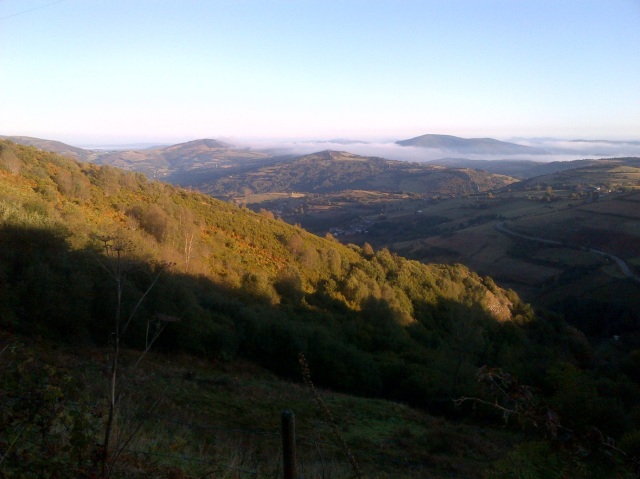
The view across the Galician hills in the early morning sun
All morning the path descended gradually, with the occasional climb out of a valley to attain a ridge, and then the slow descent re-established itself. At intervals a village appeared, mostly with only a handful of farm dwellings and occasional a small bar. It was a warm day, but I did not stop; I was comfortable at my pace and I did not want to break it
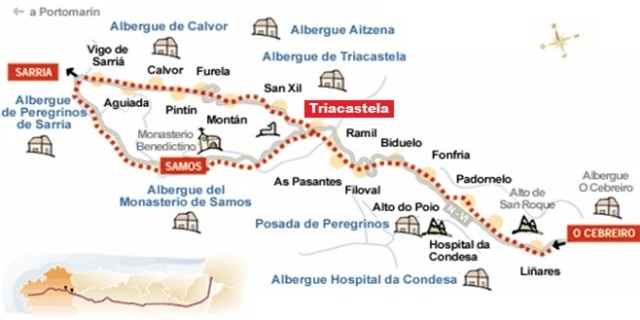
On the outskirts, leaving Triacastela, I had a choice to make. On the left was the longer flat route to Sarria, via Samos, with its famous sixth century monastery, and on the right the much shorter route, via San Xil, albeit with some steep ascents on dirt paths.
I choose the elevated route and for the rest of the day I never saw a single pilgrim. Most of them probably had stayed in Triacastela and were far ahead, or they stayed in O Cebreiro and were still behind me.
The route was beautiful, climbing through lush green woods and when it emerged on the plateau, one could see for a long way. Of course on a day of heavy rain and strong cold winds, it would not have been so pleasant.
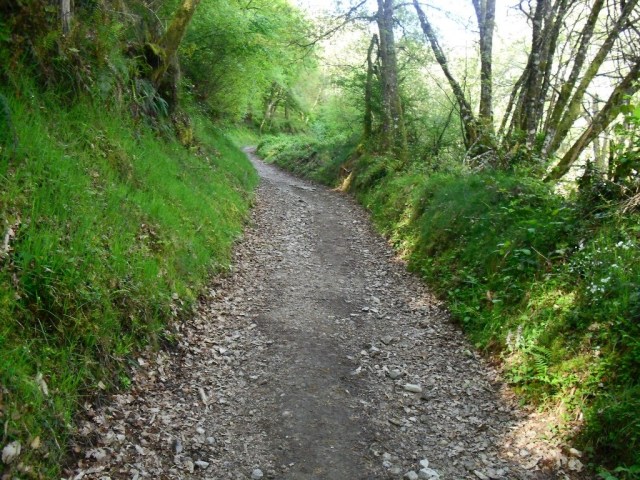
The path on a dry day
From the plateau, the route was gently downhill, until it reached the main road that led eventually into Sarria.
The Camino de Santiago is normally so well-marked with yellow arrows that it is almost impossible to get lost. But when one leaves the Camino to find accommodation, it is sometimes not so easy to find one’s way back, especially in winding streets and bad weather.
When I left the hostel that morning, I was quite disoriented.
Asking younger people or obvious immigrants the way to the Camino, is usually a waste of time; they normally never seem to know. It is the older people who are usually most helpful, and I soon found an old lady who pointed me to the Calle Camino de Santiago. I saw no yellow arrow markings, but in towns and cities they are often not so obvious. After ten minutes I checked directions with an old man, and he assured me that I going the right way to Villafranca.
But I still did not see any yellow arrows, and after half-an-hour I stopped in a bar to have a coffee and a croissant. Customers in the bar assured me that I was going in the right direction, but that I was not on the historic route, which followed a path in the countryside. They suggested that I should follow the road that I was on and that the two routes intersected in about another eight kilometres.
So I was destined to two more hours of heavy traffic through rather grotty industrial suburbs.
Not long after leaving the bar, I came across a young, very attractive pilgrim, looking quite lost and confused. She had made the same mistake like me, so I explained what we had to do to get back on the historic path.
It turned out that she was Italian, on a break from her university, and was walking from León to Santiago, like me. She spoke no English, or none that she would admit to, but she spoke some Spanish, and we chatted quite freely as we walked along.
But when she eventually pulled out a packet of cigarettes, the pretty girl attraction evaporated, and I made an excuse to stop for a while, and let her get well ahead. I never saw her again.
Once back in the countryside, the route undulated through seemingly endless vineyards. But they were vineyards unlike any I had previously come across. There were none of the tidy posts and wires that I was used to seeing. The method of cultivation seemed to let the vines grow wild as a bush, with little or no pruning. But they were heavy with huge bunches of purple grapes, so the method obviously works well.
And at the end of that day’s path, Villafranca del Bierzo, one of the most attractive little towns I had so far come across.
The Palace of the Marquisses of Villafranca
There was a settlement on the site since before the Romans arrived, but it was when the pilgrims started arriving in the Middle Ages, that it flourished. A Cluniac monastery was founded in the eleventh century and it was from the French pilgrims that settled there, that the town obtained its name – ‘French Town’.
Iglesia de Santa María, formerly the Monesterio de Cluny
And once checked into a room, I spent the rest of the afternoon sitting in the warm sun, drinking beer, and watching old men playing ‘boules‘.
Villafranca del Bierzo to Vega de Valcarce (16 km)
Friday, 28 September, 2012
The weather forecast for Spain showed heavy rain almost everywhere, except for Galicia. Given the damp reputation of Galicia, it seemed almost too good to be true, but once the early cloud dispersed, the sun did indeed shine warmly.
The road from Villafranca led gradually up a narrow valley, winding through the hills, following the course of the Rio Valcarce. Gradually the valley became narrower and narrower, until there was barely room for the river, the footpath and the road. Where there was a village, it was limited to a row of houses on each side of the road. And all one could hear were an occasional passing car, the sound of rushing water and the chatter of birds.
The road ran alongside the river and occasionally it looped under the road and back again a hundred metres later. From one of the bridges I could see large dark trout, seemingly motionless in the current, except for an occasional movement of their tail.
At the village of Trabadelo, I stopped at the bar to have a coffee and a sandwich. The walls of the bar were made of blocks of stone and on every joint and anywhere the stone projected, there were coins, from floor to ceiling. I tried to leave one too, but I could not find a single uncovered spot.
In Vega de Valcarce I had difficulty finding a room. In the end I had to settle for a very basic room in a dilapidated house beside a bar that had seen better days. When I went in, the owner and one of the staff were smoking and playing cards. The ashtray in front of them was filled with cigarette butts.
But the room did not cost me very much.
Sometimes beggars have to take what they can get… 🙂












 The Irish Rover