Bertie Peacock

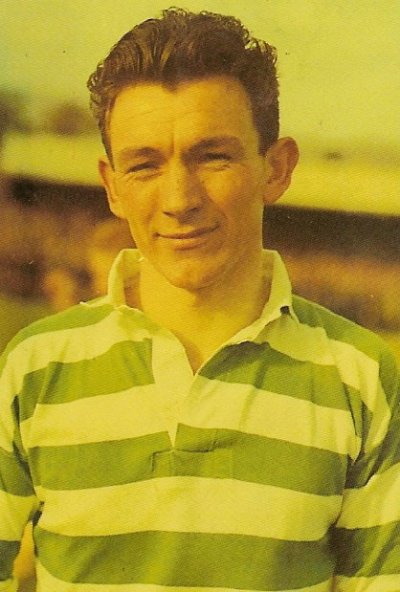
When I was a teenager, Bertie Peacock was a hero and idol in my part of Ireland.  He was born in Killowen, in Coleraine, played a few games for the local football club in 1947, before being transferred to Glentoran, in Belfast, and on to Glasgow Celtic in 1949.  There he made 450 appearances, together with 31 caps for Northern Ireland during 1952-62.  He played in the 1958 World Finals in Sweden, when Northern Ireland reached the quarter-finals, a feat not since repeated.
GW418H619
Bertie Peacock in his Glasgow Celtic days

In 1961, he returned to Coleraine as player/manager, culminating with winning the Irish Cup in 1965, at which I was present.  Soon after, I migrated to Canada and lost touch with the exploits of the team, which had several more cup and league successes.  Bertie retired in 1970, continued for a few years as manager, and eventually bought a local pub, which he named  as ‘Bertie’s Bar’.  He died in 2004.

When I recently visited the Coleraine graveyard, my brother showed me Bertie’s grave.  He told me that there was now a statue of Bertie in the Diamond in the town.

It was my great-uncle Bill and Ronnie Wilson who first took me to see a Coleraine football match.  Apart from the once-a-year North-west 200 motor cycle race and the horse racing in the fields beside Hopefield hospital, there was only local football to watch.  Television was in its infancy and, apart from the FA Cup final, no football was broadcast live.

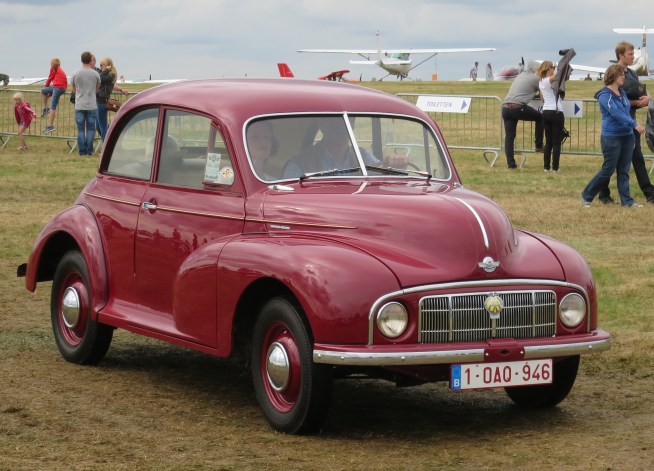
Ronnie used to work with my father.  He was a few years older than me, and Uncle Bill used to drive us the four miles to Coleraine in his little Morris Minor 1000.  Uncle Bill used to set off more than an hour before the kick-off, despite that there was never a crowd capacity of much more than 2000.  We used to race along at about 30 mph, only slightly faster that uncle Bill would have driven his horse and cart; there was always a long line of reluctant followers behind us.  He always parked in the same spot on Union Street.  And the ground was practically empty when we took the same seats on the back row at the corner of the stand.  Sometimes we had to wait outside until the man who operated the turnstile arrived.  We never missed a kick-off.
Morris_Minor_MM_(low-lights)_1950_moving
A Morris Minor 1000 – Uncle Bill’s was black

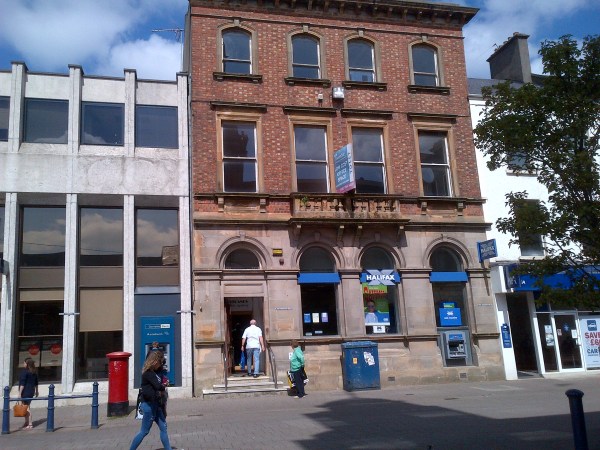
My brother dropped me off near the town centre and I strolled the rest of the way along the pedestrian mall.  The town centre that I remembered had much changed; it had been extensively rebuilt after the IRA bombings in the 1970’s.  I stopped opposite the building where I used to work and took a photo of it.  The quantity surveyors that I worked for – Dalzell & Campbell, probably no longer exists.
IMG-20170502-00149
My desk was at the window on the first floor, above the entrance


Close by, was the statue of Bertie Peacock, and reading the attached plaque was an older man.  We started to talk, as do most Irish.  I asked him what all the flags around the town were in mourning for.  He told me that they had been put up to celebrate Coleraine being in the Cup Final on the coming Saturday.  When I remarked that they all seemed to be in mourning at half-mast, he laughed and said that the men who put up the flags only had a short ladder.

IMG-20170502-00150
Johnny McCurdy reading the plaque, before I spoke to him

It turned out that the man I was talking to used to play football and he had known Bertie Peacock.  Not only that, he used to play for Coleraine.  And to cap it all, he played in the Cup Final of 1965, which was the last game I saw, before I migrated to Canada.  I was talking to Johnny McCurdy, the famed defender of the sixties and seventies, who still holds the club record for appearances at 634.  After he retired from playing, he managed the club for a time.

pic12
Johnny McCurdy as the victorious captain, with club chairman, Jack Doherty (photo from internet)

We chatted for a long time about this, that and the other, and when we went on our separate ways, I felt as if I had never been away, and that all my wandering for the past fifty-two years had been but a dream.  It was the same strong feeling of nostalgia that I always experience when I revisit my home country; of memories of happy and perhaps simpler times, tinged with a sadness that those days are gone forever, together with most of the people that I once knew.

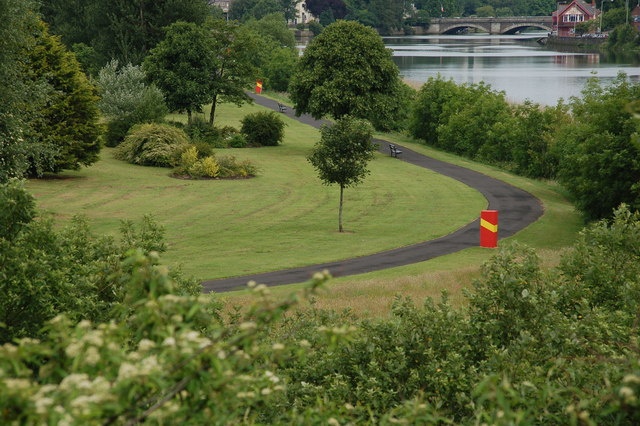
I crossed the bridge and walked slowly back to my hotel, along the beautiful riverside walk.
Ti
Part of the riverside walk (photo from internet)


George

Since my father died in 1995, I have not often been back to Ireland, in fact only in 2004, and again about eighteen months ago.  The north Antrim coast, from whence I come, is not on the way to anywhere; it is about as far as one can get from civilisation, unless one is sailing north to remote Scotland, the Faroe Islands or Iceland.  And once landed at Belfast airport, there awaits an hourly bus service to Antrim and an hourly train to Coleraine, both of which I always seem to manage to miss by no more than five minutes.

But when I step foot back on Irish soil, all the frustrations and aggravations of modern travel and living seem to evaporate, and I completely relax; I am once more 18 and on my way home again.

I met my brother the next morning at my hotel, and we headed off to the graveyard; I was anxious to visit the grave of an old friend, George.  We worked together in Coleraine in the mid-1960s.  He migrated to Toronto in 1965, together with his fiancée, Eileen.  They wanted to marry, but being of mixed religions, migration was their perceived solution.  George had a cousin in Toronto, and soon after they arrived, George and Eileen were married.  As crazy as it may seem today, that was the experience of many young Irish couples in that era.

George & Eileen

I followed soon after George and Eileen, and spent a few weeks sleeping on their living room floor.  None of us had much money and my contribution to the household was much welcomed. Eventually I moved in with five other guys, at 345 Eglinton Ave West –  Howard Abrahams, Michael Goldberg, Robin Jackson, Bill Stott and a Canadian, Gordie.  I am still in touch with Howard and Michael; Robin died a long time ago in South Africa; with the other two I have had no further contact, although I was once told that Bill did end up as the global boss of Hallmark Cards,

George worked as an estimator for a construction company – Pigott Construction, and later, he introduced me to his boss, who offered me a job, which I accepted.  Outside of work, I saw little of George socially; he was a settled suburban husband and I was a lad-about-town, playing rugby, football and partying.

Before I left for Australia in 1971, I last saw George and Eileen.  At that time, they had a little girl.  They seemed to be very happy and very much in love.  That was our last contact.

After I had a stroke in late-2005, it took some time, perhaps 2-3 years, for me to realize that my memory had not completely recovered.  I stumbled upon my own method of revitalising it – one day I may write of that difficult period of my life, and in so doing, I tried to find George.  Telephone directories, linkedin.com, facebook.com, internet etc. – there was no footprint.  I eventually dismissed him as being as a ‘Luddite’, resistant to new technology.

Until my good friend and genealogist, Norman Calvin, found him for me, or rather, found his sister.  And there I was, with my brother, looking for George’s grave.  It was no wonder that I had not been able to find him.  He came upon hard times in Toronto.  He lost his job, divorced and lost his family.  He eventually returned to Coleraine, but his situation did not improve.  On 25 November 2005 he died, a broken man.  On that day, I was fighting for my life in an intensive care ward of a hospital in Stockholm.

But where was his grave?  I had a rough idea where it was, but there were so many.  We split up, one each side of a path.  We walked up and down the rows, until I was on the point of giving up and getting more precise directions.  I distinctly remember saying out loud, ‘George, where are you’, when, in that instant, my brother shouted, ‘Over here’.

IMG-20170501-00142

It was another of the many co-incidences in my life.

Enchanted evenings

‘Greenacres’ farm

Islandflackey

c1952-1956

Some of my happiest memories date from when I was a young boy growing up on a small farm in Ireland.  Despite the fact that we did not have much, certainly little that would today be considered necessities, my childhood was a happy one.  We had no indoor toilet or bathroom, and no heating, apart from a fire in the kitchen and on special occasions, one in the living room.  During most of the year, the bedrooms were ice-cold and we took a rubber hot-water bottle to bed to fight off the chill.  We had no car and no television.  Our situation in that era was like that of most country people in Ireland.

‘Dinner’ was the main meal of the day, and we sat down to eat at one o’clock precisely, to the chimes of Big Ben and the one o’clock news.  The light meal in the evening was known as ‘tea’, and in our house, that was at 18:00 precisely, to chimes of Big Ben and the six o’clock news. Six years of military precision left their mark on my father.

By 19:30 my mother ordered me off to bed, but I could read until she came back to switch off the light.  As I got older, the lights-out time was slowly extended.

From the time when I could read, books were my passion; those who know me today would say that I have not much changed, at least in so far as books are concerned.  And when the lights went out, I fantasied about being a great explorer, a brave knight, a detective or whatever the hero of my current book did.  I was a dreamer.  I was able to borrow books from the library in Coleraine, and I read all the books on the little library shelf of my primary school.  I would have been a rare month when I did not read at least one book.

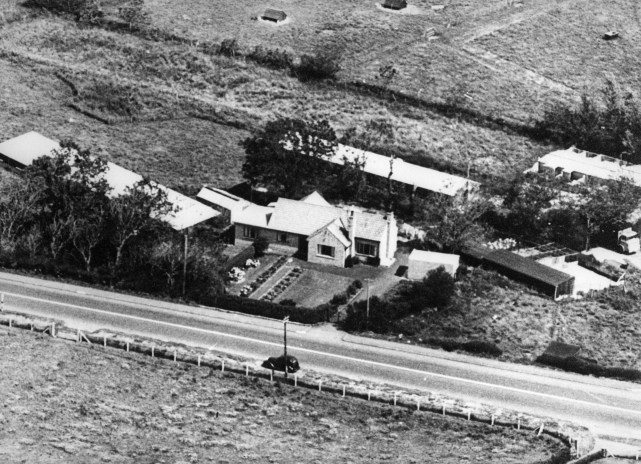
In the summer time, on a tranquil evening after ‘tea’, I used to love to go down to the piggeries and the fields behind the house.  I was alone there; the workers had gone home, my father usually to his bowling club, and my mother pottering around in her garden.  Sometimes I would climb up onto the roofs of the piggeries, armed with a rock, and try to hit one of the multitude of rats that were scampering around; the farm was always infested with rats; it was impossible to eradicate them.  It also proved impossible for me to hit them.  By the time I stood up to throw, they had disappeared like a flash.

DYZ 638
‘Greenacres farm in the mid 1950s
Farm Map
A schematic drawing of the farm near Portrush

At other times, I would go down to the stream that flowed past the old flax dam, at the end of the pig run, and race two or three empty shoe polish cans and see which would be first to the tunnel under Carnalridge Primary school, where I would retrieve them.  The flax dam was silted up and filled with reeds and some stunted willow trees grew on the banks.  In springtime, frogs laid their spawn in the pools of water, and one year I put some spawn in a large jar and watched them hatch and grow into little frogs.

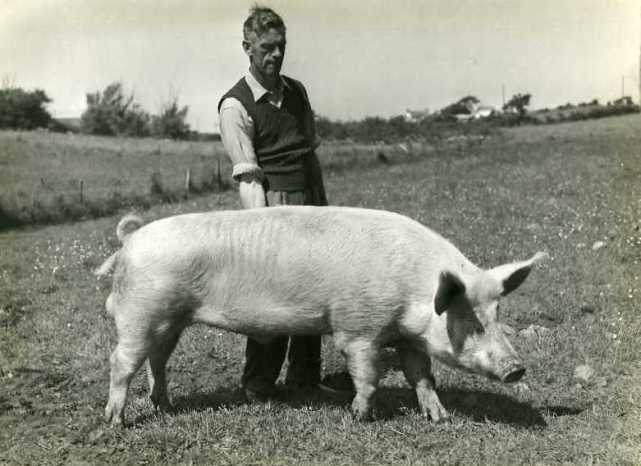
In the pig run, I once found a beautiful orchid.  I took the flower and pressed it for my collection.  My grandmother taught me how to do it, by pressing it between some heavy books that she had.  I never did again see an orchid in the pig run, or anywhere else on the farm.  Perhaps one of my father’s pigs ate it.  The pig run was always pitted, like a WWI battle field.  The pigs loved to tear up the soil looking for roots and would wallow in the hollows.

img076
My father in the pig run with the boar

On the south side of the piggeries, there was the midden heap and the area around it was quite marshy and the grass was left to grow long.  Every year a corn crake nested in that grass and every early morning and evening one could hear its ‘craeking’ call.  They were a migratory bird, but I had never seen one.  One evening I went into the long grass to find the corn crake and see what it looked like.  I must have almost stepped on it, for it burst out of the grass just in front of me and flapped away.  I felt very guilty after that, and hoped that it would come back, for I loved its call.  I never did see a cuckoo either, although at times I could hear them all around us.

corncrake300_tcm9-139763
A corncrake (picture from internet)

Today, the farm has long gone, hedgerows have been torn up, the farm buildings have been demolished; all that is left are my vivid childhood memories.

DSC00018
The overgrown ruins of part of the piggeries

As I walked out

Monday, 17 April, 2017

I have just got back from a long walk.  When I set out, the sun was shining, albeit with a strong cold north wind and some dark clouds on the horizon.  It was not long before the storm started, and by the time I returned, I looked like a snowman.
There was no mention of snow in the weather forecast.  Of course, I should not have been surprised; meteorologists change their forecasts more often than Donald Trump changes his policies or his underwear; both meteorologists and Donald Trump can usually make fortune tellers look professional.

IMG-20170417-00136
April in Uppsala

So here I am, sitting in my study in Uppsala, north of Stockholm, thawing out and watching the snowflakes flash by, and finding it hard to believe that a few days ago, I was walking in Portugal and Galicia, in shorts and shirt with glorious sunshine and blue skies.  With weather like that of Sweden and the long winter nights, one can understand why Swedes with money go south to the sun, for as long as they can afford.  Swedes with lesser resources tell one of how they love the winter.  My Swedish barber’s father once told me that he actually liked the dark.  Now how sad can that be?

With my recently completed walk still fresh in my mind, I find myself itching to plan another.  Should I try Geneva to Spain, or the more challenging Oviedo to Santiago across the Cantabrian mountains?  What about Canterbury to Rome?  Or perhaps just repeat one of the wonderful walks that I have already completed?  There are so many options.

As passionate as I now am about walking from village to village, I was not always aware of the possibilities.  It was in 1998, when I read Paolo Coelho’s novel – Le Pelerin de Compostelle, that the seed was firmly planted.  At that time, I was based in Neuchâtel, in Switzerland (hence the book was in French), but my work was demanding of my continuous involvement, and the possibility of my taking extended holidays was just not feasible at that time; the realisation would have to wait until I ceased to be a wage slave.

download
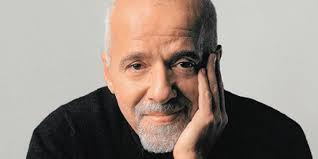
Paolo Coelho

Of course, I never envisaged that I would one day have a serious stroke – a brain haemorrhage, and after it happened in late 2005, all my focus was on surviving and recovering to the best of my ability.  The idea of long distance walking was forgotten.

Then in 2010, I read Laurie Lee’s book about walking in Spain, as a young man in the late 1930s – As I walked out one summer morning.  Reading it, I felt rejuvenated and longed to experience it myself, whatever the health risks might have been.  I tried a couple of short 4-5 day walks in Switzerland, and of course the rest is history.  To date I have survived to plan another camino.

2014+20laurielee
Laurie Lee as a young man
laurie lee 2
And much older, in front of the house in Gloustershire, England, in which he grew up

So here I sit, about to start planning my next long walk, and very much reminded of a Paolo Coelho quotation:

do-it-now-paulo-coelho-daily-quotes-sayings-pictures

Pontevedra to Santiago de Compostela

Tuesday, 4 April, 2017

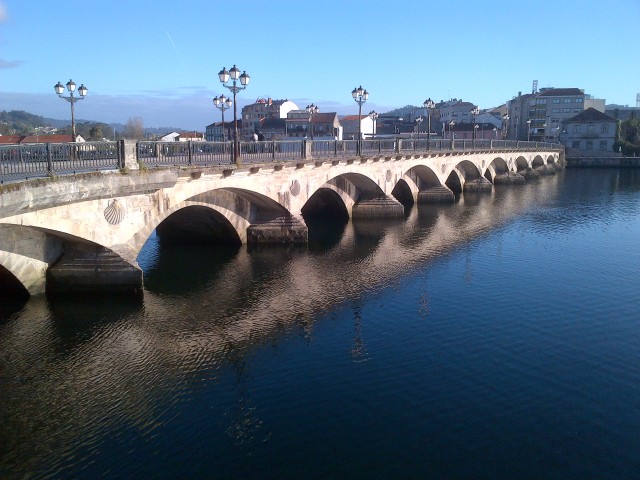
It was still early morning when I started out from Pontevedra.  The sun was barely up and there was still a distinct chill in the air.  The attendants of the early mass were filing out of the church in the main square, and one of them, an attractive girl with gorgeous eyes and long jet black hair, grabbed me and insisted on telling me the names and history of all the buildings around me.  For a fleeting second I felt as if I was once more thirty something and attractive to younger women, but of course she just wanted to make sure that a passing pilgrim left her town with a favourable impression of its architecture and history.  I could hear my mother say – ‘There’s no greater fool than an old fool’.  Still, there was a spring to my limp as I headed down to the river and across the bridge. And I felt at least forty years younger.

IMG-20170402-00118
The bridge from Pontevedra across the Río Lérez, with the shell emblems of Santiago

For the last three days, I have been on a high; the sun has shone from a cloudless sky; what little wind there has been, has been a balmy breeze; everywhere one looked, spring was rampant; old people, some quite ancient, were slowly digging, spreading manure and planting; the birds were singing their heads off; it felt so good to be alive and back in Galicia.

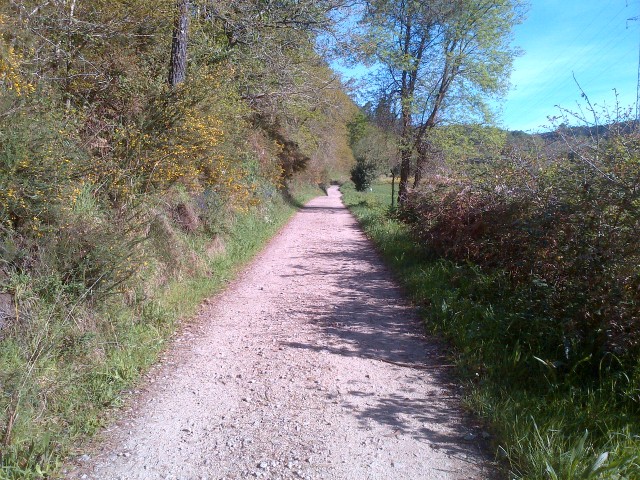
The landscape never ceased to be undulating; long stretches of uphill, a short top and then steeply down, only to start uphill again. It repeated itself quite hypnotically.  It is not a flat part of Spain.

IMG-20170403-00127
But for the three days, the surface was foot-friendly

From Pontevedra, my nights were spent in Caldas de Reis and Padrón, the latter being where the two followers of Saint James brought his body to bury it somewhere a little inland.  Legend has it that the two followers were eventually also buried with Saint James and the tombs became overgrown through neglect, and their origin forgotten, until their chance discovery by a local peasant some 800 years later.  The remains may have been moved to Santiago and the rest is the history of the camino.

Of course, the cynics say that it is all bullshit and that it was just a cunning fabrication by the local church hierarchy to gain power and induce the faithful to travel to Santiago.  We will probably never know the truth, but the romantic in me loves the legend.

So, some 70 km from Pontevedra, I struggled up the last long hill and into the city.  The walk through the suburbs and city proper seemed endless, but suddenly I was alongside a familiar park and a few more blocks bought me to my usual hotel.

I felt as if I was home once more.

And the sun warmed my shoulders and blessed my third visit to Santiago de Compostela.

If you want to read about my first time in Santiago de Compostela, it is here: Arzúa to Santiago de Compostela

Balugües to Pontevedra

Saturday, 1 April, 2017

Step by step, I have been slowly moving north across the map of northern Portugal and into Galicia.  It has been six days since I left Balugües, covering 127 km, spending nights in Ponte de Lima and Parades de Coura, before leaving Portugal and crossing into Spain, and staying in Tui, O Porriño, Arcade and tonight in the attractive city of Pontevedra.

Until the last couple of days the weather has been challenging – cold, wet and windy, with occasional downpours.  The torrential rain always waits until I am in the open countryside and far from possible shelter.

When we stayed in Montevideo, there were several sets of outdoor exercise machines, also in our current base of Green Point in Cape Town.  They always seem to be heavily used, and if broken, it would almost certainly be the result of overuse, rather than vandalism.  And now, I have walked through two small villages in Portugal, with their own set of machines, right on the camino.  I admit that I did not feel tempted to have a workout.

IMG-20170327-00080

The camino in Portugal is so well marked with the yellow flechas, that even I could not get lost.  This rather spoiled my normal excuse for talking to people in the street, but I soon found other reasons.  In Portugal language was a complication for me, as my Portuguese, so far, does not exist. I found that some Portuguese are comfortable in English, others in French or Spanish, but the majority are mono-lingual.  Before I go back to Portugal, and I surely will, I must master the basics of their language.

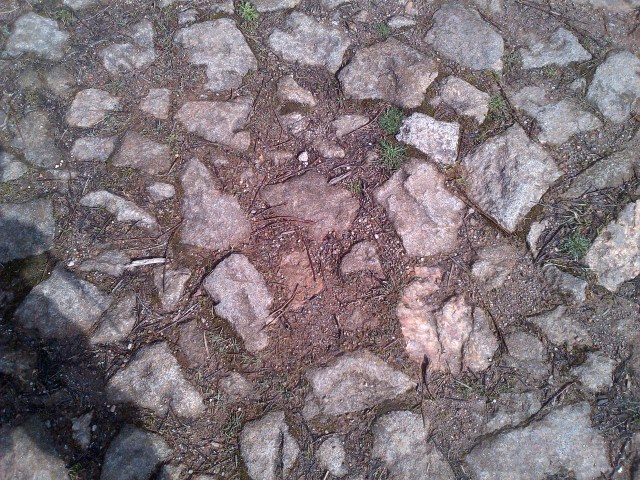
I was always aware that the Portuguese camino was mostly on paved surfaces, but I understood ‘paved’ to mean asphalt.  Big mistake!  For much of the Portuguese camino, paved means cobblestones of all sizes and shapes, whether roads and pavements through villages, roads between villages, country lanes etc.  The stones are unforgiving, and by the end of the day, my feet, knees and hips feet were quite beaten up.

IMG-20170328-00086
A typical village road
IMG-20170328-00087
A village pavement with smaller stones
IMG-20170328-00088
A typical country road

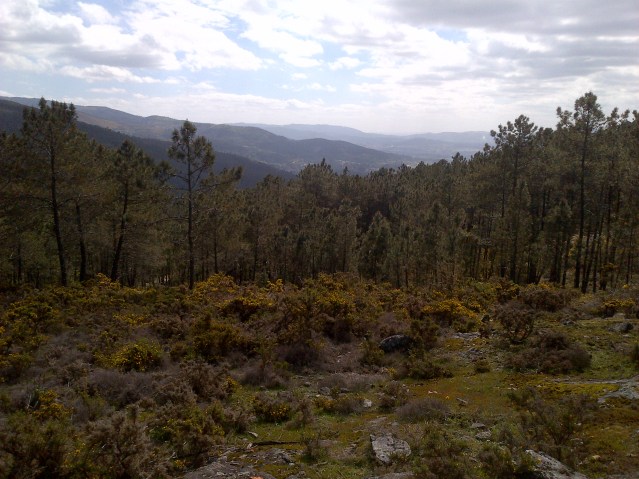
I would describe the Portuguese route as being undulating.  It is certainly not flat and in one case, between Ponte de Lima and Paredes de Coura, there is a steep climb of 400 m, largely on smooth rocks.  I had to be very careful not to sprain my ankle for the fourth time in three years.

IMG-20170328-00089
The view from the top of the climb

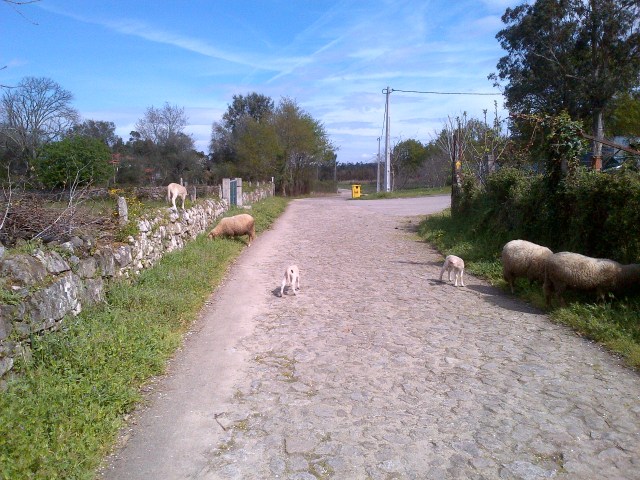
I have never before seen tame sheep wandering around a village with lambs.  One of the lambs was walking along the top of a wall and jumped down on the other side.  That set off a furious baaing by the mother, especially when its lamb could not get back onto the wall after several attempts.  I was about to set off to find the owner of the sheep, when the lamp cleared the wall in one leap.  The motherly scolding ceased and all went back to eating.

IMG-20170329-00098

Coming across a Roman mile-stone is a vivid reminder that the path had been used for more than two thousand years.  The mile-stone dated from c200 BC, probably from the reign of Trajan, and was a on a road that linked Braga with Astorga, via Lugo.

IMG-20170331-00107

The bridge from Arcade to the north was the scene of a decisive battle in the Peninsular War, when the Spanish forces defeated the French.  During the battle, one of the central arches of the bridge was destroyed to halt the French advance.

IMG-20170401-00110

The Ponte Romano de Pontesampaio across the river Vergugo at Arcade

It is now late Saturday afternoon in the beautiful city of Pontevedra, and I have just arrived.  The sun is shining, spring seems to have arrived and the plazas, streets and bars are packed, and everywhere there are children playing football.

And in three more days I hope to once more walk into Santiago de Compostela.

Porto to Balugäes

Sunday, 26 March, 2017

It is now five days since I left Porto, spending the nights in Matosinhos, Vila do Conde, Arcos, Barcelos and tonight in Balugäes.  In total I have walked about 86 km so far.

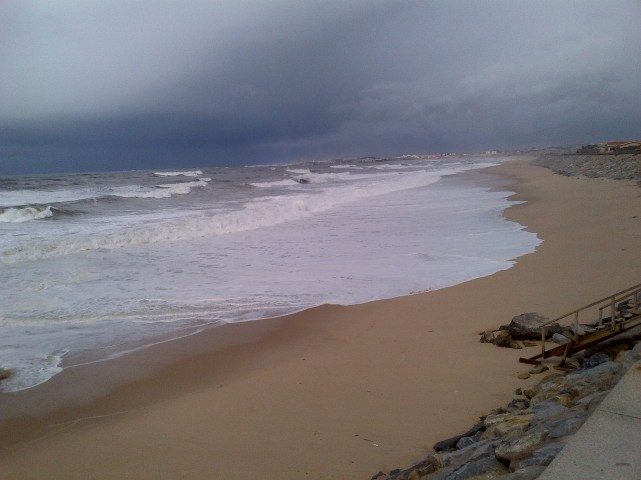
It was a blustery day when I set out last Wednesday.  Overhead the clouds were moving rapidly, but down below, along the river, all was relatively calm.  In the distance, I could see the spray of huge waves smashing against the sea wall.  I had a sinking feeling that I was going to experience a reminder of what an angry North Atlantic can be like.  And how could I ever forget; I grew up in its full blast on the north coast of Ireland.

IMG-20170322-00046
The relative calm of the river valley

As I reached the coast to turn north, the rain started.  It was like having a pressure hose aimed straight in your face.  When I first had a warning of the coming storm, I quickly donned my poncho, but it proved to be next to useless; it filled with air and threatened to lift me off, like Mary Poppins.  I scuttled along the promenade desperately looking for shelter, and finally escaped the storm into a passing coffee shop, where I spent an enjoyable time chatting with the owner.  I finally emerged, totally convinced that the Portuguese were my kind of people.  At least that lady was.

But the relative calm did not last for long, when another storm hit; one could see them coming in the distance; a huge threatening black mass, preceded by cold winds.  And for the rest of the day I was repeatedly hit, sometimes sheltered, other times totally exposed, until I finally reached my destination, feeling thoroughly beaten up.

IMG-20170323-00055
Another pending storm

The next day the sea was still thundering against the coast, but on land all was relatively calm.

IMG-20170323-00052
Not a day for swimming

I continued north along the coast, much of the time on an elevated boardwalk.  The coastal scenery was beautiful.  I was completely alone; I never saw another walker.
IMG-20170323-00051
Much of the coastal walk was on board walks such as this

I spent the night in a beautiful old hotel in Vila do Conde.

IMG-20170323-00056
Crossing the bridge into Vila do Conde

The next morning, I set off late, for it promised to be an easy day.  I headed inland along a very busy minor road, through village after village, until I reached the few houses that consisted of Arcos.

IMG-20170324-00057
The churches look quite different to those of neighbouring Spain

Finally back in the countryside at Arcos

IMG-20170324-00060

I found the walk to Barcelos to be rather challenging.  Much of it was on roads paved with cobblestones, and they are unforgiving on the feet, knees and hips.  There was no escaping them, and by the time I limped into Barcelos, I felt thoroughly beaten up.  I recall that the London Marathon has a short stretch of cobblestones in front of the Tower of London and for the race, the organizers  cover it with thick carpet to ease the impact on the runners.  There is a good reason for having that carpet.

Last night the rain started again and it rained heavily all night, with intermittent thunderstorms.  This morning it was still thumping down, so I had a late breakfast, and started out after 10:00 when the rain finally ceased and the sun started to shine.

For much of the route a cross-country cycling race was taking place and the backs of the competitors were plastered with mud.

IMG-20170326-00065

And finally one for my sons, who once claimed that only bulls could have horns.  You can just about see the tiny calf behind its mother.

IMG-20170326-00063

This has not been an easy camino so far, but sometimes I have to remind myself that a pilgrimage can turn out to be a physical and mental challenge.  It is not a short stroll in the countryside.  I have not been walking comfortably – my leg is not happy, but in my head and in my heart, I feel good.

Algo es algo, peor es nada.

Porto

Today finds me in Porto, in northern Portugal.  I arrived two days ago from Cape Town, via London Heathrow and Gatwick.  I did not want to leave the beautiful weather and wonderful people of Cape Town, but needs must; my visa would have expired the next day.  I will soon return.

In the meantime I intended to undertake another of my annual walks in the direction of Santiago de Compostela, this time from Porto.

But just prior to leaving Cape Town, I learned of the serious illness of an old lady, for whom I had a huge respect.  She was my former mother-in-law, but I have never ever thought of her as an ‘ex’.  From day one, she welcomed me into her extended family.  They were exiles from Castro’s Cuba – some prospered, some struggled.  She was an elegant woman with artistic talents.  Her paintings are witness to that.  On many occasions she even cut my hair.

A few years ago I walked part of the pilgrimage coastal  path from Bayonne across Northern Spain and diverted to Mundaka, from where her Lázaga ancestors originated.  I sent her an account of what I had seen.  Perhaps I will re-publish that account.

To say that I loved the woman would be an understatement.

17362369_10209009577172110_1057562187046987418_n
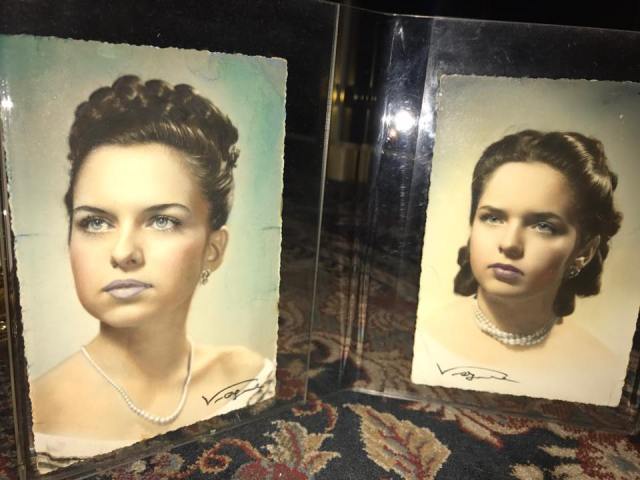
Norma Suárez Lázaga on the right, with her older sister Dinorah
17265265_10155133349744508_7051579230842233883_n
And in recent years

I did not learn of her death until I arrived here.  It greatly saddened me and I felt no enthusiasm for my planned walk.  I always have problems with my partially paralysed foot and leg after a long overnight flight, but this time I was struggling more than normal.  I was sorely tempted to abandon my plan and do whatever old farts do, but then that would not be me.
So tomorrow morning, in the forecast rain and wind, I will set off north, one step at a time.

In the meantime I have had a long walk around the old city, up and down steep hills, through a maze of narrow lanes.

IMG-20170321-00039
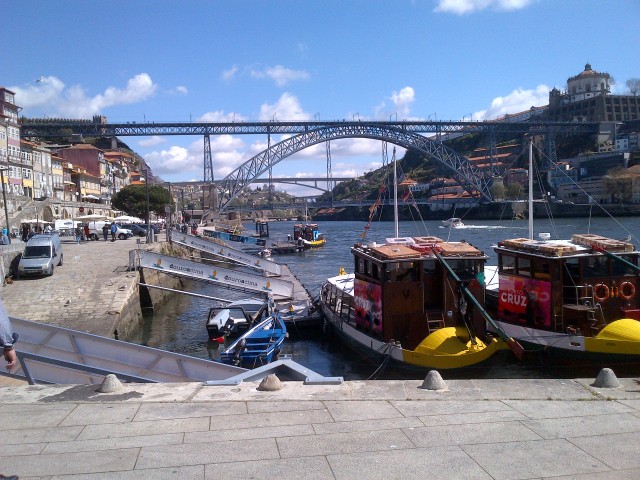
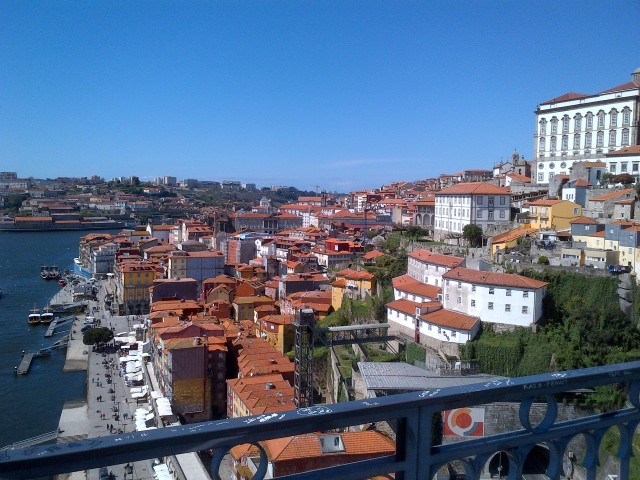
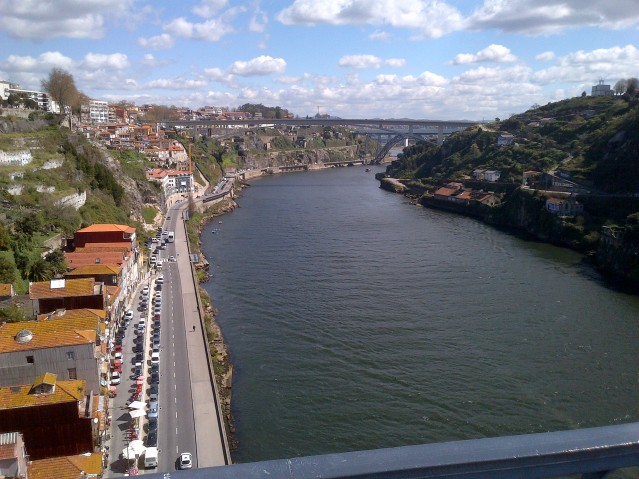
The Rio Douro looking west from the Luis I bridge
IMG-20170321-00041
And looking east


IMG-20170321-00043
Looking east from the river to the Luis I bridge

Norma Suárez Lázaga – this pilgrimage will be for you…  🙂


Madrid

Madrid, 1987

It was late evening when I checked into my hotel in Madrid.  I had flown in from London Heathrow and was staying near the Nuevos Ministerios metro station.  It was my first visit to Madrid.  I had recently been given the additional responsibility of my company’s international business, which included a minority shareholding in a small Spanish recruitment company, and I was looking forward to once more having the opportunity of operating in a Spanish environment.

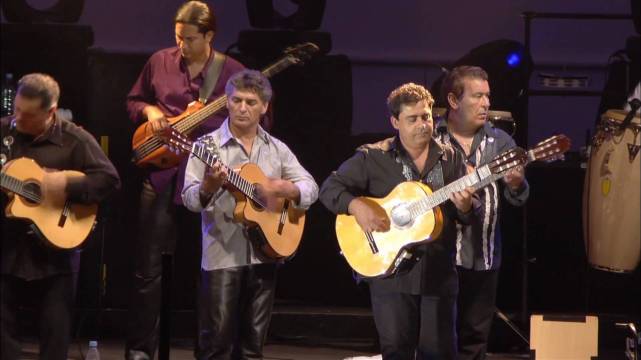
I had two meetings arranged for the next day, the first not until lunchtime, so I settled down in my hotel room, wine glass in hand, to watch some television and attempt to tune my ear to the Castellano of Madrid.  Flicking through the channels, I stumbled on a concert, that seemed to have just begun, and the music of many guitars, the raucous singing, the rhythms, the relentless beat, held my attention for the next more than an hour. It was like a mix of flamenco and salsa.  It was a group known as The Gypsy Kings..

maxresdefault

I had never heard of them before then, despite my enthusiasm for most things Latin.  The next morning I called in at a nearby Corte Inglés, to see if they had a copy of a Gypsy Kings recording, and I was not disappointed.  The salesman told me that they were the current rage in Spain, but that they were not from Spain,but from the French south-west.  There were two brothers and several other cousins and that their parents were gypsies who had fled Catalonia during the 1930s Spanish Civil War.   They sang flamenco and salsa with an Andalusian accent.  I still have my original purchase.

My lunch appointment was most interesting.  My host was a consultant, who wanted to be considered as a junior partner in international projects that we undertook from time to time, and where we might have need of Spanish market expertise.  He was not comfortable in English, but we managed to converse in Spanish, with no obvious problems.

The owner of the restaurant was a friend of my host, and when he was taking the order, he suggested that I try his speciality.  ‘Por qué no’ is a response that has got me into trouble many times, and this was to be no exception.  The dish came in a wooden bowl with a top, and when I removed the latter, the contents heaved and wriggled. They were baby eels from Bilbao. I was assured that they were well cooked and it was the cooler air that caused them to contract and move when not alive, just like the huge rattlesnake that I once killed in California, that roamed around the yard for at least half- an-hour after I had chopped it in half.  But that is another story for another day.

img_1146-750x501
The anguilas were surprisingly quite tasty

After the lunch – by then it was nearly five o’clock, I walked over to the nearby office of our recruitment consultancy, to meet with Antonio ‘Tony’ Ares de Paz, the main shareholder.  Tony proved to be a most charming man, aristocratic, and with faultless English, albeit with a heavy Spanish underlay.  During the Spanish Civil War, his father had moved his family to the relative safety of Mexico City.  I could not swear to it, but I believe that he said that after their exile, he did not see his father again.

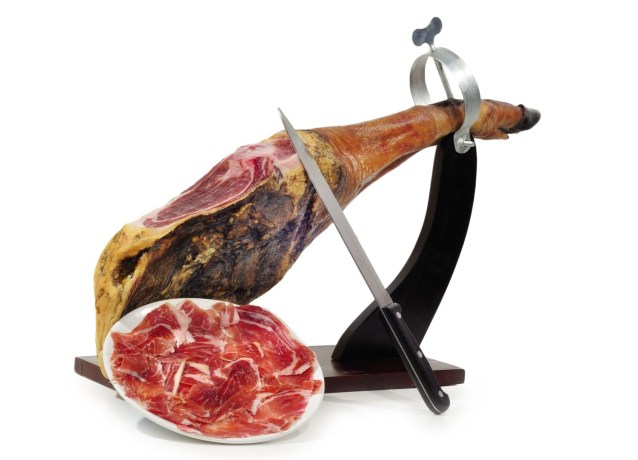
Later in the evening, Tony and his wife picked me up at my hotel and took to his club on Gran Via, or Broadway as Tony called it, and from there to an intimate restaurant near the Royal Palace, and my introduction to Pata Negra, the revered ham of the free range black pigs, mostly reared in the western Spanish provinces of Extremadura and Cáceres. and fed on acorns and olives.jamon_recien_cortado

After the meal, the owner offered to show me the tunnel in the basement, that the randy royal males used to use in order to slip out of the palace for a night of debauchery.  Of course, the tunnel was blocked with a locked door.  I never did get a straight answer as to if the then-royal-family still used the tunnel.

I felt quite tired when I finally got back to my hotel room.  Two large meals, a lot of wine, and stimulating conversation; my mind was in a whirl.

And the music of The Gypsy Kings and Volare was still throbbing in my head.

It was the end of the first of very many visits to Spain to come.

Life felt good that night.


Brian’s Farm

Brian’s Farm

Bumping along dirt roads, the rear mirror filled with dust

Crossing dehydrated stream beds, impassable in the wet

Gate after gate, opened and carefully closed

Until only the lonely cluster of welcome awaits

Embracing, kissing, laughing, relaxing

Nothing had changed, at least not that we wanted to see

Cold cans cracked, news exchanged, it felt good to be together again

Country Roads had brought us home once more

Wood fire crackling, the smell of roasting lamb

Smoke in our hair, the taste of cheap red wine

The air throbbing with the sound of Hot August Night

And we were as one, and it felt so very, very good

It was not quite dark, when alone I walked up the hill

Intoxicated with the beauty of the southern sky

The smell of the night breeze in my face

I didn’t ever want the night to end

Sitting on a rock, still warm from the summer sun

Listening to the rustle and occasional squeak in the bush

Recalling so many nights of carefree abandon

Loving one and loving all.

I wrote that piece a few years ago, as part of an assignment for an Open University course in Creative Writing.  The particular task was to recall a beautiful personal memory and to include all the five senses.  I called it ‘Brian’s Farm’ and it was loosely based on my memories of a period in my life in Australia, during the years 1971-6.

When I knew Brian, he was in his mid to late twenties.  When he was eighteen he bought a track of undeveloped bush near Guyra, about 70 km north of Armidale in northern New South Wales.  I seem to remember that he had about 3000 acres, but I could not swear to that.  His land was partly undulating, before backing up into the hills, and it included mineral rights to a river that flowed down from the hills, and contained evidence of gold and sapphires.

Now, when I tell you that Brian spent the first two years on his land living alone in a tent, while he slowly cleared a small area of bush to create some paddocks for sheep and horses, you can start to realize that he was an exceptional individual, of true pioneer spirit.  He was of medium height and not heavily built, but he oozed strength.

I once met his father, a stocky balding little Englishman of florid complexion. I think that he was an English teacher in Armidale.  I don’t remember his mother ever being mentioned.  I suspect that his father helped him with the funds to buy the land.  In those days, undeveloped bush land cost only a few dollars an acre.

Brian’s first building that he erected was a large wool shed, with a kitchen attached and containing a wood fired oven.  At the back, he added a second small building, containing a shower unit and toilet.  With the door open, the view from the toilet across the valley was stunning.

The shower unit was a marvel of engineering.  The water from the roof of the woolshed was captured in a huge tank and from there it was pumped up the hill to another similar tank.  From there it flowed with some force to a boiler above a wood fireplace.  A cold shower was available at any time, but before having a hot shower, the water had to be heated.  The shower room was large and had a ceiling shower head of enough diameter to allow six people to comfortably shower together.  Brian encouraged communal showers, ostensibly to economize on water!
When Brian completed the woolshed, he started work on a small bungalow for himself, and that was where he was living when I first knew him.  At that time, he was offering the opportunity to spend a week in his woolshed for a quite modest cost.  And of course, it not just gave Brian some additional income, but brought some social opportunity into his otherwise hermitic existence.

Visitors had the opportunity to ride his horses, to go rock climbing, and to prospect for precious stones and gold.  For those who doubted the existence of treasure in the river, Brian would show his jars of topaz and gold nuggets.  And there was of course the wildlife, with lots of red kangaroos, kookaburras, and plenty of snakes.

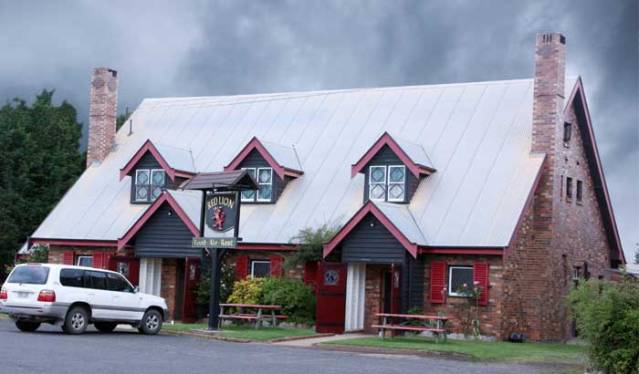
The nearest ‘civilisation’ was The Red Lion Tavern in the tiny village of Glencoe, about 25 km north.  Any visit to Brian’s farm was not complete without an evening in The Red Lion, with its roast lamb, washed down with copious glasses of Aussie red.  How I would love to be able to turn the clock back to those days.

6896-837071330
The Red Lion Tavern in Glencoe

But life moves on, and there have now been nearly 500 full moons since I left Australia on my South American travels.  I am yet to return.

I lost touch with Brian; keeping in contact was not as easy in those days of writing paper, envelopes, stamps and snail mail.  I did hear that he married and then was once more on his own.  It would have been a lonely life for a woman, especially if she was a city girl.

Occasionally I wonder what he is up to these days. Could he still scale Chimney Rock or do a forward roll over two wool bales, like we used to

Once upon a time…