The path north from Guillena to Zafra covers 125 km and passes through five villages – Castilblanco, Almadén de la Plata, El Real de la Jara, Monestario and Fuente de Cantos. The villages are between 15 km and 27km apart, a distance that a hiker, carrying a backpack, can comfortably cover in a day. Originally it would have been the distance that a heavily armed Roman soldier would have been expected to march. Apart from some farmland adjacent to the villages, the countryside was empty of habitation.
A cork plantation near Castilblanco
For the first three days, the path wound through the rugged Parque Natural de la Sierra Norte to El Real de la Jara, shortly before passing from Andalusia into Extremadura. There was a long climb to Monestario, after which the landscape transcended onto the plains that surround Mérida.
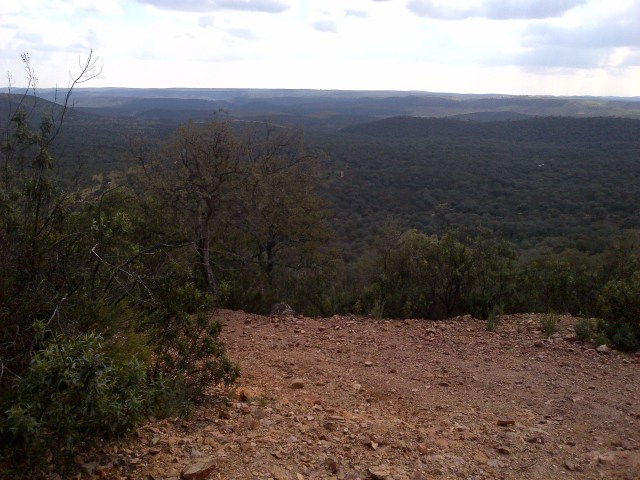
Looking back from a ridge, before descending to Almadén de la plata
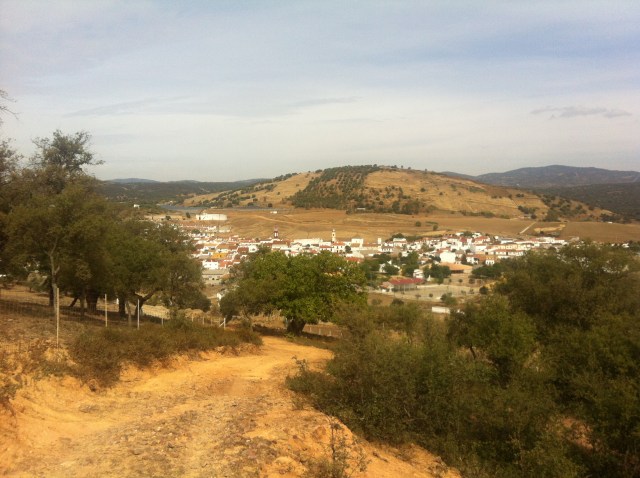
And the path down to Almadén de la Plata
Apart from Zafra, which is a large town with a rail and bus station and several hotels, the villages that we passed through were small, each with its church and a small central plaza, an hotel or rural hostel with a few rooms, an albergue with dormitory accommodation, a bar, and little else. And the houses and buildings were universally painted white, with red tiled roofs.
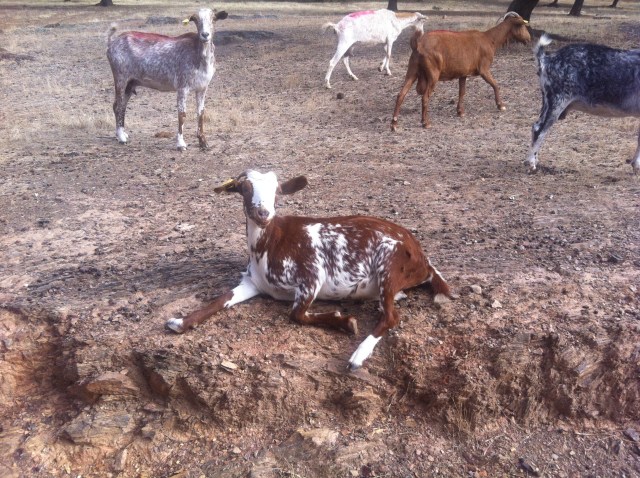
In the first three days, where the landscape was more rugged, the path led through many huge paddocks, where herds of cattle, pigs, goats, sheep and horses ranged free.
Free-ranging goats
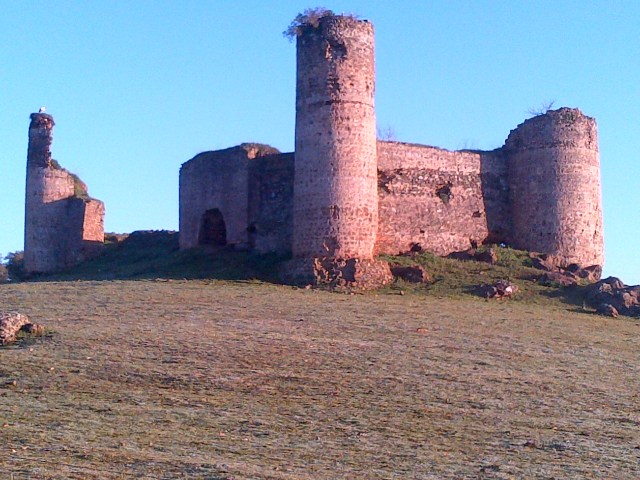
Pigs looking like hippos, with their own poolEl Castillo de las Torres (XIII century) outside El Real de la Jara
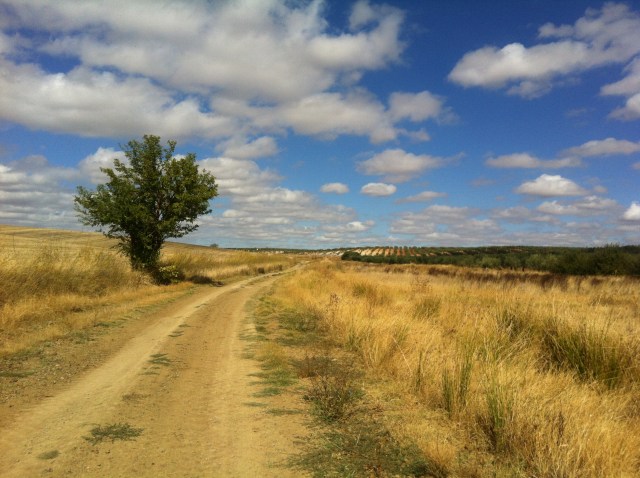
After Monestario, the land flattened, and the farming changed from mainly animals to crops, with occasional olive groves and grape vines. The path was dusty and the land parched; it seemed as if it had been since the last sustained fall of rain.
In the seven days that we walked from Sevilla to Zafra, the only other hikers that we saw were the strange couple pulling the cart; we had seen them arriving in the bar in Guillena and pulling their cart up the stairs to their room. We passed them a couple of times on the path, when they were sitting in the shade, resting or having something to eat and drink. They seemed to be quite shy, or perhaps they just wanted to be alone. I can well sympathize with the latter.
We always knew when they were ahead of us, when we spotted the tracks that the wagon tyres left in the dust. And each night we usually saw them arrive in a village, sometime after we did. On a couple of occasions we saw them enter the same hostel where we were staying, but they were quite reclusive and stayed in their room. I thought that they might have been on their honeymoon.
When we were on our way out of Zafra, we stopped at the bar of a comfortable hotel to have a coffee and a croissant, and who walked out of the restaurant and up the stairs but the strange couple with the cart.
Little did we know that we were to see them every day until Cáceres.
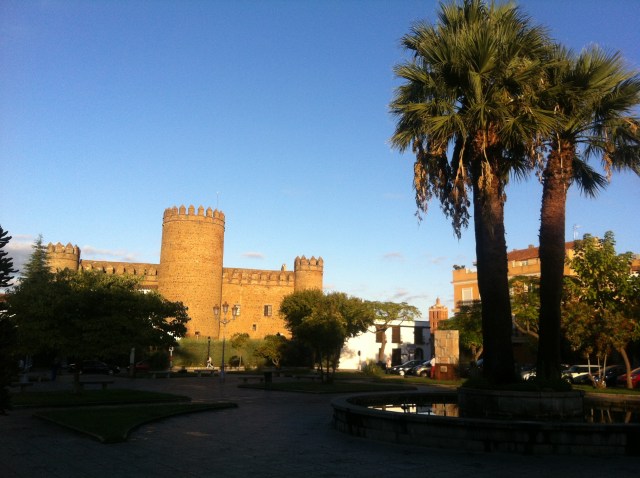
Leaving Zafra and passing the castle in the early morning sun
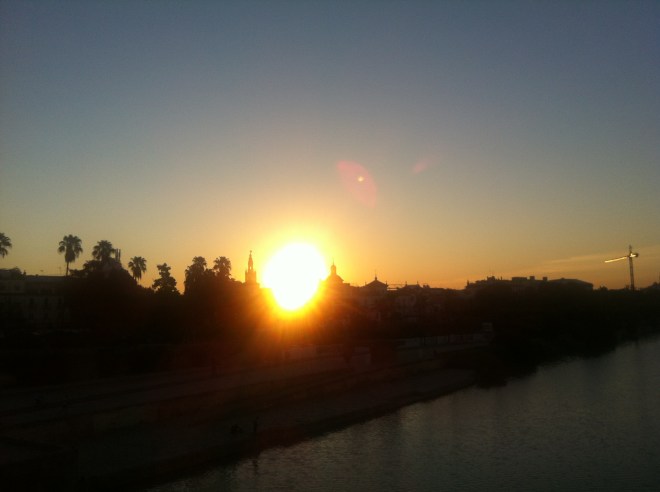
We set out early, before dawn, and took the metro to close by the cathedral. From there our camino began. We walked along the river and when we reached the Puente de Triana, the sun was rising; the buildings to the east were in silhouette and those on the west were bathed in rose light.
Looking back across the river from the Puente de TrianaAnd looking forward to the Castillo de San Jorge, with the moon clearly visible
The route took us through typical industrial suburbs and abandoned lots, rather depressing, but typical of large cities anywhere in the world.
About 10km from the centre of Sevilla, we passed through the small town of Santiponce, largely built on the former Roman city of Italica, founded in 206 BC. One can visit the amphitheatre that once held 25,000 spectators.
The amphitheatre of Italica (photo from internet)
Two of the best known of the ‘good’ Roman emperors – Trajan and Hadrian, were born in Italica. Trajan was known for his public works and his expanding Rome to its maximum territorial extent. Hadrian followed Trajan and is best known for the wall he had built across northern England to keep out the Scots. Ironically these days, many Scots would like to have the wall rebuilt to keep out the English.
When we finally reached the end of the industrial zone, at a large roundabout, we were confronted by two attractive women, bent over and baring their bottoms to passing cars and trucks. Until I greeted them with ‘Buenos días señoritas‘, they were not aware of our passing presence. Sevilla has its unique way of welcoming visitors to its city.
From close to that roundabout a long straight undulating dirt road led to Guillena. From the top of each incline one could see the town in the far distance, but after each hour of walking, we scarcely seemed to be any closer.
The long straight road to Guillena
We passed the hollow, where two years previously the road had been waist deep in flood water, and where I had slipped and got very muddy and wet. It was bone-dry, with no hint that a stream had ever existed.
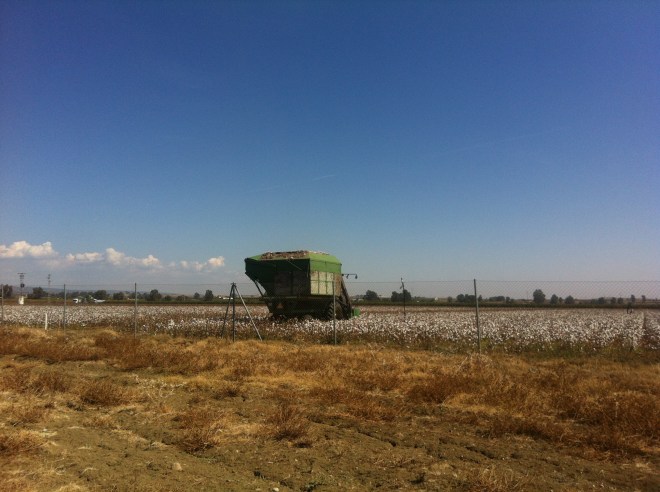
Harvesting cotton outside Guillena
Later, when we had checked into the only hostel in the village, and were having a beer in the bar downstairs, we witnessed a strange couple enter and inquire about a room. He was tall and very thin and she was short and quite plump, and neither of them spoke Spanish. They were both heavily dressed, considering that it was a warm day, and he was strapped around the waist to the handles of a cart, which was piled with bags and camping gear. It was almost comical to witness the two of them hauling the cart up the stairs to their room. I would have loved to have captured the incredulous looks on the faces of the locals in the bar.
We were not long back from our four months in Chamonix, when I started to plan our next long hike along one of the pilgrimage paths that eventually arrive in Santiago de Compostela. My mind was set on walking across France, from Geneva to Saint-Jean-Pied-de-Port, via Puy-en-Velay. I booked flights from Stockholm for 28 September and started to plan the stages of the walk.
But I had nor progressed very far in my planning, before I realised my potential mistake; we would be crossing the Massif Central, the mountainous south-central part of France, in late October, when the weather could be quite cold. And as I don’t ‘do’ cold, I switched my attention to the Vía de la Plata, that starts from a much more temperate Sevilla. And conveniently there was a low-cost morning flight from Geneva to Sevilla on 29 September.
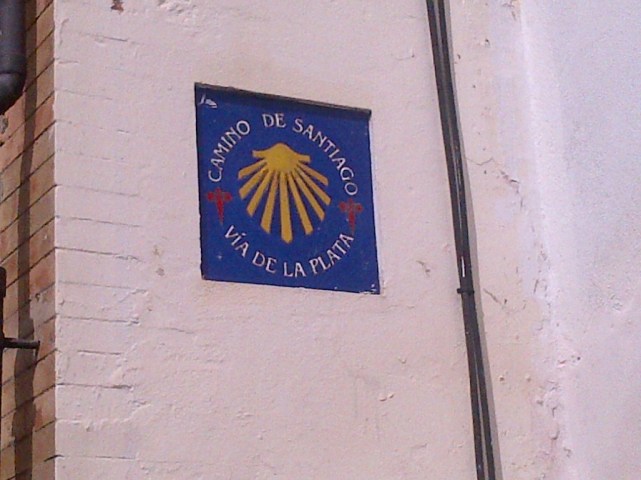
The Vía de la Plata is the longest of the pilgrimage routes in Spain, heading north from Sevilla to Zamora, then north-west to Santiago, a total distance of about 1000 km. Much of the route is on ancient Roman roads. The route was also known as the Camino Mozárabe, originally followed by the Christians of North Africa.
Vía de la Plata
I was no stranger to the route from Sevilla. In mid-February of 2015, I had set out to walk from Sevilla. The temperature was perfect for hiking, but my start was delayed for nearly a week by torrential rain. When I eventually got going, I found low-lying areas to be flooded, streams with stepping stones to be deep under water, and mountain paths washed out. Twice I slipped and fell in the water, and when I reached Villafranca de los Arroyos, the heavy rains started again. The forecast was for rain, rain and even more rain for the week ahead and extensive flooding. I decided to abandon the walk and return another time.
My second attempt was in late September of the same year, but this time it was in soaring temperatures and with little or no shade. When I walked into Mérida the temperature was 42 °c. The heatwave showed no sign of abating, so I once more stopped.
But ‘Stubborn’ is my middle name and back to Sevilla I went once more, this time with Lotta. It was her first time in Sevilla, so we spent the first day seeing some of the sights.
The central core of Sevilla is a labyrinth of narrow streets branching out from the massive cathedral. Some of the lanes are so narrow that one can stretch out ones’ arms and almost touch the walls on each side. The lanes twist and turn, and despite being close to the cathedral, one cannot see it until one exits the maze.
The cathedral is the third-largest church in the world and is the burial site of the alleged bones of Christopher Columbus. It has fifteen doors on its four facades. It is so extensive that it can only be seen in its totality from the air.
Part of one of the facades of the cathedral
Sevilla is a popular tourist destination, for it is an interesting scenic and historic city. But one of the downsides of exploring the tourist area is being the constant target of touts trying to entice one into restaurants, sell tickets to flamenco shows, rides in a carriage etc.
Coches de Caballo – Rather expensive tourist traps
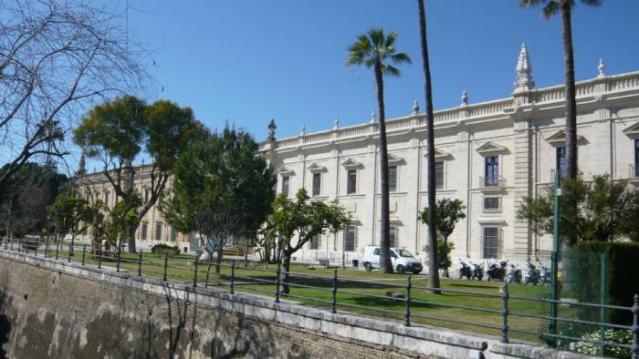
One of the largest buildings ever constructed in Europe was the Royal Tobacco Factory. It measures 250 m by 180 m and was built in the mid-eighteenth century. It was the first tobacco factory in Europe. Since the 1950s, it has housed part of the University of Seville.
The Royal Tobacco Factory (picture from internet)
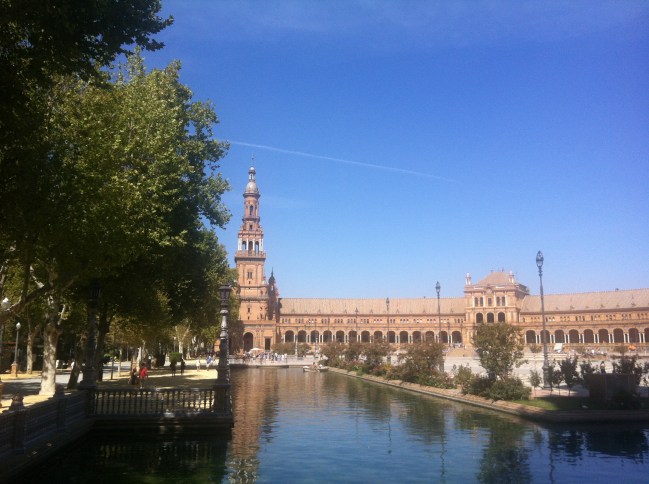
The magnificent Plaza de España was built in 1929 and was the central feature of the Ibero-American Exposition, held to strengthen the ties between Spain, Portugal and their former colonies. The building is semi-circular and features a canal crossed by several ornate bridges.
A view of one of the symetric ends of the building
And one of the pairs of bridges crossing the canal
The building has 58 pairs of benches, each one representing a province of Spain, with a typical scene from the province and a map, all surfaced in painted ceramic tiles.
And at the end of the day, a timely reminder of why we were in Sevilla…
It was in the very early 1970s that I read ‘Papillon’, the alleged memoirs of Henri Charrière, the French convict, who escaped from Devil’s Island off the coast of French Guinea, and who ended up, years later, in Caracas. I once went to his restaurant in Baruta, just outside Caracas, but by then he had died.
In his memoirs, he wrote of his experiences in escaping from the notorious prison on a raft built of coconut shells, eventually landing on the Guajira Peninsula on the coast of Colombia. There, for some time, he lived with two Indian women. Whether factual or not, the account had no small part in my desire to travel and to experience something of Central and South America.
In 1976, I travelled across the Pacific on a Greek passenger ship, from Sydney to Panamá, via Auckland and Paapete (Tahiti), and eventually on bus, country by country, through the plethora of Central American countries, to the US, eventually ending up living by the beach at Marina del Rey in Los Angeles. There I was able to rebuild my savings by working at odd jobs, mostly dirty tasks that were uninteresting to the local unemployed.
But the great consumer society held little attraction for me, and a few months later I headed back south, intent on going as far as my meagre savings would allow. In those days, local bus travel was relatively inexpensive and basic accommodation was easy to find.
When I reached Panamá, I was unaware that the roads ended there, and that there were none south through the Darien Peninsula; there was, and still is, a 160 km gap in the 48,000 km Pan-American highway, that runs from northern Alaska to the southern tip of Argentina. The only way of crossing from Panamá to Colombia was by plane, or by boat, east along the Caribbean coast, or south along the Pacific. I flew to Medellín and from there continued on by local buses, hopping from place to place through Colombia and Ecuador to Perú. Early Christmas day found me on a bus heading south from Lima.
With its colonial walls built from white volcanic stone, I found Arequipa to be a most impressive city, especially in the Convent of Santa Catalina. And in Puno and Lake Titicaca, at 3827 m, with its floating islands and colourful Indian culture, I felt as if I was in a completely different world. But sadly, my funds were running low, and as much as I wanted to continue into Bolivia, I had to turn back north.
Arequipa,with Misti in the backgroundOne of the floating islands off Puno
Unfortunately, the next morning my funds became more depleted. As I was boarding the train to Cuzco, I became involved in a scuffle between some men trying to leave the train and as others trying to board. It was eventually resolved, but fifteen minutes later, I realized that the money that I had had in my pocket was no longer there. I had been robbed. Fortunately, I had money in a dirty sock in my bag and some more in the sole of my shoes, about enough to get me back to California.
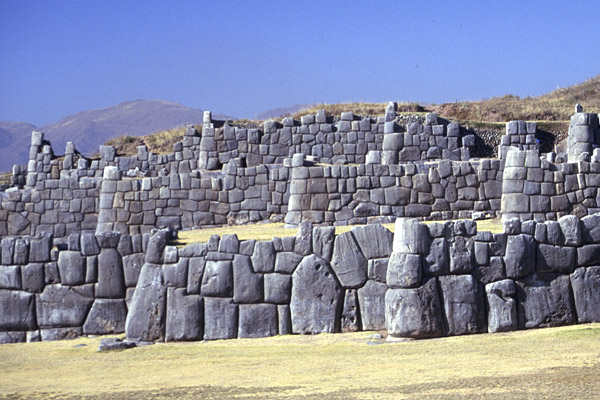
I loved Cuzco and I would have stayed there much longer if I could. The Inca history, with the Spanish culture imposed upon it, I found most fascinating. During my first morning there, I went to a bookshop to thumb through a local history book – I could not afford to buy it. I overheard an elder American tourist asking if they had any postcards of sexy women. I was all ears, for the man looked as if he would have had apoplexy if an attractive woman passed within 100 m of him. It turned out that he was referring to the ruins of Sacsahuaman, a fortress just outside Cuzco.
The next day I went there and what an impressive monument it turned out to be, with its massive walls built with huge multi-sided stones, all fitting together as in a jig-saw puzzle, so tightly fitting that a thin knife could not be inserted between them.
Few people go to Cuzco without also taking the day-trip to Machu Picchu, and I was no exception. The train was heavily fortified, with many armed soldiers. Once there, I ignored the buses that traveled the zig-zag road to the ridge, but climbed up the old Inca trail. After wandering the impressive ruins, I tried to climb up to the peak that overlooks Machu Picchu, but a heavy thunderstorm cut it short, otherwise I could have easily slipped and slipped on the greasy stones and ended up in the Urubamba River a long way below.
With regret, I left Cuzco on a ramshackle old bus, destination Lima. I was the only ‘gringo’ on the bus, but I had the consolation of a seat beside a beautiful young Indian girl. Unfortunately, she spoke little Spanish and I spoke even less. All day we seemed to be descending into a valley with a steep ascent on the other side. The bus coughed and wheezed and seemed to be on its last legs. It was dark when progress ground to a halt. For a while we all sat and waited, while the driver fiddled with the engine. Eventually, one by one, we all descended to stretch our legs and empty our bladders. The sky was clear and the stars were crystal clear, but it was very cold.
I was wearing only shorts and shirt and I was not prepared for cold. But the lovely little Indian girl offered to share her blanket with me, and I gratefully accepted. I eventually understood that she was a maid in a house near Lima and that she was returning from a short holiday with her family in Cuzco.
As the night wore on and the bus remained stationary, the occupants slept, and the driver and his assistant continued to fiddle with the engine. It was more comfortable if I put my arm around the girl, and she soon slept with my other arm around her waist. Eventually at some time in the night, the engine roared into life and we jolted and jerked our way closer to Lima. And we kissed in the dense night light.
The morning came too soon; I felt as if I could have spent the rest of my life with my arms wrapped around that little Indian girl, but it was not to be. Her destination arrived, she descended, we kissed a long time and she walked away. She never looked back. As she turned a corner, I wanted to run after her, but my courage failed me. I climbed back on board the bus.
I have often wondered if Henri Charrière ever had the same regret when he left the Indian sisters on the Colombian coast.
I was 42 when I first became a father. To say that the news ‘rocked my boat’ would have been an understatement; it was more like a tsunami hitting me. I had never had any roots, and if any had ever started to sprout, I moved to new pastures. If I ever thought about having children, I would have dismissed it as something that might happen one day, but not just yet. I was a nomad at heart. Some would say I still am.
But I eventually got used to the inevitability of fatherhood, although I could only ever envisage having a daughter. I was never ‘one of the lads’; I loved women and their company. The idea of having a smelly little snot-nosed son did not much appeal.
Eventually ‘launch day’ arrived and the only name for the baby that we had considered was Lucy Ann. If the baby turned out to be a boy, we would cross that bridge when we came to it. At least that was how I remembered it.
So, the baby had no name for the first couple of days, until someone in the hospital suggested the name Andrew, as he was born on Saint Andrew’s Day. I happily agreed and added Douglas, which was my own second name and my mother’s maiden name.
It was not until after a couple of days at home that I was left alone with Andrew, while his mother went grocery shopping. Predictably the door had barely closed, when he evacuated his little bowels, and left me in previously uncharted territory. By the time I had completed the clean-up, he and I were the best of friends and all that winter, during the weekends, he used to lie in my arms, while I watched rugby and other sports on the television.
Then there was Robert Charles, again not a girl, followed by John William, most definitely not a girl. When Philip James was born, the idea of a daughter called Lucy Ann was abandoned; four children under seven is quite a handful in any society, especially when there are no relatives to help out.
Clockwise from the left – Andrew (Barcelona), Robert (Barcelona), John (London) and Philip (Basingstoke)
So who was Lucy Ann, after whom I had wanted to name a daughter?
Lucy Ann English (1846-1934) was one of my great grandmothers. She was married to William Blackwood of Hethel, about whom I mentioned in a previous article. I have no idea what her name appealed to me, but I loved the sound of it.
She was born and raised in Mulbarton, a few kilometres south-west of Norwich. She had a younger brother, James, born in 1849, but two years later her mother, Lucy, died in Thorpe Lunatic Asylum of an internal hernia. Perhaps it was the result of a difficult birth. Lucy Ann’s father remarried in 1856, but his new wife died less than three years later.
The death certificate of Lucy English, formerly Lucy Baldry
Lucy Ann’s grandfather, James English (1788-1861), lived in the same village with his third wife, the previous two having died. When I was researching this branch of my family many years ago, I was unable to locate James in the 1841 census, but found him in both the 1851 census and that of 1861. It puzzled me, for he was nowhere to be found in the UK. I wondered if he had gone abroad for a few years.
It was not until quite recently that I discovered where he was in 1841. He was not with his wife in Mulbarton for a very good reason. He was in the County Gaol & House of Correction of Norwich Castle. At the Count Session of 30 June, 1841, he was convicted of larceny and sentenced to imprisonment. He was perhaps lucky to have been imprisoned in England, for up until a few years earlier, he might have been transported to a penal colony, such as Australia.
Lucy Ann would have known her grandfather, James. She was 15 when he died. I have no idea if she knew of his imprisonment, but I suspect that, in a small village, it would have been common knowledge.
There are many James in my ancestry, both in England and in Ireland. In his second name, my youngest son carries their memory. Many Australians are proud of having been descended from a convict. In its way, it is a form of inverted snobbery.
It was in mid-1985 that I first became interested in genealogy. My mother had recently died and I realised then how little I knew of my ancestry.
My father was of no help in getting me started on my research; he said that he knew no more than I did. He left home when he was 16 and it is quite probable that his parents never told him some of the less-than-flattering facts about some of their numerous siblings, facts than I subsequently encountered. His parents were a very Victorian couple. For many people of that era, illegitimacy, unmarried cohabitation, and divorce were scandalous and best not spoken of.
Both my parents were only-children, so I had no uncles or aunts to turn to for their possible input. I had to start from scratch.
In 1985, family research was both time-consuming and relatively expensive, compared to recent years. There were no computers, no databases, no software and no internet. Research was carried out on the original documents and charts of ancestry were drawn by hand. One wall of my study was eventually covered with a huge chart holding 2+4+8+16+32=62 ancestors for each of my parents.
As the records for Ulster were held in Belfast and I was living south-west of London, I started my research with my father’s ancestry.
He was born in Norfolk, as were both of his parents. The records for English births, marriages, deaths and census returns, dating back to 1837, were held in London, and over many months and numerous visits, the chart on my study wall began to fill up. And as far back as 1837 I found that all my father’s parent’s ancestors were also born in Norfolk.
To go back before 1837, one had to visit the relevant county record archives, which in my case meant a long drive to Norwich and an overnight stay. Once having obtained a reader’s permit, one could submit a request to have access to the original documents of a given parish and 20-30 minutes later, they would arrive from the archives and research could begin.
Initially I concentrated on the Blackwood line and after a couple of visits I found that four generations of my father’s ancestors had lived in the two adjoining parishes of Hethel and Wreningham. The oldest event that I found was the marriage of my great (x4) grandfather, Robert Blackwood, in Hethel in 1756.
To this day, I have not been able to locate his birth. Every line on an ancestral chart eventually ends in a brick wall, and breaking one down inevitably leads to two more.
Hethel was a small parish with no village as such, just an ancient 11th century church, and a handful of farms. In 1841 there were 211 inhabitants, but by 1901 the population had dropped to 153. In 1841 there were 15 Blackwoods living there, but by 1881 there was only one, my great great grandmother. She died in 1889.
An airfield was built there during WW2, after which it was closed. Today it houses Lotus Cars. Hethel is also known for having an ancient thorn tree, reputed to be more than 800 years old, the oldest on record.
Hethel is about 10 km south-west of Norwich and it was on a beautiful summer day in 1986 that I first went there. It is not on a main road, and is only accessible down narrow country lanes. When the trees and hedgerows are in full leaf, it is easy to miss the turning.
I parked beside the church gate and went in. The graveyard was largely uncared for, the grass was long, and there were several large clumps of nettles. I had a very strange feeling that I had been in that graveyard before, but of course that was impossible. It was probably just the nervous anticipation of finding evidence of my ancestors.
I did not start looking at the nearby gravestones, but went straight into a clump of nettles away to the left of the entrance, and with my foot trod them aside, to fully reveal two adjacent gravestones. They were the graves of my great great grandparents, Robert Blackwood (1809-1867) and Susanna Ringwood (1811-1889).
Of course, most people would say that it was just a coincidence that I went straight to those graves, but I am not so sure. I clearly remember feeling as if I was being led directly to them.
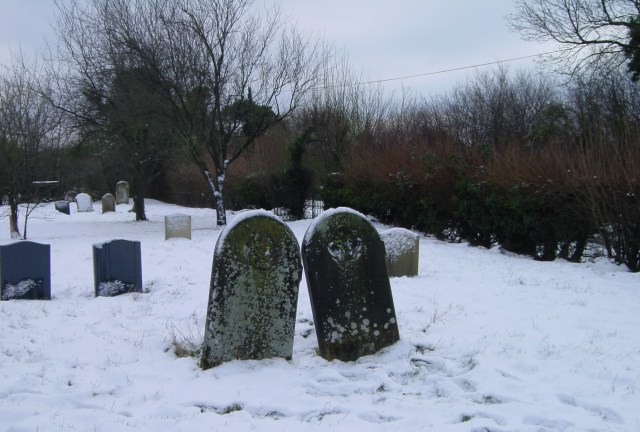
I have been back to Hethel twice since then, the last time in an overnight snowfall, just before Christmas. There was a strong easterly wind blowing and it was bitterly cold.
All Saints Church, Hethel
There were no leaves on the trees and of course no nettles. The graves of my great great grandparents were clearly visible, leaning to one another, as if she had moved closer to him for warmth, sleeping on his shoulder.
The graves of Robert Blackwood and Susanna Ringwood
The inscriptions on the gravestones are now very eroded and difficult to read. One day in the not distant future they will be completely illegible.
Neither of my great great grandparents could write; they signed their name in the parish registers with a mark, an ‘X´. They were undoubtedly poor – he was an agricultural labourer, and he died at the age of 59, whereas she lived for another 22 years.
It was possibly their son, my great grandfather, William Blackwood (1847-1927), who had the gravestones erected. He was the first of the Blackwoods to be able to write and he worked as a miller, with his own mill in Harleston, 18 km south on the Essex border.
Harleston Mill
I once came across a beautiful expression in a book I was reading:
Existimos mientras alguien nos recuerde (We exist as long as someone remembers us)
If I ever succeed in publishing, in some form, my series of articles, perhaps one of my descendants will one day read this, and be motivated to visit the churchyard in Hethel, as I first did, now more than 30 years ago.
And in so doing, our family links with the past will be refreshed, and some of those who came before us will be remembered.
I grew up on a farm in Ireland and from the age of crawling, I was exposed to shit.
There was cow shit, horse shit, chicken shit, pig shit, sheep shit, goose, duck, goat, dog and cat shit, and other shit that I have trod on, but not noticed. And more than once a passing bird has evacuated its bowels on my head, which Irish logic would explain why I have been exceptionally lucky all my life.
And there was the manure heap, with the daily contents of the piggeries and the chicken houses, together with the remains of dead animals and birds. It was a veritable soup of bacteria, constantly stirred by an army of rats.
Of course, we kept ourselves pristine clean: my mother made me have a bath once a week, but only if I really needed it. Now to some of you that may sound a little extreme, but one should remember that we had no running water until I was eight or nine years old, and then no heating.
The only times I ever had to take a precautionary medical measure, was when, on occasions I cut myself and went to the doctor to have a tetanus injection. And of course, there was the ringworm infection that I had on my forehead, probably from wiping my sweaty brow on a warm day. It started to spread towards my hair and I had to have treatment.
I still have most of my hair, albeit not as lush as formerly
When I migrated to Canada, I first heard of allergies. It was a new word for me. If it existed in Ireland, I had never heard of it before. So many people in Canada seemed to be allergic to something. And there was the modern infliction of stomach ulcers and haemorrhoids. As an innocent Irish immigrant, I was on a steep learning curve.
Some years later, on one of my last nights in Lagos, with some of my friends, I went to my favourite little French bistro in the city. It rained heavily while we ate and when we emerged, the streets were flooded, and the parking lot, where I had left the car – I was driving, was a lake. The sewers had regurgitated their contents, and the water was putrid.
I took off my shoes and socks – I was already in shorts, and waded to the car and managed to start the engine and exit the car park. When my friends got in, they were nauseated by the smell that rose from my legs. When we got back to my apartment, to my amusement, one of the girls (a very city girl) insisted on dousing my legs with disinfectant, despite that I had already showered.
Once in Chamonix in recent years, with Lotta and some of my sons, just about to start dinner, Andrew mentioned that the toilet in his room was blocked. ‘Leave it to me’, I said, and I leapt into action. Sure enough, it the toilet was filled to the brim and solidly blocked. I plunged my arm up to the elbow, pulled and pushed at the blockage, and with an enormous sucking noise, it all disappeared.
Was I treated as a ‘hero’ for my heroic action? Not at all. ‘Yuk’, ‘OMG’, ‘how could you do that? etc. And once again I was doused with all sorts of disinfectants. And dinner was a rather subdued affair.
Sometimes being Irish is no fun… 😦
When it comes to gardening, I can understand women wanting to protect and keeping their ‘hands soft and smooth´, but I have never understood why men wear gloves. To me, gardening in gloves is comparable to sex with a condom: to feel and assess the moisture content and the texture of the soil, one has to get one’s hands dirty. I could never imagine my father or his workers ever wearing gloves in their work.
I remain totally convinced that exposure to germs, bacteria or whatever they are called, from a young age, helps to build a resistance that lasts a lifetime.
I appreciate that my view is diametrically opposed to that of the product propaganda of the cleansing and pharmaceutical companies and most city people.
Until I moved to Caracas in 1978, I had never lived anywhere within easy access to mountains.
The landscape around where I grew up on the north coast of Ulster, could be described as ‘gently undulating’, and it would be an exaggeration to describe the ‘mountains’ in the north of Ireland as anything more than ‘cuddly little hills’.
Likewise, Toronto and London are as vertically challenged as a slightly creased table cloth. There are small mountains inland from Sydney, but they are at least a two-hour drive away. On a rare day, clear of smog, from Los Angeles, with binoculars one can sometimes see the Rockies, but again a long drive. And Lagos is on the vast delta of the river Niger.
So, on that morning in November 1978, when I was shown to my new office on the seventh floor of Maraven, in Caracas, and I looked across the adjacent city airport and saw that massive green wall rising from the northern suburbs, I felt so fortunate to have the opportunity to be there.
Pico Oriental (2640 m), with the city aitport in the foreground (from internet)
The mountain at which I was looking, was the western end of El Parque Nacional El Ávila, that stretches for 80 km along the north coast, and is about 16 km wide. The highest point is Pico Naiguatá at 2765 m, with Caracas at about 1000 m.
For quite a while, the mountains were ever present in my mind, but by necessity they were in the background; I was busy settling in, getting my bearings, coping with the challenges of a new job, and above all, wrestling with the Spanish language.
But eventually the urge to climb that mountain and walk along the ridge was irresistible. I asked around the office, but nobody seemed to have ever climbed the mountain, nor did they seem to know anything about the access paths.
It was my new friend and eventually my constant companion, Ivonne, who inquired at an information office somewhere in the city, and obtained some documentation. So, one Saturday morning we set off to climb Pico Oriental.
There was nothing technically challenging about the climb; it was like going up steep stairs for 2-3 hours. And it was a very warm day. But the views from the top were incredible, with Caracas on one side, and the Caribbean far below on the other. And we could see planes flying below, and landing at the city airport, and on the other side, at the international airport of Maiquetía.
Over the next year on several weekends, we explored most of the paths on the mountain, accompanied by various permutations of Ivonne’s younger sisters – Maureen, Vilma and Dayra, and two of our colleagues from Maraven – Aiden Lehane and Laín Burgos-Lovece.
We went along the ridge as far as the Humbolt Hotel, at 2015 m, then deserted and decayed. It had been built in 1956, with a cable car climbing from Caracas in the valley and then down the other side to Macuto, at the coast. It was shut down in the early 1970’s, due to operational and technical issues with the cable car system. It was reopened in the late 1980’s as a School of Tourism.
Hotel Humbold at 2015 m
Kaare & Lonny Plesner (Danish friends), with the author and Ivonne Garban, in 1979
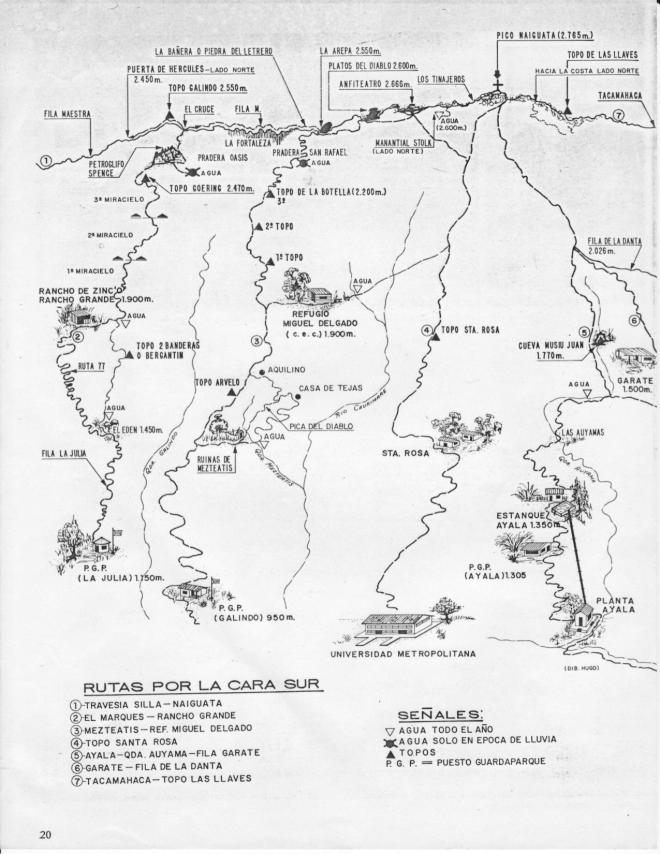
Ivonne somehow obtained a faded copy of a document that gave the history of the ascent of Naiguatá, so one weekend we set off from Petare, in the eastern suburbs of Caracas.
The front page of an old 8-page document about Pico de Naiguatá
And a map showing some of the possible ascents to Naiguatá
Once more there was nothing technical about the climb, it was just long, and in the valley, the weather was hot that day. And once again the views were stunning.
View of Naiguatá from the western ridgeLooking west from Naiguatá, with Caracas on the left, and the Caribbean on the right
Although there were several paths up the south side of Ávila, I never found one descending from the ridge on the north side, down to the Caribbean. The north side was reputed to be a naturalist’s paradise, with many different species of flora and fauna.
There was no road along the coast for the length of the park. The road ended at a beach club on the western end of the park, and just outside Higuerote on the eastern end. In between, there was about 50 km of a rough track, only suitable for a 4-wheel drive.
One day I decided that I was going to run and walk the 50 km. Ivonne drove me to Higuerote, and I started out just after the sunrise. We agreed to meet at the other end at 18:00, around sunset.
As crazy as it may seem today, I took nothing with me: no pack, no food, no water. I had just my running gear. And of course there were no mobile phones in those days.
But the distance for me, was a little more than that of a marathon, of which I had already done several. And a few weeks earlier I had run and walked 80 km in training in Caracas, so I was not in awe of the distance.
The going was rough in parts, particularly in the middle third, and it was hot and very humid in the sun. I drank from streams and surprisingly, I found several banana plants, with ripe fruit, possible descended from a long-vanished subsistence plot.
I had no concept of distance covered, but I had calculated on it taking no more than ten hours. When ten hours had elapsed and there was still no sign of civilisation, I started to feel a little uneasy, especially when it looked like it would not be long until the sun set. I began to regret the time had spent on those idyllic breaks that I had taken, sitting on the beach, or cooling my feet in the streams.
It was quite dark when I finally emerged from the bushes to find myself in the car park of the club at Naiguata. And there was Ivonne with one of her sisters, patiently waiting for me in my car.
Mission accomplished.
Since Caracas, I have had several opportunities to live close to mountains, and I have never lost my fascination for them.
But my memories of Ávila stand out above all others.
Over the last few years, Valencia has become one of my favourite cities. Indeed, I have even been considering settling down there, although I confess that I am not yet quite ready for that big step. For me, it is not easy to blow the full-time whistle on more than 50 years of my nomadic life-style. That day will come, but not just yet.
Valencia has much of what I enjoy.
First and foremost, it has a wonderful subtropical climate, with a summer season lasting from April to November, mild winters, and an annual average of seven hours of sunshine per day. That is almost double the average for northern Europe. And only a precipitation average of 44 days in the year.
Then there is the glorious heart to the city, with its cathedral and its buildings, its history and the maze of narrow streets and alleyways. And the multitude of inexpensive restaurants and bars. The city throbs with life, day and night. The typical Valenciano lives in the street.
And the beach is a short bus ride away.
But for me, the jewel of Valencia is El Jardín del Turia.
In October, 1957, the river Turia overflowed yet again, causing a lot of devastation and many deaths. The authorities finally decided to divert the river, avoiding the heart of Valencia. In subsequent years, the bed of the river was converted to a sunken park, which was inaugurated in 1986.
Today, the park extends over 9 km of former riverbed, from Cabecera Park to the City of Arts and Sciences, and includes 18 bridges.
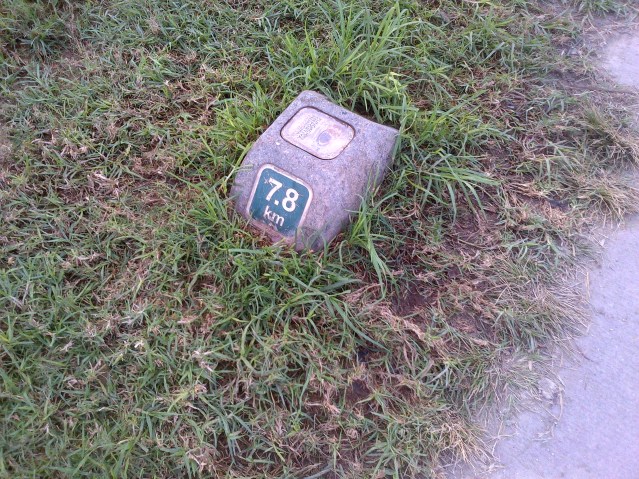
It is a relative paradise for a runner, with a marker every 100 m.
At the down-river end of the park, there is the group of futuristic buildings that comprise the City of Arts and Sciences.
The Opera HouseThe Science museum, in the shape of the skeleton of a whaleThe Ágora, for special events
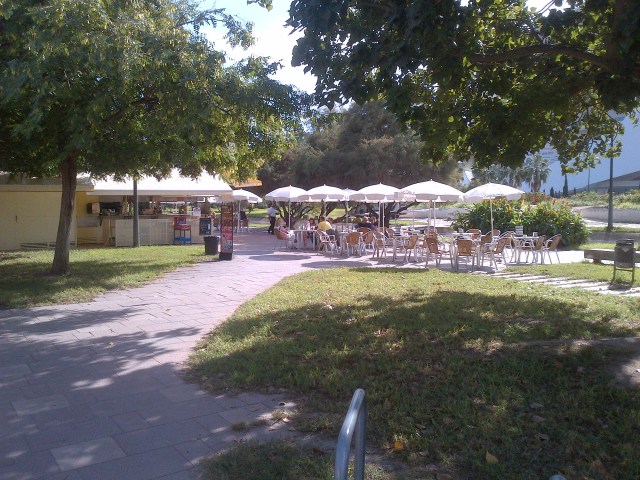
Throughout the length of the park there several bars and restaurants.
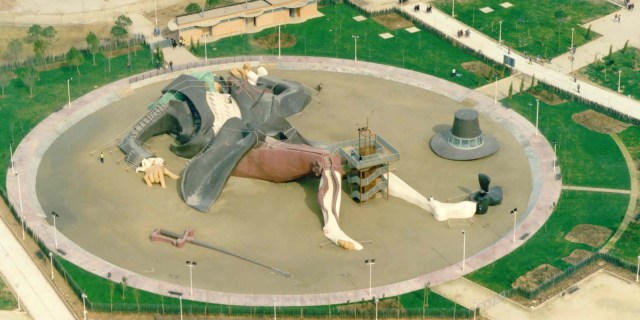
One of the unique features of the park is the Gulliver Park for children and the not-so-young. Only from the air can one appreciate the size of the sculpture and the ant-like people.
The Palau de la Música, that houses the Valencia orchestra. In the foreground, the spectacular fountains are undergoing a complete restauration.
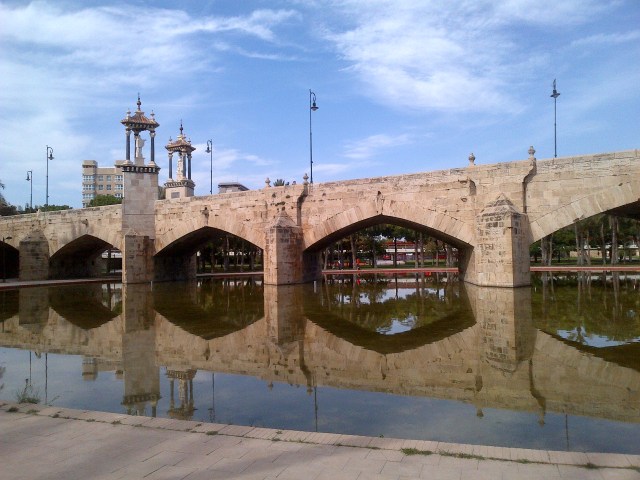
And if one forgets that one is on the bed of a river, there is the Puente del Mar to remind one that it was first built on the site in 1425.
For the sports minded, there are facilities for football, rugby, tennis, baseball, hockey, athletics than others that I have forgotten.
Today finds me in Alicante, in southern Spain. While most of northern Europe is shivering in near, or below freezing temperatures, I am in shorts and light shirt, basking in 25°c. It’s not very hard being me.
Give or take a week, it was about this time of the year, forty-eight years ago in 1968, that I first was in Alicante. And the weather was like today.
I was on my way south to Gibraltar. As a child, I had read of the history of Gibraltar, a tiny enclave of Britain, at the tip of Spain and separated by a short distance from Africa. It had fascinated me.
Gibraltar was ceded to Britain by the Treaty of Utrecht in 1713, but unfortunately, there was no map of the boundaries, nor any detail of what was entailed. Unsurprisingly, to this day Gibraltar has continually been subject to differing interpretations.
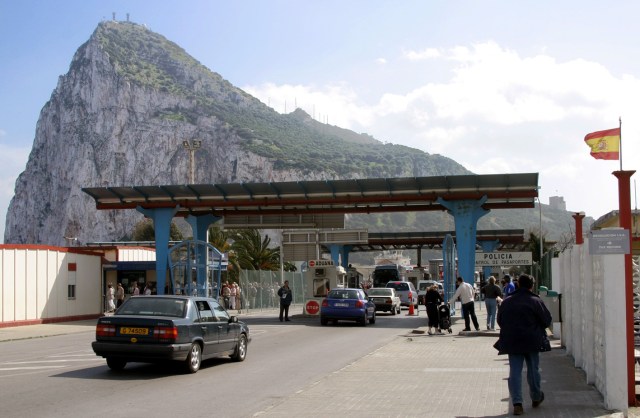
I have no recollect of how I reached the Gibraltar border from nearby Algeciras, probably by bus, but when I did, I found the border was not open. It had been closed on June 8 of the same year, by General Franco, the Spanish dictator, and it remained closed until February 1985.
The border between Spain and Gibraltar, as it is in modern times (photo from internet)
I spent the night close to the border, in La Línea, in a pension, in the dampest bed in which I have ever slept. The room felt as if it had not been occupied since the Treaty of Utrecht.
The next day I went back to Algeciras, and caught a ferry across the bay to Gibraltar. That access was surprisingly still open.
On the ferry, I met one of the most interesting people I have ever encountered. He was a retired English sailor. From early teenage, he had worked all his life on boats, all over the world. He was a small thin wiry man with scarcely any hair, with a deeply weathered and tanned face.
He told me that when he was forced to retire, he tried to settle in England, but he could not fit in. He had no family, no relatives, no real friends. He was too restless to live in one place, so he had taken all his possessions in a small backpack and set off to follow his nose.
In the next four years, he had traveled all over the world, in all the continents, sometimes working his passage across the oceans. He ended up back in England, but did not stay long. When I met him, he was on his way back south. He said he was not going back to England again.
I asked him where he was going after Gibraltar. He said that he was going to catch a ferry to Ceuta and then overland to South Africa.
And what if got ill? He said that he would be treated like the local people, wherever he was. And when he died, he said that they could have his few possessions to pay for his burial.
He did not seem to be lonely. In fact, he appeared to be very content with his life. In some ways, the old sailor reminded me of the legend of the itinerant Jew, although, in the end, the latter just wanted to die.
The last I saw of him, he was heading to the offices of the ferry companies, to get a passage to Africa, and I headed to the town.
Since then, I have often wondered whatever happened to the old sailor.





















 The Irish Rover