Emmanuel

If I have internet access, my mornings are little different, whether I am in Cape Town, Montevideo, Chamonix, Uppsala or Timbuktu; I rise early and update my investment accounts, read the business news, answer emails and usually write a little.  And by no later than midday, I set off on a long walk.

In Cape Town that walk usually encompasses one or all of the Waterfront complex, the Stadium, Green Point Park or Ocean View Drive, along Signal Hill.  And all my walks inevitably pass along the ocean promenade for as far as I feel comfortable.  That is my routine and I love it.  On those walks I do most of my thinking.

In Green Point Park, I look for the massive pike in the lake, for the Egyptian Geese and their eight goslings and the coots with their six little chicks.  And the huge scruffy bird that I have not yet identified; he or she always looks so sad and lonely.

Along the promenade I watch out for dolphins and whales and am always thrilled when I am fortunate to see them.  And the raw power of the ocean when it sends its waves pounding against the sea wall and launches its spray over me, as I pass by, reminds me so much of my native coast in the north of Ireland.

At Sea Point park, I often stop to watch the paragliders land from Signal Hill.  I have often watched them in Chamonix, landing on a run, but these people drop like a stone and suddenly stop in mid-air, slowly drift down for the last few metres and step down, as if they were getting out of bed.  They make it look so very easy.

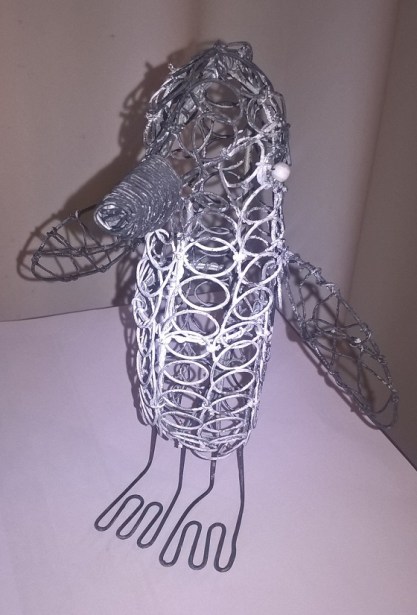
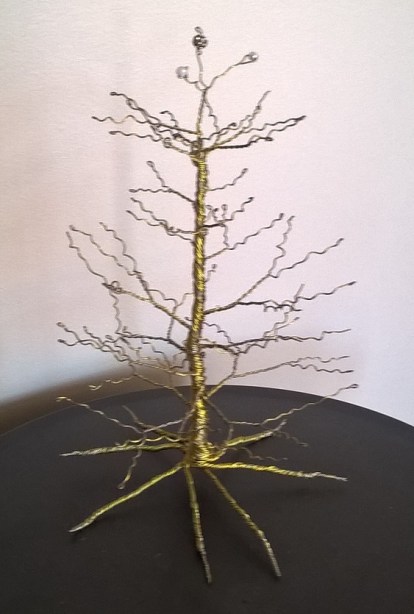
When I return on the promenade along Mouille Point, I often see a young guy sitting on the wall, making models of sharks, whales, birds, penguins etc. from wire.  He is an artist with wire.  He is there most days, almost regardless of the weather.  When the waves sweep over his corner of the promenade, he retreats to a bench beside adjacent Beach Road.  His name is Emmanuel Chitsinde and he is from Zimbabwe.  He has been in South Africa for a while now, first in Durban, then Port Elizabeth and now in Cape Town, which I think he prefers.  He has a wonderfully cheerful disposition.

Emmanuel Chitsinde
Emmanuel in his workshop, with Pingu

I don’t know what people in Zimbabwe are like, but the vast majority of those that I know of, or have heard of in Cape Town, are all hard working and reliable – staff in the bars and restaurants that we frequent, Uber drivers, the girls where Lotta gets her nails manicured.  Most save hard to send money home to aid their impoverished families.  It is depressing to hear of the deprived state to which the corrupt Zimbabwe government has reduced their country.
WP_20170730_18_44_57_Pro
Pingu the penguin
WP_20180126_13_32_17_Pro
The tree

Like Emmanuel, I also once went away from my homeland, more than 50 years ago, when I was young.  Fortunately, I eventually prospered and could send money home every month to help my parents.  I did that for many years, until there for was no further need; until they were no longer.

I feel empathy for Emmanuel and his compatriots.  I wish them every good fortune in their struggle.

And for more of Emmanuel’s art, see his website

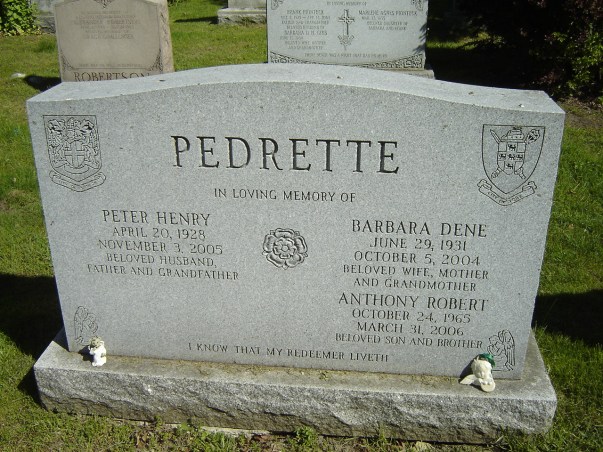
Peter Pedrette

Toronto, 1965

I had been in Canada for some ten days, I had very little money, I was only 18, but I did have a job starting the following Monday.  But where could I stay?

It was the result of a phone call to my dear friends, George and Eileen Darragh, that my dilemma was solved, at least temporarily.  They had just recently moved into a small one-bedroom apartment at the corner of Keele and Lawrence, had few financial resources themselves, and welcomed the pittance that I could offer, in return for my sleeping in the corner of their living room and an occasional evening meal.  And as it turned out, George worked only two blocks away from my new employer, so we travelled in each morning by bus to Yonge Street, and then by metro into the city, a journey of about an hour.

The office of Helyar, Vermeulen, Rae & Maughan (HVR&M) was on the seventh floor of an old building at the corner of Bay & Richmond.  One could tell that the building was ancient by the elevator, with its sliding mesh doors and which could only be operated by an attendant, day or night.  Across Bay Street was the huge multi-storey Simpson’s department store, occupying an entire city block.

simpsons.jpg.size.custom.crop.850x566
The corner of Simpson’s where I first met Sandy

When I joined HVR&M, there were only three employees – an Australian receptionist (Janice), an English bookkeeper (I can’t remember her name), and an English quantity surveyor, Peter Pedrette.  Soon after, we were joined by another Englishman –  Jack Brown, and a rather shy little Jamaican – Leroy, who rarely ever spoke.

Quantity-Surveyor
The typical desktop of a quantity surveyor

Peter was 36 when I first knew him and he had only recently arrived in Canada, with his wife, Barbara.  He had spent some years working in Kuwait and it was there that he met Barbara, a school teacher.  They were both devout Catholics and not long married.  Their first child was due later that year.  They were devoted to each other and they always addressed each other as ‘Darling’.  They were well-educated and well-spoken.  I developed a great respect for them.

It was Peter who fuelled my nascent interest in equity investment by talking of shares he was considering buying.  One lunch hour we went to the Toronto Stock Exchange and I was fascinated to see how the trading worked in the cacophony of noise, with traders shouting their offers and communicating with their team by hand signals.  And the tickertape of deals, moving relentlessly across the screens.  I was well and truly hooked and I spent many evenings in the city library, around the corner from the office, reading investment books, and forming my own approach to equities.  It has turned out to be a lifetime interest, and my methods today are little changed from my initial approach more than 50 years ago.

I suspect that Peter was quite well off, at least by my standards. One day he asked me if I would help him to carry some gold from the bank where he was going to buy it, to his deposit box in another bank further up the street.  I carried one of the bars for him, while he carried the other.  They were small but extremely heavy.  It was my first exposure to gold and those two bars would today be worth much more than a million dollars each.

Across the street from the office and a floor higher in Simpson’s, we could see girls in white uniforms working at the windows.  We used to wave to them.  Jack’s fiancée was a buyer in Simpson’s and one day he reported back that the windows were part of the Elizabeth Arden beauty salon.  One afternoon, Jack suggested that we take a large sheet of architects drawing paper and write ‘Telephone number?’  on it, and hold it up at our window, when the girls were looking out.  This we did, and a blonde girl signalled back their number.  But what to do next?  Peter was married, Jack was engaged and Leroy was too shy, so it was left to me to make the call.  Well one thing led to another and before long the girl – Sandy, and I became constant companions, a situation that lasted for the next eight years and through many countries.  And her friend Valerie, who was also at the windows, ended up married to my friend Howard, and thanks to internet, I am still in periodic contact with both of them.

Peter and Barbara lived in a small cottage on Algonquin Island, one of a chain of islands just south of the Toronto mainland.  There were no cars on the island and Peter commuted to work by ferry.  It was an idyllic setting.  Sandy and I visited them many times, sometimes for a meal, once to babysit their little son – Anthony, and another time to help with raking up the knee-deep layer of autumn leaves.  Eventually they bought a large old house with wood panelling, near High Park.  I helped them with the move.

Toronto_Islands_panorama
Toronto Islands, with Algonquin Island on the far left
hobeachtour8jpg.jpeg.size.custom.crop.1086x725
And could well have been their little cottage

Inevitably time moves on, we eventually left Toronto on our long journey across Canada to Vancouver and San Francisco and island hopping to Australia.  And I lost touch with Peter.  Apart from a brief business visit in 2001, I have never been back to Toronto.

A few years ago, I tried to trace Peter and Barbara through internet sites, but to no avail; I could not find their footprints.  It was only recently that I stumbled on them.  It turned out that Barbara died of cancer in 2004, Peter in 2005 and his oldest son five months later.

And Peter died the same month as I had my own near-death experience in Stockholm, the day before George died in Coleraine.

Of the three of us, I was the lucky survivor.

137298463_1413410249

Procrastination

Putting things off is the biggest waste of life: it snatches away each day as it comes, and denies us the present by promising the future.

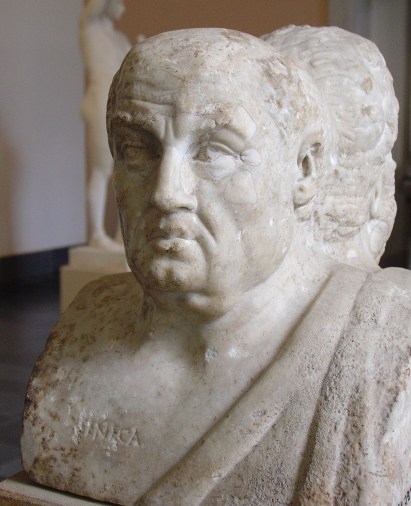
Seneca – 4 BC (Córdoba) – 65 AD (Rome)

Duble_herma_of_Socrates_and_Seneca_Antikensammlung_Berlin_07

That line comes from Seneca’s essay – ‘De Brevitate Vitae’ (The Shortness of Life), written in 49 AD.

And as Wayne Gretsky, the former Canadian ice hockey star, once said – ‘Procrastination is one of the most common and deadliest of diseases and its toll on success and happiness is heavy.  You miss 100% of the shots you don’t take’.

wayne-gretzky-oilers-kings-rangers-birthday-list

I well remember a Qantas commercial from the early 1970s when I lived in Australia.  It started out with a young man saying that when he finished school he was going to travel.  Then it was after he completed his studies.  One saw the young man looking a little older, saying that when his children grew up, he was going to see the world.  Then the man looking much older, salt-and-peppered and conservative, saying that when he retired he was going to travel and see the world.  Finally, there appeared a very old grey bearded wrinkly saying – ‘One of these days…’.

For me, decisions involving my own money – buying a house, shares, a car, a phone, a computer etc. are relatively easy.  I know what I want, I have a reasonable idea of the cost, and when I find it, I buy it.  I really don’t care if I later find that I could have bought it for less somewhere else, or by waiting I could have had a better deal. The deal is done and I move on.  For me the old saying, that ‘time is money’ very much applies.  I very much believe that it is important to know what your time is worth and not to waste it in trying to make relatively insignificant savings.

In a similar manner decisions involving where I live and/or work have also been relatively easy for me and have always been because of what I wanted to do next in life. We have no choice of parents or of where we are born and raised, but we certainly can decide where we want to live.  Consequently, I have left a trail of cities behind me – Toronto, Sydney, Los Angeles, London, Lagos, Caracas, Miami, Panama, Lima, Camberley, Neuchâtel, Paris, Uppsala, Chamonix, Montevideo and now Cape Town.  One of these days I may settle down… 🙂

At work the major decisions are usually much more complex and involve many variables.  Making 5 out of 5 profitable decisions hardly seems possible.  With 4 out of 5, promotion is just a matter of time.  With 3 out of 5, one may remain employed.  Anything less usually results in ‘adios’.  And procrastination on a difficult decision rarely wins respect.

Where I have often struggled is with the negative decisions involving people, for example in terminating a relationship or someone’s employment.  With some, I would certainly never win a popularity contest.  And yet, once the decision is made and communicated, I have usually felt an overwhelming sense of relief.  As is written in the bible, and frequently misquoted, ‘the truth sets you free’.

Life is too short to waste on regretting what could have been…

In the words of Edith Piaf – ´Non, Je ne regrette rien’.

maxresdefault

Edith Piaf – Non, je ne regrette rien – (original)

Applying for South Africa Residency

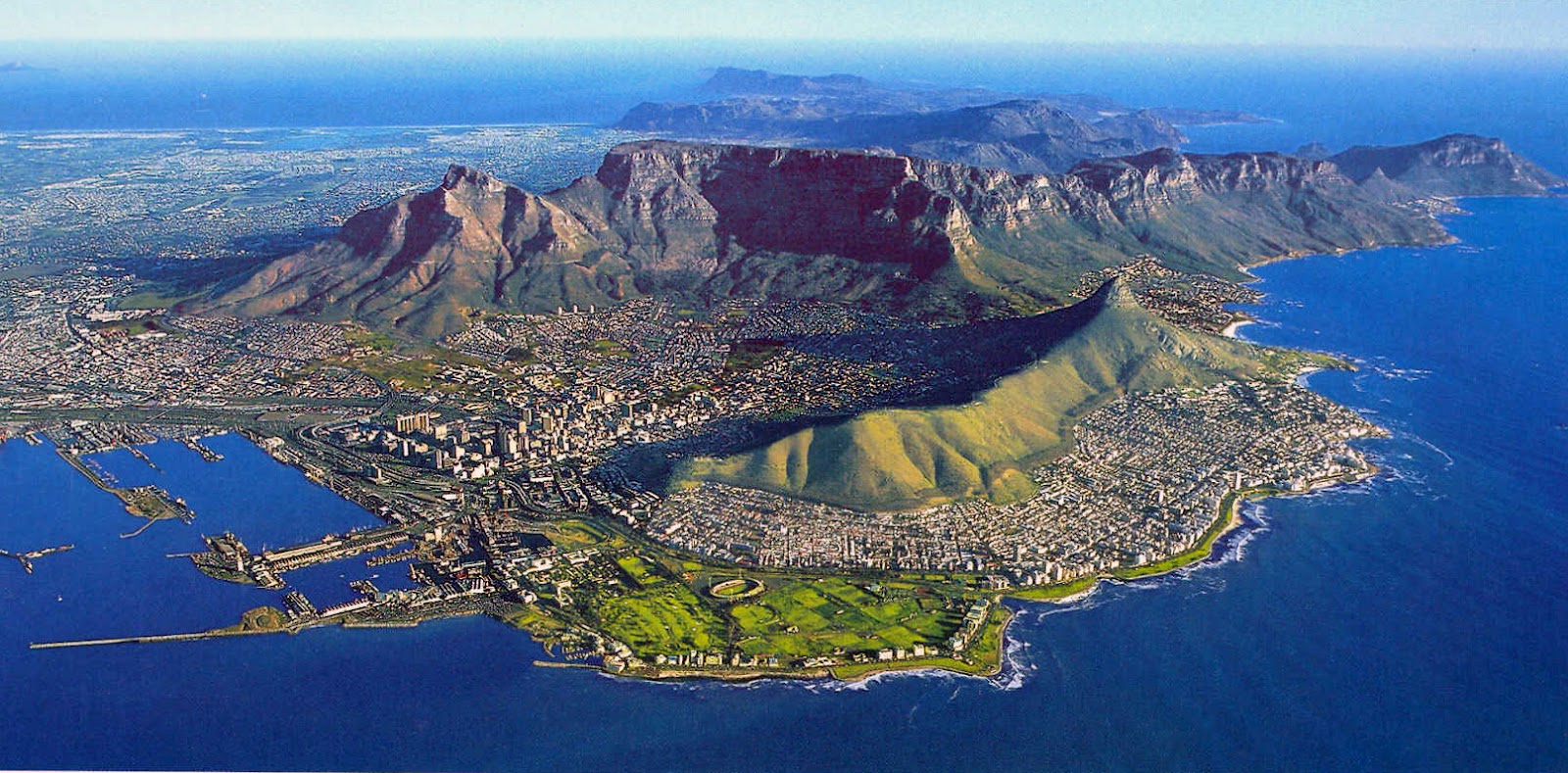
I love Cape Town – the ocean, the mountains, the climate and the super-friendly people of all colours, both well-off and poor.  I feel so totally at home here, that after a year and three visits, I have started the process of obtaining a temporary 4-year residence, to be immediately followed by an application for […]

I love Cape Town – the ocean, the mountains, the climate and the super-friendly people of all colours, both well-off and poor.  I feel so totally at home here, that after a year and three visits, I have started the process of obtaining a temporary 4-year residence, to be immediately followed by an application for permanent residence.

cape-town-overview

In most parts, it is not a demanding process.  I must provide apostilled (that was a new word for me) copies of my birth and divorce certificates.  Then there is a basic medical examination and chest x-rays.  I also must demonstrate that I have at least a net annual income of Rand 444,000 (c£26,000 or c$34,000).  But the painful part is providing police clearance from every country in which I have lived since I was 18.

Now for most countries, the process is not very demanding – basic identification data plus a fee.  But the US requires a set of fingerprints on ‘card stock’ plus a plethora of personal data, such as height, weight, colour of eyes, hair etc.  And their northern poodle requires electronic fingerprints, which are not readily accessible outside of Canada.  And neither of their embassies and consulates provide any assistance whatsoever.  To complicate the process, the US has a minimum of a 10-week service level, before the end of which my application could be rejected – I just hope that I did not give my height and weight in metric, leaving me to start all over again… 😦

Once I get all the required documentation, I must book an interview at an RSA embassy, in my case London – there is currently a one month wait.  And if my documentation is accepted, there is a further 33 working day delay until the permit is issued or rejected, during which time my passport is retained by the embassy.  As I also have an Irish passport, the latter is no handicap.

So, if everything I goes according to plan, I hope to be a South Africa resident by the end of this year.

Wish me luck… 🙂

Fidel and Pedro

The time that I spent in Venezuela in 1978-81, resulted in a seismic change in my direction in life: the geography of the country; the people, the friends that I made, with some of whom I am still in contact, the challenge of learning the language, the food, the music, the wonderful climate.  I could go on and on, and usually do.

And of course, it was in Caracas, where I was introduced to competitive running, inspired by Herbert Robertson, about whom I have previously written (see lenblackwood.com/2016/05/11/3).  But there were two others, who greatly contributed to my modest success as a long-distance runner – Fidel Rotondaro and Pedro Penzini.

I first met Fidel while training in the Parque del Este.  He was the enthusiastic organizer of local races and runners under the name ‘Club Ataka’.  I happily accepted to join with his group and often, after a race or long training run, he would invite us to his house for a beer or three.

Fidel was an economist by discipline, but in those days, he had a charter business, with his own 6-seater turbo-prop, stationed at the city airport, just across from where I worked, at Maraven, the oil company.  He used to transport wealthy businessmen and tourists, both within Venezuela and internationally. Twice he invited several of us to accompany him, in his plane, to races in Florida.  And when there, we stayed at his house in Fort Lauderdale.

Fidel was not just hospitable to his friends, he sponsored and subsidized two young talented local runners, poor guys with few resources.

Once, Fidel arranged a race in Canaima, in Eastern Venezuela, with a group of runners from Caracas and Indians from a local football club.  We set off in three small planes and one by one we landed in a field by the river Orinoco.  The landing strip was quite short, and twice we overshot the field and took off again, to avoid ending up in the water.  From there we took a canoe to an island in the river, where Fidel, or perhaps one of his friends, had a large open-sided dwelling.  We had a huge bar-b-cue and slept the night in hammocks.  It was idyllic.  The next day we had a short flight to Canaima.  By air, was the only means of getting to Cainama; there were no roads.

The 15 km race was run over dirt tracks, out and back, through beautiful countryside, with no shade.  It was quite hot and the last stage was along the airport runway, when my legs moved, but everything else seemed to be stationary.  After, we took some canoes on the lagoon and passed behind one of the waterfalls.  I will never forget the experience.

15495-svcn-fsxzip-5-svcn1
The landing strip at Canaima, with the lagoon and the waterfalls in the background (photo from internet)

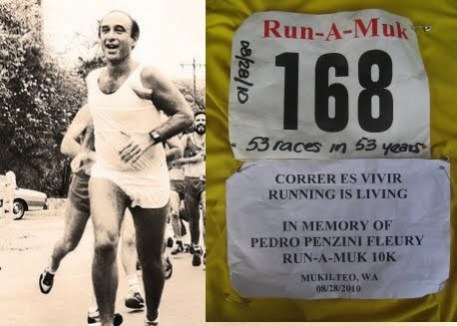
Pedro was not with us that weekend.  He was a chemist, at that time working in the pharmaceutical industry.  He was an enthusiastic advocate of healthy living and wrote a weekly column for a national paper, under the heading ‘Correr es Vivir‘ – (To run is to live).  He wrote a book on the subject, in the early days of mass running, when Bill Rodgers, Alberto Salazar and Greta Waitz were every runner’s heroes.  I will never forget one of his weekly columns entitled – ‘Escupir o no escupir‘, ‘To spit or not to spit’.  It was about the effects of the loss of fluid during a long race, and I never did know whether he was being serious or just ‘tongue-in-cheek’.

Correr es vivir
Photo from internet

When I returned from the Cleveland marathon in May 1980, having attained a Boston qualifying time of under 2:50, Pedro wrote a very flattering article about me for El Nacional.  I remember that I was wearing my all black running shorts and singlet (John Walker, the 1500 m runner of New Zealand, was one of my heroes in that era), while the photographer took shot after shot of me running past him.  I don’t know what happened to my copy of the article.

El médico Pedro Penzini Fleury
A formally dressed Pedro, complete with microphone (photo from internet

But life moved on, and so did I.  For twenty years, Pedro continued to write his weekly ‘Correr es Vivir‘, on running, sports and healthy living.  He had a daily program on radio and later on television, and became a well-known personality.  But despite his clean-living life-style, he fell ill and died in 2010, at the age of 74.

Pedro Penzini Fleury 1
A race in memory of Pedro was run in 2010 (photo from internet)

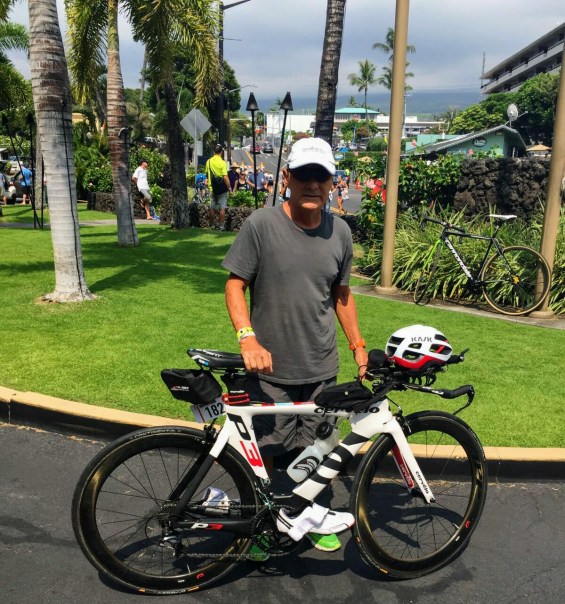
Fidel has never stopped running.  He is the only Venezuelan, and one of the few of any nationality, that have completed a marathon in all seven continents.  And yes, that includes Antarctica.  He has had a serious illness and a debilitating Achilles tear, but went on to compete successfully at international level in a plethora of Ironman triathlons.  He is now 76, living between Isla Margarita and Miami, and still competing.

fidelbikecheckin
At 76, Fidel is still looking good (photo from internet)

As I sit here tonight in Cape Town, with my head filled to overflowing with warm memories of nearly 40 years ago, I feel so privileged to have had the opportunity to have known Fidel and Pedro.

Each, in their own way, enriched my life, and that I will never forget.

Landing on my feet

July, 1965

Despite all my macho bravado and naïve ambition, when that early morning arrived for me to get up and leave home, to go off into the relative unknown, I felt suddenly quite nervous.  The enormity of what I was going to do, with little money and even less marketable skills hit me, and I just wanted to find it to be just a dream.  But my mother knocking on the bedroom door was real.  I took a deep breath and got up.

I had a hurried breakfast, while my parents silently watched.  Their faces said it all.  They looked sad and concerned.  It was a emotion that I did not understand until I, in my turn, experienced my own sons setting off for their first time, albeit from afar.

Greenacres May 1963
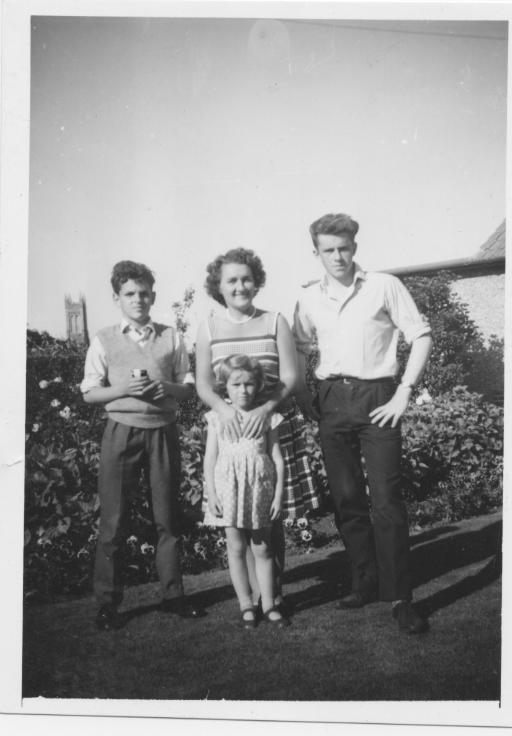
Photo taken not long before I left home

My friend, Stewart Barnes, arrived to drive me to the airport.  I went to the bedroom to say goodbye to my brother.  He was half asleep when I kissed him.  I will never forget the sleepy look of bewilderment in his face.  I don’t remember going to my sister.

The rest of the day passed in a blur – to Belfast, then Heathrow and on to Toronto, where my grandparents were waiting for me.  I remembered my grandmother from a visit she made to us in Ireland, but I had never seen my grandfather. They migrated to Canada soon after the end of the war and he never returned. They lived in Brampton, about 50 km from downtown Toronto.

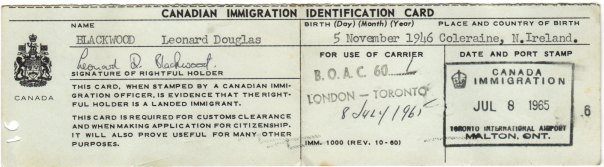
Immigration card

After a couple of days walking around sleepy suburban Brampton, I decided that it was not for me.  My grandparents were keen that I stayed there, but to me, Brampton felt about as exciting as a night out in a funeral parlour.  So I decided to try my luck in Toronto, where my friends, George and Eileen, had settled.

Adam & Flo Douglas Brampton 1963
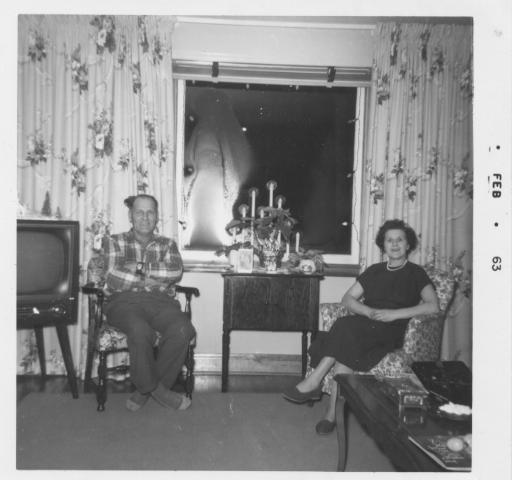
My maternal grandparents in their living room in Brampton, in 1963

I took a Greyhound bus to the terminal in Toronto and went to a nearby restaurant to eat something, before starting job hunting.  Apart from hamburger, I recognized nothing on the menu, so hamburger was what I ordered.  There were no chips.  Afterwards I realised that chips were called French fries in Canada.  I had never been in a restaurant before.  My innocence must have been glaringly obvious.

I walked towards the city, completely awed by the size of the buildings.  At that time, they were completing the twin towers of the Toronto Dominion Bank, the tallest of which had 56 floors.  I had never seen a building with more than three floors.

I stopped in a phone booth, close to the new city hall.  In those days there were still phone books in phone booths, and in the yellow pages I found a small section for Quantity Surveyors; there were only three entries.  One with the grand name of Helyar, Vermuelen, Rae & Mauchan, attracted my attention, and I called them.  A gentleman called Peter Pedrette answered my call and suggested that I go and see them right away, as their office was close by the city hall, at the corner of Richmond and Bay, opposite the big Simpsons department store.

4557762400_4e621e0be8_b
The new Toronto City Hall, with the old city hall on the right (photo from internet)

I was interviewed by Bob Maughan and James Rae, two Scots who had been several years in Toronto.  They soon seemed to be more than happy with my capabilities as a junior and were more interested in the fact that I played rugby.  They called a friend, Norman, connected to the Toronto Scottish, and arranged for me to attend their training later that week.  And, by the way, I could start the next Monday on a salary of 55 dollars a week, a princely sum to me; that was more in one week, than I earned in a month in Ireland.  It was only later that I realised that the cost of living in Toronto was much greater than that of Ireland.

I accepted their offer without any hesitation and I skipped and danced my way back to the Greyhound bus depot.  I was deliriously excited about my new job.

I felt as if I had arrived.

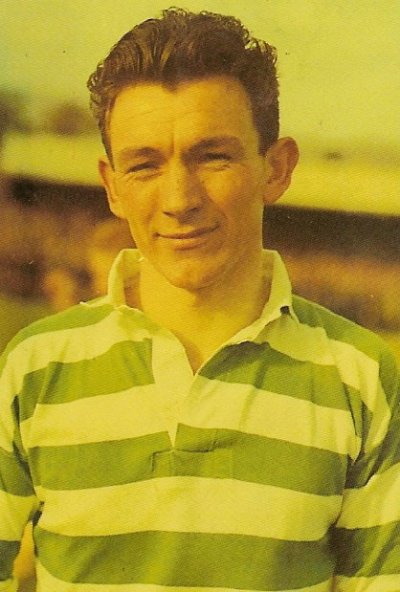
Bertie Peacock

When I was a teenager, Bertie Peacock was a hero and idol in my part of Ireland.  He was born in Killowen, in Coleraine, played a few games for the local football club in 1947, before being transferred to Glentoran, in Belfast, and on to Glasgow Celtic in 1949.  There he made 450 appearances, together with 31 caps for Northern Ireland during 1952-62.  He played in the 1958 World Finals in Sweden, when Northern Ireland reached the quarter-finals, a feat not since repeated.

GW418H619
Bertie Peacock in his Glasgow Celtic days

In 1961, he returned to Coleraine as player/manager, culminating with winning the Irish Cup in 1965, at which I was present.  Soon after, I migrated to Canada and lost touch with the exploits of the team, which had several more cup and league successes.  Bertie retired in 1970, continued for a few years as manager, and eventually bought a local pub, which he named  as ‘Bertie’s Bar’.  He died in 2004.

When I recently visited the Coleraine graveyard, my brother showed me Bertie’s grave.  He told me that there was now a statue of Bertie in the Diamond in the town.

It was my great-uncle Bill and Ronnie Wilson who first took me to see a Coleraine football match.  Apart from the once-a-year North-west 200 motor cycle race and the horse racing in the fields beside Hopefield hospital, there was only local football to watch.  Television was in its infancy and, apart from the FA Cup final, no football was broadcast live.

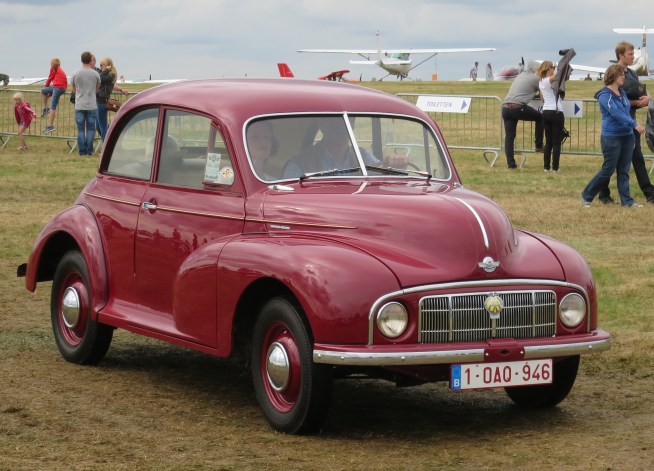
Ronnie used to work with my father.  He was a few years older than me, and Uncle Bill used to drive us the four miles to Coleraine in his little Morris Minor 1000.  Uncle Bill used to set off more than an hour before the kick-off, despite that there was never a crowd capacity of much more than 2000.  We used to race along at about 30 mph, only slightly faster that uncle Bill would have driven his horse and cart; there was always a long line of reluctant followers behind us.  He always parked in the same spot on Union Street.  And the ground was practically empty when we took the same seats on the back row at the corner of the stand.  Sometimes we had to wait outside until the man who operated the turnstile arrived.  We never missed a kick-off.

Morris_Minor_MM_(low-lights)_1950_moving
A Morris Minor 1000 – Uncle Bill’s was black

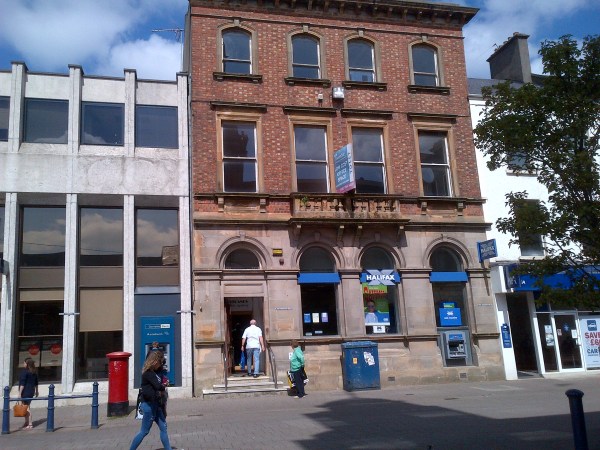
My brother dropped me off near the town centre and I strolled the rest of the way along the pedestrian mall.  The town centre that I remembered had much changed; it had been extensively rebuilt after the IRA bombings in the 1970’s.  I stopped opposite the building where I used to work and took a photo of it.  The quantity surveyors that I worked for – Dalzell & Campbell, probably no longer exists.

IMG-20170502-00149
My desk was at the window on the first floor, above the entrance


Close by, was the statue of Bertie Peacock, and reading the attached plaque was an older man.  We started to talk, as do most Irish.  I asked him what all the flags around the town were in mourning for.  He told me that they had been put up to celebrate Coleraine being in the Cup Final on the coming Saturday.  When I remarked that they all seemed to be in mourning at half-mast, he laughed and said that the men who put up the flags only had a short ladder.

IMG-20170502-00150
Johnny McCurdy reading the plaque, before I spoke to him

It turned out that the man I was talking to used to play football and he had known Bertie Peacock.  Not only that, he used to play for Coleraine.  And to cap it all, he played in the Cup Final of 1965, which was the last game I saw, before I migrated to Canada.  I was talking to Johnny McCurdy, the famed defender of the sixties and seventies, who still holds the club record for appearances at 634.  After he retired from playing, he managed the club for a time.

pic12
Johnny McCurdy as the victorious captain, with club chairman, Jack Doherty (photo from internet)

We chatted for a long time about this, that and the other, and when we went on our separate ways, I felt as if I had never been away, and that all my wandering for the past fifty-two years had been but a dream.  It was the same strong feeling of nostalgia that I always experience when I revisit my home country; of memories of happy and perhaps simpler times, tinged with a sadness that those days are gone forever, together with most of the people that I once knew.

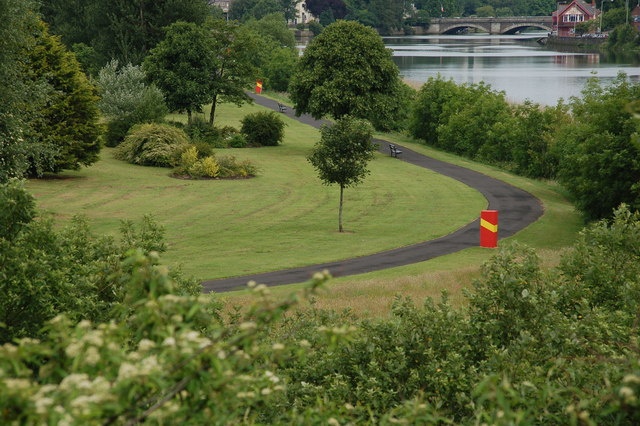
I crossed the bridge and walked slowly back to my hotel, along the beautiful riverside walk.

Ti
Part of the riverside walk (photo from internet)


George

Since my father died in 1995, I have not often been back to Ireland, in fact only in 2004, and again about eighteen months ago.  The north Antrim coast, from whence I come, is not on the way to anywhere; it is about as far as one can get from civilisation, unless one is sailing north to remote Scotland, the Faroe Islands or Iceland.  And once landed at Belfast airport, there awaits an hourly bus service to Antrim and an hourly train to Coleraine, both of which I always seem to manage to miss by no more than five minutes.

But when I step foot back on Irish soil, all the frustrations and aggravations of modern travel and living seem to evaporate, and I completely relax; I am once more 18 and on my way home again.

I met my brother the next morning at my hotel, and we headed off to the graveyard; I was anxious to visit the grave of an old friend, George.  We worked together in Coleraine in the mid-1960s.  He migrated to Toronto in 1965, together with his fiancée, Eileen.  They wanted to marry, but being of mixed religions, migration was their perceived solution.  George had a cousin in Toronto, and soon after they arrived, George and Eileen were married.  As crazy as it may seem today, that was the experience of many young Irish couples in that era.

George & Eileen

I followed soon after George and Eileen, and spent a few weeks sleeping on their living room floor.  None of us had much money and my contribution to the household was much welcomed. Eventually I moved in with five other guys, at 345 Eglinton Ave West –  Howard Abrahams, Michael Goldberg, Robin Jackson, Bill Stott and a Canadian, Gordie.  I am still in touch with Howard and Michael; Robin died a long time ago in South Africa; with the other two I have had no further contact, although I was once told that Bill did end up as the global boss of Hallmark Cards,

George worked as an estimator for a construction company – Pigott Construction, and later, he introduced me to his boss, who offered me a job, which I accepted.  Outside of work, I saw little of George socially; he was a settled suburban husband and I was a lad-about-town, playing rugby, football and partying.

Before I left for Australia in 1971, I last saw George and Eileen.  At that time, they had a little girl.  They seemed to be very happy and very much in love.  That was our last contact.

After I had a stroke in late-2005, it took some time, perhaps 2-3 years, for me to realize that my memory had not completely recovered.  I stumbled upon my own method of revitalising it – one day I may write of that difficult period of my life, and in so doing, I tried to find George.  Telephone directories, linkedin.com, facebook.com, internet etc. – there was no footprint.  I eventually dismissed him as being as a ‘Luddite’, resistant to new technology.

Until my good friend and genealogist, Norman Calvin, found him for me, or rather, found his sister.  And there I was, with my brother, looking for George’s grave.  It was no wonder that I had not been able to find him.  He came upon hard times in Toronto.  He lost his job, divorced and lost his family.  He eventually returned to Coleraine, but his situation did not improve.  On 25 November 2005 he died, a broken man.  On that day, I was fighting for my life in an intensive care ward of a hospital in Stockholm.

But where was his grave?  I had a rough idea where it was, but there were so many.  We split up, one each side of a path.  We walked up and down the rows, until I was on the point of giving up and getting more precise directions.  I distinctly remember saying out loud, ‘George, where are you’, when, in that instant, my brother shouted, ‘Over here’.

IMG-20170501-00142

It was another of the many co-incidences in my life.

Enchanted evenings

‘Greenacres’ farm

Islandflackey

c1952-1956

Some of my happiest memories date from when I was a young boy growing up on a small farm in Ireland.  Despite the fact that we did not have much, certainly little that would today be considered necessities, my childhood was a happy one.  We had no indoor toilet or bathroom, and no heating, apart from a fire in the kitchen and on special occasions, one in the living room.  During most of the year, the bedrooms were ice-cold and we took a rubber hot-water bottle to bed to fight off the chill.  We had no car and no television.  Our situation in that era was like that of most country people in Ireland.

‘Dinner’ was the main meal of the day, and we sat down to eat at one o’clock precisely, to the chimes of Big Ben and the one o’clock news.  The light meal in the evening was known as ‘tea’, and in our house, that was at 18:00 precisely, to chimes of Big Ben and the six o’clock news. Six years of military precision left their mark on my father.

By 19:30 my mother ordered me off to bed, but I could read until she came back to switch off the light.  As I got older, the lights-out time was slowly extended.

From the time when I could read, books were my passion; those who know me today would say that I have not much changed, at least in so far as books are concerned.  And when the lights went out, I fantasied about being a great explorer, a brave knight, a detective or whatever the hero of my current book did.  I was a dreamer.  I was able to borrow books from the library in Coleraine, and I read all the books on the little library shelf of my primary school.  I would have been a rare month when I did not read at least one book.

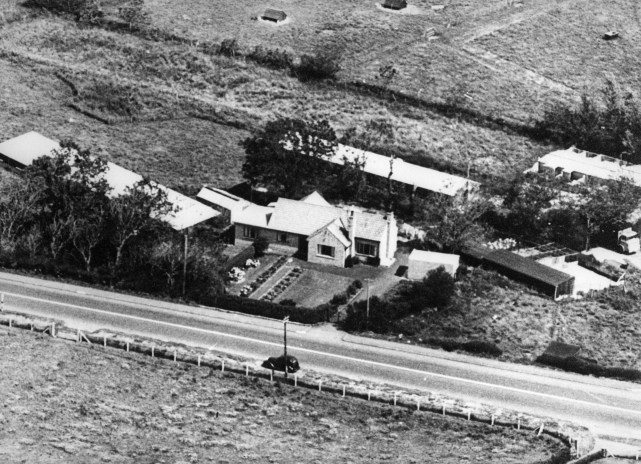
In the summer time, on a tranquil evening after ‘tea’, I used to love to go down to the piggeries and the fields behind the house.  I was alone there; the workers had gone home, my father usually to his bowling club, and my mother pottering around in her garden.  Sometimes I would climb up onto the roofs of the piggeries, armed with a rock, and try to hit one of the multitude of rats that were scampering around; the farm was always infested with rats; it was impossible to eradicate them.  It also proved impossible for me to hit them.  By the time I stood up to throw, they had disappeared like a flash.

DYZ 638
‘Greenacres farm in the mid 1950s
Farm Map
A schematic drawing of the farm near Portrush

At other times, I would go down to the stream that flowed past the old flax dam, at the end of the pig run, and race two or three empty shoe polish cans and see which would be first to the tunnel under Carnalridge Primary school, where I would retrieve them.  The flax dam was silted up and filled with reeds and some stunted willow trees grew on the banks.  In springtime, frogs laid their spawn in the pools of water, and one year I put some spawn in a large jar and watched them hatch and grow into little frogs.

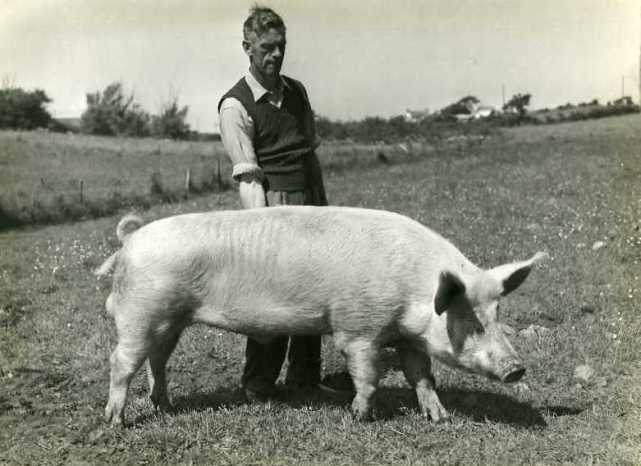
In the pig run, I once found a beautiful orchid.  I took the flower and pressed it for my collection.  My grandmother taught me how to do it, by pressing it between some heavy books that she had.  I never did again see an orchid in the pig run, or anywhere else on the farm.  Perhaps one of my father’s pigs ate it.  The pig run was always pitted, like a WWI battle field.  The pigs loved to tear up the soil looking for roots and would wallow in the hollows.

img076
My father in the pig run with the boar

On the south side of the piggeries, there was the midden heap and the area around it was quite marshy and the grass was left to grow long.  Every year a corn crake nested in that grass and every early morning and evening one could hear its ‘craeking’ call.  They were a migratory bird, but I had never seen one.  One evening I went into the long grass to find the corn crake and see what it looked like.  I must have almost stepped on it, for it burst out of the grass just in front of me and flapped away.  I felt very guilty after that, and hoped that it would come back, for I loved its call.  I never did see a cuckoo either, although at times I could hear them all around us.

corncrake300_tcm9-139763
A corncrake (picture from internet)

Today, the farm has long gone, hedgerows have been torn up, the farm buildings have been demolished; all that is left are my vivid childhood memories.

DSC00018
The overgrown ruins of part of the piggeries

As I walked out

Monday, 17 April, 2017

I have just got back from a long walk.  When I set out, the sun was shining, albeit with a strong cold north wind and some dark clouds on the horizon.  It was not long before the storm started, and by the time I returned, I looked like a snowman.

There was no mention of snow in the weather forecast.  Of course, I should not have been surprised; meteorologists change their forecasts more often than Donald Trump changes his policies or his underwear; both meteorologists and Donald Trump can usually make fortune tellers look professional.

IMG-20170417-00136
April in Uppsala

So here I am, sitting in my study in Uppsala, north of Stockholm, thawing out and watching the snowflakes flash by, and finding it hard to believe that a few days ago, I was walking in Portugal and Galicia, in shorts and shirt with glorious sunshine and blue skies.  With weather like that of Sweden and the long winter nights, one can understand why Swedes with money go south to the sun, for as long as they can afford.  Swedes with lesser resources tell one of how they love the winter.  My Swedish barber’s father once told me that he actually liked the dark.  Now how sad can that be?

With my recently completed walk still fresh in my mind, I find myself itching to plan another.  Should I try Geneva to Spain, or the more challenging Oviedo to Santiago across the Cantabrian mountains?  What about Canterbury to Rome?  Or perhaps just repeat one of the wonderful walks that I have already completed?  There are so many options.

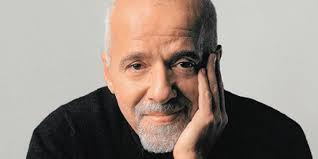
As passionate as I now am about walking from village to village, I was not always aware of the possibilities.  It was in 1998, when I read Paolo Coelho’s novel – Le Pelerin de Compostelle, that the seed was firmly planted.  At that time, I was based in Neuchâtel, in Switzerland (hence the book was in French), but my work was demanding of my continuous involvement, and the possibility of my taking extended holidays was just not feasible at that time; the realisation would have to wait until I ceased to be a wage slave.

download
Paolo Coelho

Of course, I never envisaged that I would one day have a serious stroke – a brain haemorrhage, and after it happened in late 2005, all my focus was on surviving and recovering to the best of my ability.  The idea of long distance walking was forgotten.

Then in 2010, I read Laurie Lee’s book about walking in Spain, as a young man in the late 1930s – As I walked out one summer morning.  Reading it, I felt rejuvenated and longed to experience it myself, whatever the health risks might have been.  I tried a couple of short 4-5 day walks in Switzerland, and of course the rest is history.  To date I have survived to plan another camino.

2014+20laurielee
Laurie Lee as a young man
laurie lee 2
And much older, in front of the house in Gloustershire, England, in which he grew up

So here I sit, about to start planning my next long walk, and very much reminded of a Paolo Coelho quotation:

do-it-now-paulo-coelho-daily-quotes-sayings-pictures