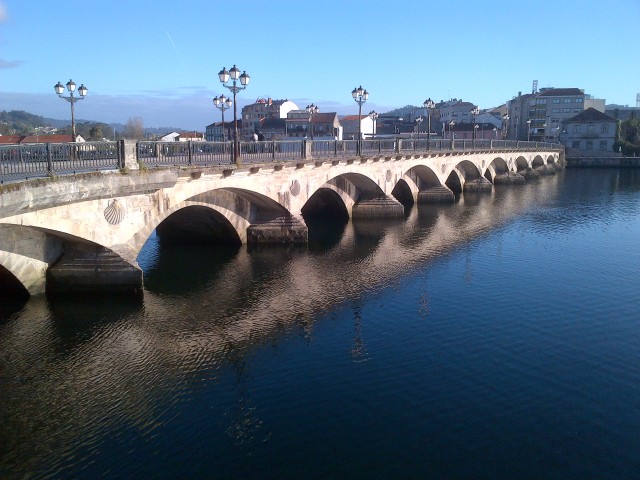
It was still early morning when I started out from Pontevedra. The sun was barely up and there was still a distinct chill in the air. The attendants of the early mass were filing out of the church in the main square, and one of them, an attractive girl with gorgeous eyes and long jet black hair, grabbed me and insisted on telling me the names and history of all the buildings around me. For a fleeting second I felt as if I was once more thirty something and attractive to younger women, but of course she just wanted to make sure that a passing pilgrim left her town with a favourable impression of its architecture and history. I could hear my mother say – ‘There’s no greater fool than an old fool’. Still, there was a spring to my limp as I headed down to the river and across the bridge. And I felt at least forty years younger.
The bridge from Pontevedra across the Río Lérez, with the shell emblems of Santiago
For the last three days, I have been on a high; the sun has shone from a cloudless sky; what little wind there has been, has been a balmy breeze; everywhere one looked, spring was rampant; old people, some quite ancient, were slowly digging, spreading manure and planting; the birds were singing their heads off; it felt so good to be alive and back in Galicia.
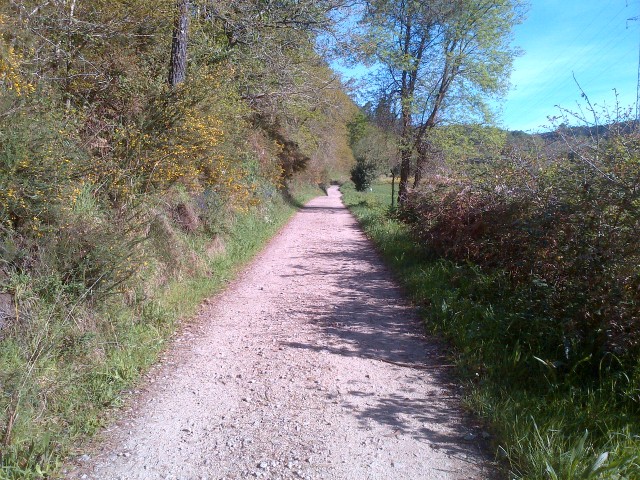
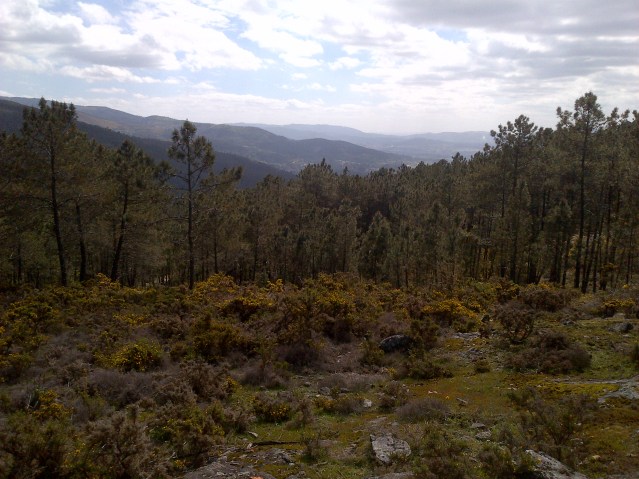
The landscape never ceased to be undulating; long stretches of uphill, a short top and then steeply down, only to start uphill again. It repeated itself quite hypnotically. It is not a flat part of Spain.
But for the three days, the surface was foot-friendly
From Pontevedra, my nights were spent in Caldas de Reis and Padrón, the latter being where the two followers of Saint James brought his body to bury it somewhere a little inland. Legend has it that the two followers were eventually also buried with Saint James and the tombs became overgrown through neglect, and their origin forgotten, until their chance discovery by a local peasant some 800 years later. The remains may have been moved to Santiago and the rest is the history of the camino.
Of course, the cynics say that it is all bullshit and that it was just a cunning fabrication by the local church hierarchy to gain power and induce the faithful to travel to Santiago. We will probably never know the truth, but the romantic in me loves the legend.
So, some 70 km from Pontevedra, I struggled up the last long hill and into the city. The walk through the suburbs and city proper seemed endless, but suddenly I was alongside a familiar park and a few more blocks bought me to my usual hotel.
I felt as if I was home once more.
And the sun warmed my shoulders and blessed my third visit to Santiago de Compostela.
Step by step, I have been slowly moving north across the map of northern Portugal and into Galicia. It has been six days since I left Balugües, covering 127 km, spending nights in Ponte de Lima and Parades de Coura, before leaving Portugal and crossing into Spain, and staying in Tui, O Porriño, Arcade and tonight in the attractive city of Pontevedra.
Until the last couple of days the weather has been challenging – cold, wet and windy, with occasional downpours. The torrential rain always waits until I am in the open countryside and far from possible shelter.
When we stayed in Montevideo, there were several sets of outdoor exercise machines, also in our current base of Green Point in Cape Town. They always seem to be heavily used, and if broken, it would almost certainly be the result of overuse, rather than vandalism. And now, I have walked through two small villages in Portugal, with their own set of machines, right on the camino. I admit that I did not feel tempted to have a workout.
The camino in Portugal is so well marked with the yellow flechas, that even I could not get lost. This rather spoiled my normal excuse for talking to people in the street, but I soon found other reasons. In Portugal language was a complication for me, as my Portuguese, so far, does not exist. I found that some Portuguese are comfortable in English, others in French or Spanish, but the majority are mono-lingual. Before I go back to Portugal, and I surely will, I must master the basics of their language.
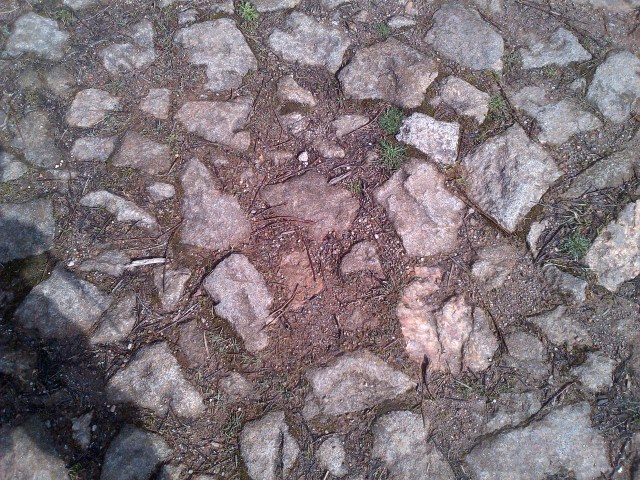
I was always aware that the Portuguese camino was mostly on paved surfaces, but I understood ‘paved’ to mean asphalt. Big mistake! For much of the Portuguese camino, paved means cobblestones of all sizes and shapes, whether roads and pavements through villages, roads between villages, country lanes etc. The stones are unforgiving, and by the end of the day, my feet, knees and hips feet were quite beaten up.
A typical village roadA village pavement with smaller stonesA typical country road
I would describe the Portuguese route as being undulating. It is certainly not flat and in one case, between Ponte de Lima and Paredes de Coura, there is a steep climb of 400 m, largely on smooth rocks. I had to be very careful not to sprain my ankle for the fourth time in three years.
The view from the top of the climb
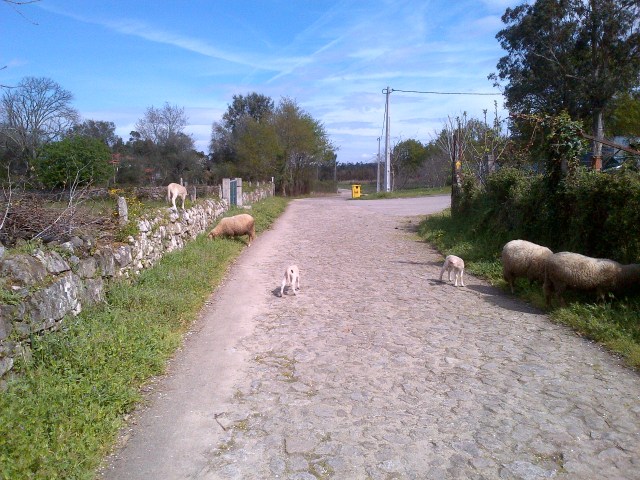
I have never before seen tame sheep wandering around a village with lambs. One of the lambs was walking along the top of a wall and jumped down on the other side. That set off a furious baaing by the mother, especially when its lamb could not get back onto the wall after several attempts. I was about to set off to find the owner of the sheep, when the lamp cleared the wall in one leap. The motherly scolding ceased and all went back to eating.
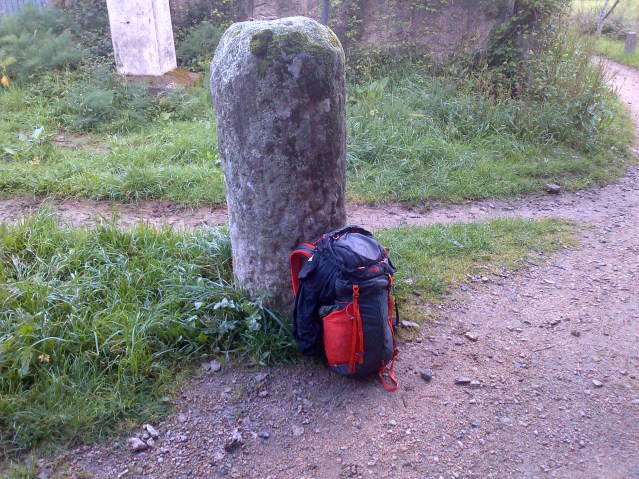
Coming across a Roman mile-stone is a vivid reminder that the path had been used for more than two thousand years. The mile-stone dated from c200 BC, probably from the reign of Trajan, and was a on a road that linked Braga with Astorga, via Lugo.
The bridge from Arcade to the north was the scene of a decisive battle in the Peninsular War, when the Spanish forces defeated the French. During the battle, one of the central arches of the bridge was destroyed to halt the French advance.
The Ponte Romano de Pontesampaio across the river Vergugo at Arcade
It is now late Saturday afternoon in the beautiful city of Pontevedra, and I have just arrived. The sun is shining, spring seems to have arrived and the plazas, streets and bars are packed, and everywhere there are children playing football.
And in three more days I hope to once more walk into Santiago de Compostela.
It is now five days since I left Porto, spending the nights in Matosinhos, Vila do Conde, Arcos, Barcelos and tonight in Balugäes. In total I have walked about 86 km so far.
It was a blustery day when I set out last Wednesday. Overhead the clouds were moving rapidly, but down below, along the river, all was relatively calm. In the distance, I could see the spray of huge waves smashing against the sea wall. I had a sinking feeling that I was going to experience a reminder of what an angry North Atlantic can be like. And how could I ever forget; I grew up in its full blast on the north coast of Ireland.
The relative calm of the river valley
As I reached the coast to turn north, the rain started. It was like having a pressure hose aimed straight in your face. When I first had a warning of the coming storm, I quickly donned my poncho, but it proved to be next to useless; it filled with air and threatened to lift me off, like Mary Poppins. I scuttled along the promenade desperately looking for shelter, and finally escaped the storm into a passing coffee shop, where I spent an enjoyable time chatting with the owner. I finally emerged, totally convinced that the Portuguese were my kind of people. At least that lady was.
But the relative calm did not last for long, when another storm hit; one could see them coming in the distance; a huge threatening black mass, preceded by cold winds. And for the rest of the day I was repeatedly hit, sometimes sheltered, other times totally exposed, until I finally reached my destination, feeling thoroughly beaten up.
Another pending storm
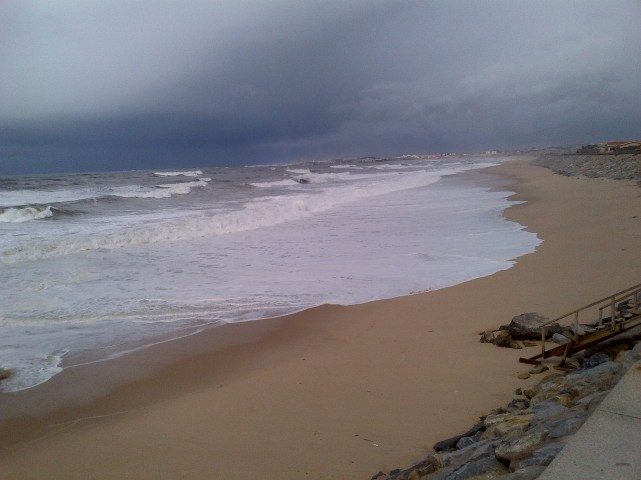
The next day the sea was still thundering against the coast, but on land all was relatively calm.
Not a day for swimming
I continued north along the coast, much of the time on an elevated boardwalk. The coastal scenery was beautiful. I was completely alone; I never saw another walker.
Much of the coastal walk was on board walks such as this
I spent the night in a beautiful old hotel in Vila do Conde.
Crossing the bridge into Vila do Conde
The next morning, I set off late, for it promised to be an easy day. I headed inland along a very busy minor road, through village after village, until I reached the few houses that consisted of Arcos.
The churches look quite different to those of neighbouring Spain
Finally back in the countryside at Arcos
I found the walk to Barcelos to be rather challenging. Much of it was on roads paved with cobblestones, and they are unforgiving on the feet, knees and hips. There was no escaping them, and by the time I limped into Barcelos, I felt thoroughly beaten up. I recall that the London Marathon has a short stretch of cobblestones in front of the Tower of London and for the race, the organizers cover it with thick carpet to ease the impact on the runners. There is a good reason for having that carpet.
Last night the rain started again and it rained heavily all night, with intermittent thunderstorms. This morning it was still thumping down, so I had a late breakfast, and started out after 10:00 when the rain finally ceased and the sun started to shine.
For much of the route a cross-country cycling race was taking place and the backs of the competitors were plastered with mud.
And finally one for my sons, who once claimed that only bulls could have horns. You can just about see the tiny calf behind its mother.
This has not been an easy camino so far, but sometimes I have to remind myself that a pilgrimage can turn out to be a physical and mental challenge. It is not a short stroll in the countryside. I have not been walking comfortably – my leg is not happy, but in my head and in my heart, I feel good.
Today finds me in Porto, in northern Portugal. I arrived two days ago from Cape Town, via London Heathrow and Gatwick. I did not want to leave the beautiful weather and wonderful people of Cape Town, but needs must; my visa would have expired the next day. I will soon return.
In the meantime I intended to undertake another of my annual walks in the direction of Santiago de Compostela, this time from Porto.
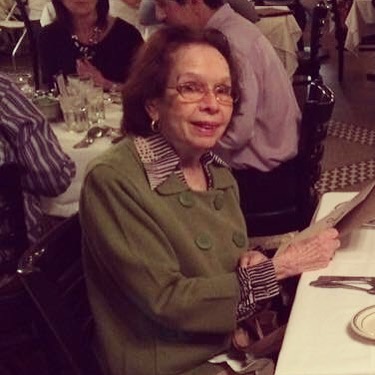
But just prior to leaving Cape Town, I learned of the serious illness of an old lady, for whom I had a huge respect. She was my former mother-in-law, but I have never ever thought of her as an ‘ex’. From day one, she welcomed me into her extended family. They were exiles from Castro’s Cuba – some prospered, some struggled. She was an elegant woman with artistic talents. Her paintings are witness to that. On many occasions she even cut my hair.
A few years ago I walked part of the pilgrimage coastal path from Bayonne across Northern Spain and diverted to Mundaka, from where her Lázaga ancestors originated. I sent her an account of what I had seen. Perhaps I will re-publish that account.
To say that I loved the woman would be an understatement.
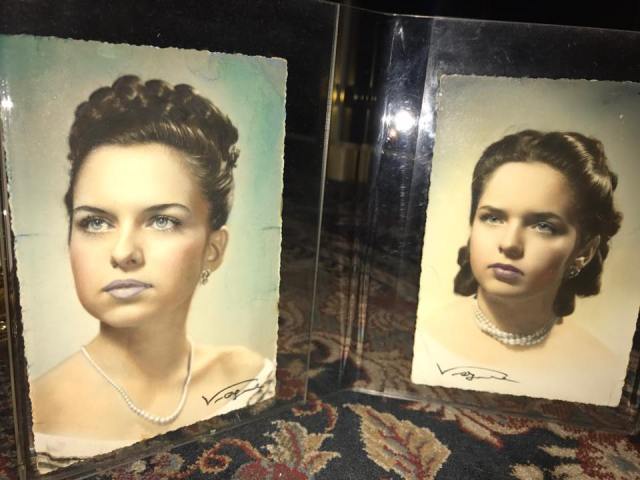
Norma Suárez Lázaga on the right, with her older sister DinorahAnd in recent years
I did not learn of her death until I arrived here. It greatly saddened me and I felt no enthusiasm for my planned walk. I always have problems with my partially paralysed foot and leg after a long overnight flight, but this time I was struggling more than normal. I was sorely tempted to abandon my plan and do whatever old farts do, but then that would not be me.
So tomorrow morning, in the forecast rain and wind, I will set off north, one step at a time.
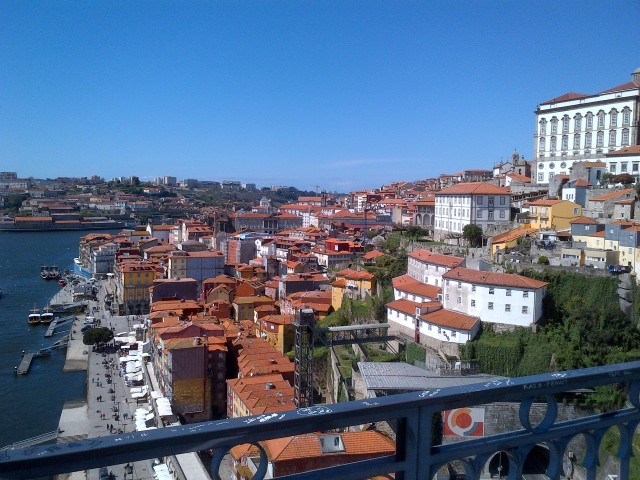
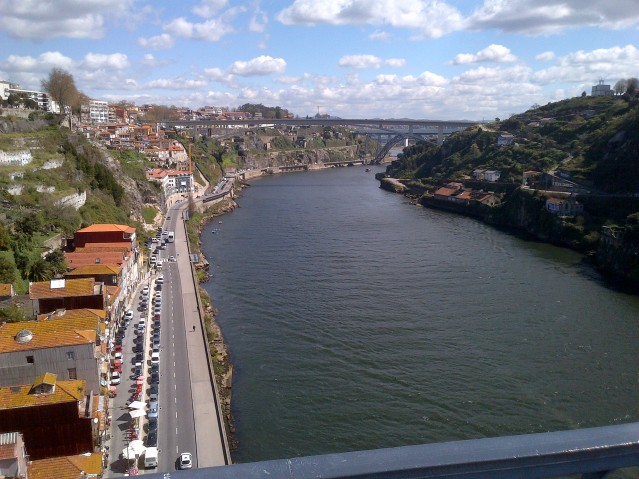
In the meantime I have had a long walk around the old city, up and down steep hills, through a maze of narrow lanes.
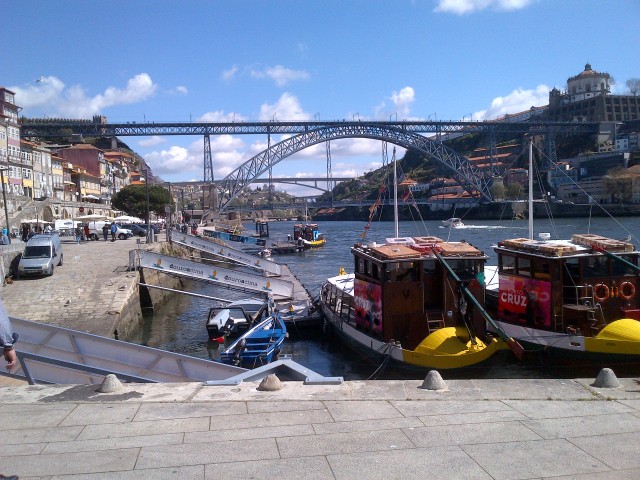
The Rio Douro looking west from the Luis I bridgeAnd looking east
Looking east from the river to the Luis I bridge
Norma Suárez Lázaga – this pilgrimage will be for you… 🙂
It was late evening when I checked into my hotel in Madrid. I had flown in from London Heathrow and was staying near the Nuevos Ministerios metro station. It was my first visit to Madrid. I had recently been given the additional responsibility of my company’s international business, which included a minority shareholding in a small Spanish recruitment company, and I was looking forward to once more having the opportunity of operating in a Spanish environment.
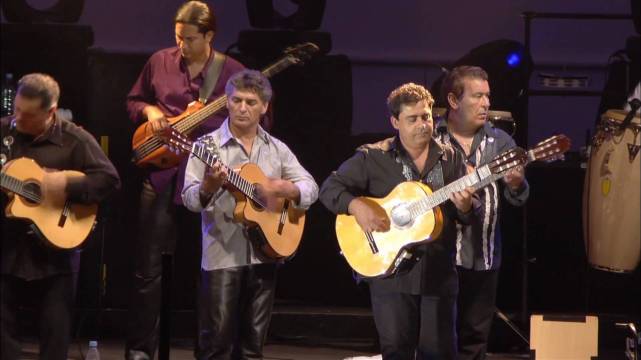
I had two meetings arranged for the next day, the first not until lunchtime, so I settled down in my hotel room, wine glass in hand, to watch some television and attempt to tune my ear to the Castellano of Madrid. Flicking through the channels, I stumbled on a concert, that seemed to have just begun, and the music of many guitars, the raucous singing, the rhythms, the relentless beat, held my attention for the next more than an hour. It was like a mix of flamenco and salsa. It was a group known as The Gypsy Kings..
I had never heard of them before then, despite my enthusiasm for most things Latin. The next morning I called in at a nearby Corte Inglés, to see if they had a copy of a Gypsy Kings recording, and I was not disappointed. The salesman told me that they were the current rage in Spain, but that they were not from Spain,but from the French south-west. There were two brothers and several other cousins and that their parents were gypsies who had fled Catalonia during the 1930s Spanish Civil War. They sang flamenco and salsa with an Andalusian accent. I still have my original purchase.
My lunch appointment was most interesting. My host was a consultant, who wanted to be considered as a junior partner in international projects that we undertook from time to time, and where we might have need of Spanish market expertise. He was not comfortable in English, but we managed to converse in Spanish, with no obvious problems.
The owner of the restaurant was a friend of my host, and when he was taking the order, he suggested that I try his speciality. ‘Por qué no’ is a response that has got me into trouble many times, and this was to be no exception. The dish came in a wooden bowl with a top, and when I removed the latter, the contents heaved and wriggled. They were baby eels from Bilbao. I was assured that they were well cooked and it was the cooler air that caused them to contract and move when not alive, just like the huge rattlesnake that I once killed in California, that roamed around the yard for at least half- an-hour after I had chopped it in half. But that is another story for another day.
The anguilas were surprisingly quite tasty
After the lunch – by then it was nearly five o’clock, I walked over to the nearby office of our recruitment consultancy, to meet with Antonio ‘Tony’ Ares de Paz, the main shareholder. Tony proved to be a most charming man, aristocratic, and with faultless English, albeit with a heavy Spanish underlay. During the Spanish Civil War, his father had moved his family to the relative safety of Mexico City. I could not swear to it, but I believe that he said that after their exile, he did not see his father again.
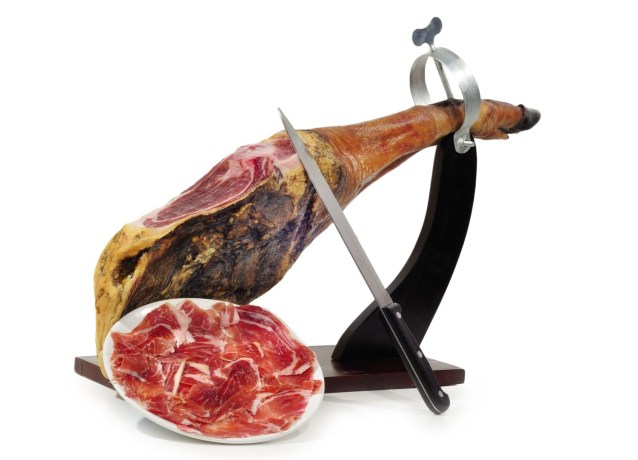
Later in the evening, Tony and his wife picked me up at my hotel and took to his club on Gran Via, or Broadway as Tony called it, and from there to an intimate restaurant near the Royal Palace, and my introduction to Pata Negra, the revered ham of the free range black pigs, mostly reared in the western Spanish provinces of Extremadura and Cáceres. and fed on acorns and olives.
After the meal, the owner offered to show me the tunnel in the basement, that the randy royal males used to use in order to slip out of the palace for a night of debauchery. Of course, the tunnel was blocked with a locked door. I never did get a straight answer as to if the then-royal-family still used the tunnel.
I felt quite tired when I finally got back to my hotel room. Two large meals, a lot of wine, and stimulating conversation; my mind was in a whirl.
And the music of The Gypsy Kings and Volare was still throbbing in my head.
It was the end of the first of very many visits to Spain to come.
Bumping along dirt roads, the rear mirror filled with dust
Crossing dehydrated stream beds, impassable in the wet
Gate after gate, opened and carefully closed
Until only the lonely cluster of welcome awaits
Embracing, kissing, laughing, relaxing
Nothing had changed, at least not that we wanted to see
Cold cans cracked, news exchanged, it felt good to be together again
Country Roads had brought us home once more
Wood fire crackling, the smell of roasting lamb
Smoke in our hair, the taste of cheap red wine
The air throbbing with the sound of Hot August Night
And we were as one, and it felt so very, very good
It was not quite dark, when alone I walked up the hill
Intoxicated with the beauty of the southern sky
The smell of the night breeze in my face
I didn’t ever want the night to end
Sitting on a rock, still warm from the summer sun
Listening to the rustle and occasional squeak in the bush
Recalling so many nights of carefree abandon
Loving one and loving all.
I wrote that piece a few years ago, as part of an assignment for an Open University course in Creative Writing. The particular task was to recall a beautiful personal memory and to include all the five senses. I called it ‘Brian’s Farm’ and it was loosely based on my memories of a period in my life in Australia, during the years 1971-6.
When I knew Brian, he was in his mid to late twenties. When he was eighteen he bought a track of undeveloped bush near Guyra, about 70 km north of Armidale in northern New South Wales. I seem to remember that he had about 3000 acres, but I could not swear to that. His land was partly undulating, before backing up into the hills, and it included mineral rights to a river that flowed down from the hills, and contained evidence of gold and sapphires.
Now, when I tell you that Brian spent the first two years on his land living alone in a tent, while he slowly cleared a small area of bush to create some paddocks for sheep and horses, you can start to realize that he was an exceptional individual, of true pioneer spirit. He was of medium height and not heavily built, but he oozed strength.
I once met his father, a stocky balding little Englishman of florid complexion. I think that he was an English teacher in Armidale. I don’t remember his mother ever being mentioned. I suspect that his father helped him with the funds to buy the land. In those days, undeveloped bush land cost only a few dollars an acre.
Brian’s first building that he erected was a large wool shed, with a kitchen attached and containing a wood fired oven. At the back, he added a second small building, containing a shower unit and toilet. With the door open, the view from the toilet across the valley was stunning.
The shower unit was a marvel of engineering. The water from the roof of the woolshed was captured in a huge tank and from there it was pumped up the hill to another similar tank. From there it flowed with some force to a boiler above a wood fireplace. A cold shower was available at any time, but before having a hot shower, the water had to be heated. The shower room was large and had a ceiling shower head of enough diameter to allow six people to comfortably shower together. Brian encouraged communal showers, ostensibly to economize on water!
When Brian completed the woolshed, he started work on a small bungalow for himself, and that was where he was living when I first knew him. At that time, he was offering the opportunity to spend a week in his woolshed for a quite modest cost. And of course, it not just gave Brian some additional income, but brought some social opportunity into his otherwise hermitic existence.
Visitors had the opportunity to ride his horses, to go rock climbing, and to prospect for precious stones and gold. For those who doubted the existence of treasure in the river, Brian would show his jars of topaz and gold nuggets. And there was of course the wildlife, with lots of red kangaroos, kookaburras, and plenty of snakes.
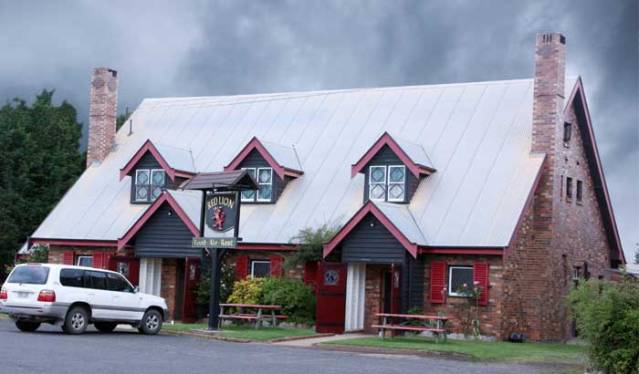
The nearest ‘civilisation’ was The Red Lion Tavern in the tiny village of Glencoe, about 25 km north. Any visit to Brian’s farm was not complete without an evening in The Red Lion, with its roast lamb, washed down with copious glasses of Aussie red. How I would love to be able to turn the clock back to those days.
The Red Lion Tavern in Glencoe
But life moves on, and there have now been nearly 500 full moons since I left Australia on my South American travels. I am yet to return.
I lost touch with Brian; keeping in contact was not as easy in those days of writing paper, envelopes, stamps and snail mail. I did hear that he married and then was once more on his own. It would have been a lonely life for a woman, especially if she was a city girl.
Occasionally I wonder what he is up to these days. Could he still scale Chimney Rock or do a forward roll over two wool bales, like we used to
For access to open spaces, fresh ocean air and multiple sporting facilities, Green Point, Cape Town, is by far the best place in which I have ever had the opportunity to live. I suspect that I will never find better. And add in friendly and laid-back people, affordable food and wine, and a Goldilocks climate – never too hot, never too cold. For me, it is perfect.
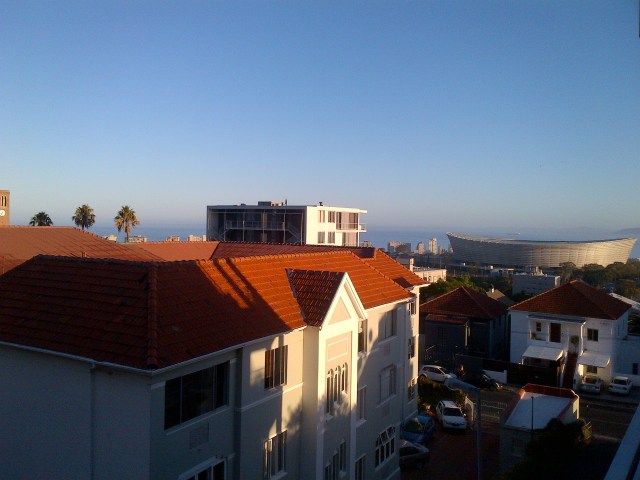
From our eyrie on the slopes of Signal Hill, it is about 600 m to the Green Point shops, restaurants, bars etc. and across the road is the edge of the sporting and recreational park, with the Cape Town stadium, two cricket grounds, an international standard athletics track, an 18-hole golf course, a rugby club with several pitches and a beautiful park, with lakes, abundant birdlife and a plethora of native flora.
And beyond the park is the ocean and a wide promenade, that stretches as far as I would ever care to walk.
An early morning from our balcony
One day recently, on my usual daily walk past the rugby grounds, I noticed that several huge tents were being erected and each day after, more and more tents were being added. The event was the Cape Town rugby 10s tournament, also incorporating a netball and beach volleyball competition. All in all, there were 100 rugby teams, 40 netball and 40 volleyball, all competing over three days.
Now I have played in a few rugby 7s competitions, in my very amateurish and much younger days, but I had never heard of rugby 10s. The game involves ten players on each team – five forwards and five backs, and each game has two 9-minute halves, with a 2-minute half-time. The rules are similar to rugby 7s.
And typical of anywhere one finds rugby, copious volumes of beer were consumed, and the Cape Town event sported, what was reputed to be, Africa’s largest beer tent.
The rugby event, as seen from the air (photo from internet)
Two days later, the tents, and all evidence of the rugby event, had disappeared, to be replaced, outside the football stadium and surrounding roads, by the construction of temporary facilities for the Cape Town leg of the Triathlon World Cup.
This event is held over two days, month by month, in several cities in both hemispheres. There are four categories in the competition, with the elite competing over 750 m swim, 40 km cycle and 10 km run.
The swim in the cold water of the Waterfront harbour (photo from internet)The cycling over laps along Beach Road (photo from internet)The eventual first and second in the elite female category (photo from internet)With a sprint to the finish by the football stadium (photo from internet)
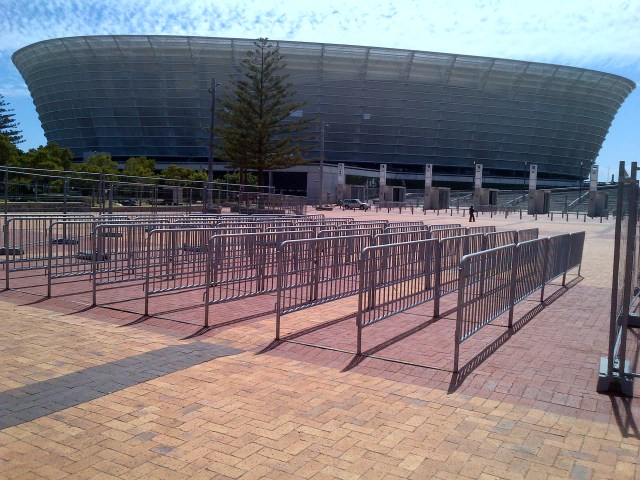
As with the rugby competition, all evidence of the complex facilities had disappeared within two days. On the third day, I found several strange metal strips on the forecourt near the stadium, each with protrusions at intervals. There were two groups apart, but at angles to each other and not parallel. I was quite puzzled.
The next day, I found that barriers had been added, but I still could not imagine what they were for. This time I found a park employee, who explained that when there was a football match in the stadium, the whole area was fenced off, and all spectators had to pass through the barriers to be searched for alcohol, drugs, knives, guns etc.
Sure enough, the next day I found that the whole area had been fenced off. It was not obvious at the start.
This weekend, there is a limited-overs cricket match taking place.
And of course, tonight there will be the football match at the stadium.
It seems that there is never a dull moment in Green Point.
We decided to continue as far as Cáceres, some 74 km to the north of Mérida, spending the nights in Aljucén, Alcuésar and Aldea de Cano.
About 5 km north of Merida, we passed around the Proserpina dam – El Embalse de Proserpina. It was built in the early days of Mérida, to supply water to the city across aqueducts. The aqueducts have long been in ruins, but the reservoir, with its 12m retaining wall, still exists.
El Embalse de Proserpina
At one point on the route, we saw in the distance the couple with the cart. She was strapped in and hauling, while he was ahead, walking with a perceptible limp. A little later we passed them: they were sitting some distance from the path.
Aljucén is a very small village with one bar and a rather strange Casa Rural – Termas Aqua Libera, at which we turned out to be the only guests. From the street, there was nothing unusual about the place, but once across the threshold, one was transported to Roman times. It seemed to be quite an authentic copy of a Roman villa, and we were shown where we could select from a choice of Roman togas to wear, if we were interested in dressing the part. We respectfully declined the opportunity.
When we went out some time later, there seemed to be a party going on, with several couples dressed in Roman gear, with lots of flashing legs and thighs. But when we returned a couple of hours later, all was quiet, much to Lotta’s relief and my disappointment; I had never before been to a Roman orgy and I still haven’t. One can but live in hope… 🙂
The highlight of the next day was our encounter with the pigs, black pigs, hundreds of them, in a huge open range paddock: the black pigs that produce the famous pata negra ham. The black Iberian pig, or cerdo negro, are apparently the only pigs that naturally seek out and eat mainly acorns.
But like most pigs, they are very curious, and want to smell you and perhaps taste the salt on your legs. Now I was brought up with pigs, so nothing new there, but I suspect that Lotta would have preferred to have seen them from the other side of a fence. She was quite happy to eventually cross a cattle grid and leave that massive paddock.
The place where we stayed in Alcuésar was also quite strange. I had only vague instructions that led us nowhere, so we stopped in a bar to ask directions. After another caña, the very helpful barman drew us a simple map on a serviette: it turned out that we had been quite close, but not close enough.
But when we found the street and the right block, we could not see a door. I asked an old toothless man if he knew where the entrance was and he immediately scuttled up a side-street and rang a door bell, signalling that we had arrived. An elderly aristocratic-looking lady answered the door, hustled us in and in a whirlwind of introductions and instructions, swept us in and out of rooms, up stairs, down steps and along corridors until we were in a small apartment that was ours for the night. I was quite disorientated.
Thankfully our exit was close by, via a side door of the house, which it turned out occupied an entire block of the town. It must have been a rich family that built the house and perhaps the aristocratic lady was a descendant. We never did see her again.
We managed to navigate our way from the apartment into the town and back again, without once getting lost. And when we returned, who did we see watching television as we passed a large room that served as a lounge? The couple with the cart!
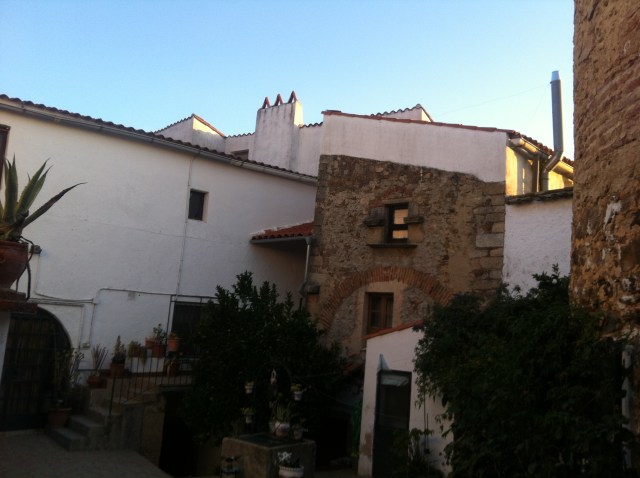
Somewhere in the house was the little apartment
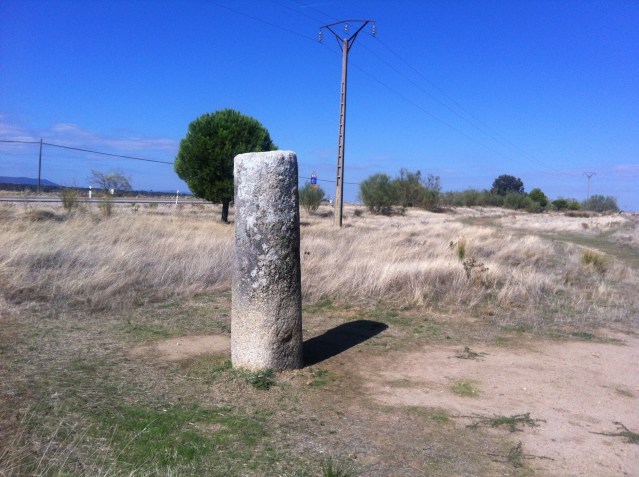
Between Alcuésar and Aldea de Cano, we came across several Roman milestones. A Roman mile was the distance that a legion would march 1000 paces, a pace being each time the left foot struck the ground. It was the origin of the English mile, and each Roman milestone had its distance from Rome engraved on it.
A typical Roman miöestone
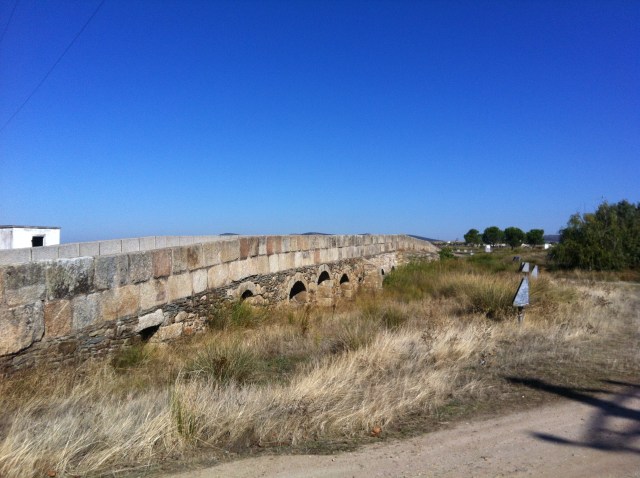
Prior to Aldea de Cano, we passed through an extensive area with bridges and stepping stones, even though the ground was bone dry. Apparently, it was a swamp when it rained.
Dry, but sometimes not so…
When we arrived in Aldea de Cano, there was a sign on the door of our Casa Rural to say that our hostess would not be there until two hours later. So, we settled ourselves down in the sun, outside a nearby bar, and quenched our thirst and ate some tapas. We were soon joined by an old farmer, who obviously already had had a few drinks. He was delightful company. At one stage, he disappeared and emerged with some more beers for us, and later I reciprocated.
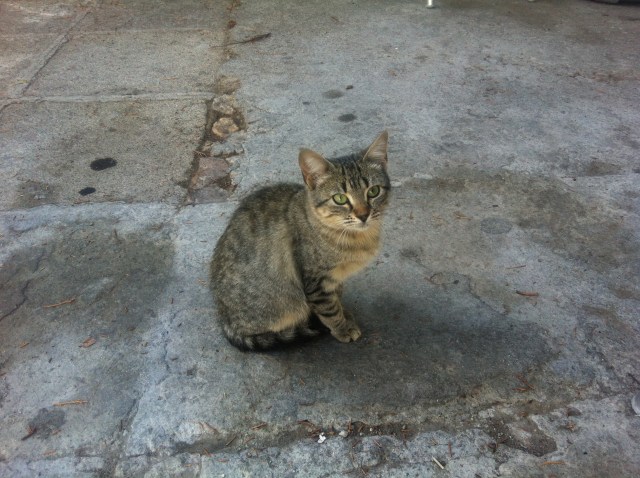
In the meantime, we had been joined by a little kitten. It watched us, but never got close. When I tried to stroke it, it quickly retreated. The farmer said that it was a street cat and he wanted one for his farm, to keep the vermin under control. He tried to tempt it to come close, but to no avail.
The rodent hunter
That night we finally met the ‘strange couple with the cart’. I had arranged for the owner to serve us dinner, and when we sat down, the couple emerged from a nearby room. It turned out they were indeed German, quite shy, but passionate about hiking. He was a web developer, quite a ‘geek’ and I don’t recall what she did. They did not live together, but were ‘married’ in their passion for hiking. I rather liked them.
The next morning, we left early and stopped at a bar on the edge of the village. And who came in, just as we were about to leave? Nope, wrong this time. The old farmer, he of the kitten, arrived to have his early morning drinks with his mates, before setting off to his land. I’ll never forget how his face lit up when he saw us and I am sure that mine was a mirror image. We chatted for a few minutes before we had to set out. The memory of the old farmer is ingrained in my memory.
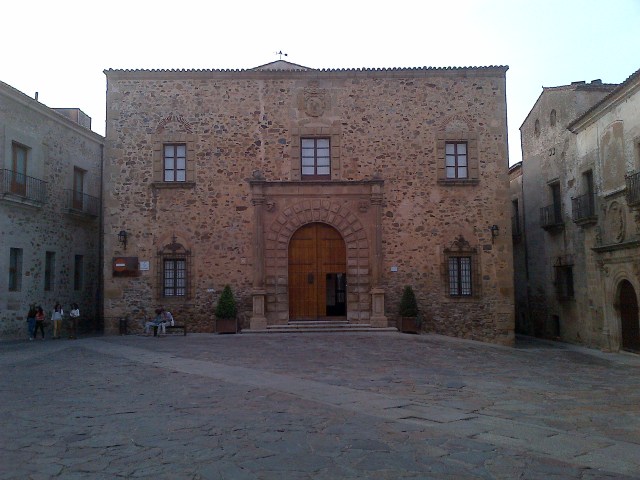
The path to Cáceres was long, but uneventful, and eventually we wended our way through the industrial suburbs and the centre of the city, and finally up the steep hill to the Plaza Mayor and the old city. Our hotel was just off the Plaza Mayor.
The old city from the Plaza Mayor
The weather was starting to get quite cold overnight and we were not equipped for late autumn in Northern Spain. To come, there would have been the historic cities of Salamanca and Zamora, but they would have to wait for another day. So, we headed to Madrid, and eventually back to Uruguay.
When I first started walking to Santiago de Compostela, I was aware of the legend of Saint James, one of Jesus’s disciples; of his preaching in north-western Iberia; of his eventual return to Jerusalem, his arrest and beheading; of his two faithful followers taking his body to Galicia, and his interment there. But to me, it was just a legend, an interesting tale, but bearing little relevance to any historic events. To me, Galicia seemed a long way from Jerusalem.
But until I went there, I had not realized how developed and sophisticated was that part of Europe in that era, with its nearly 1000 km of straight paved road, running from south to north, allowing the rapid movement of armies and the transportation of gold, silver, other minerals and crops to the waiting ships in the south, and on to Rome. I had seen Roman ruins in Astorga in the north and Sevilla in the south, but walking on the former Roman road for day after day, and seeing the remains of the Roman city of Mérida, caused me to change my view: perhaps there was some credence in the legend of Saint James.
We walked across the Puente Romano on a beautiful early autumn afternoon, past the Muslim fort, and up the hill to the old town. I had reserved the same hotel, where two years previously I had become stuck in the elevator, and was eventually hauled up and out by the owner. It was no surprise that he had no hesitation in remembering me, when we checked in. And he assured me that he had had no further problems with the elevator since my incident, but just in case, he gave us a room on the ground floor.
The modern city of Mérida has been built on top of the walled Roman city of Augusta Emerita, originally founded in 25 BC, in the reign of Augustus. Hence the origin of the name.
A model of Mérida, as it was in Roman times
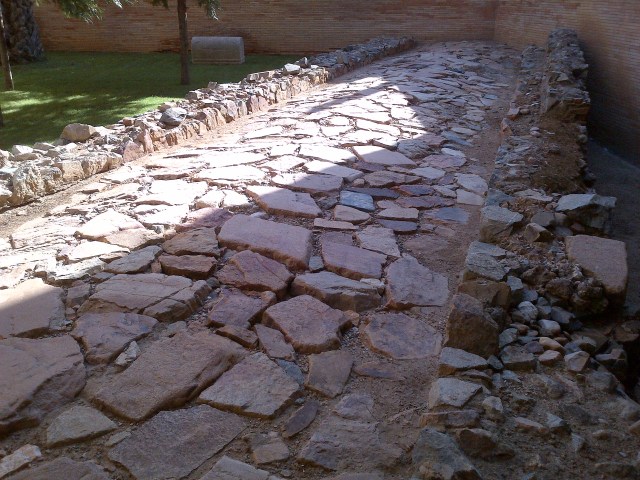
The original Roman street and block layout has been maintained, and there are several places in the city where one can see the original street surface.
A section of an original Roman street
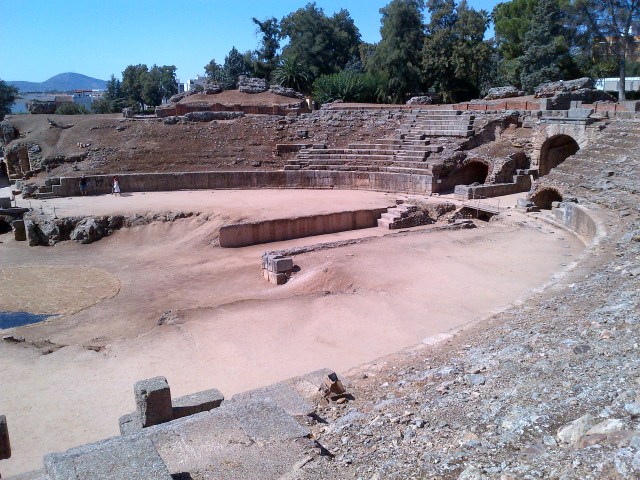
Mérida had an impressive amphitheatre and an adjoining theatre, the latter which has been partially restored and is still used for productions.
The amphitheatreThe stage of the theatreAnd the restored seating
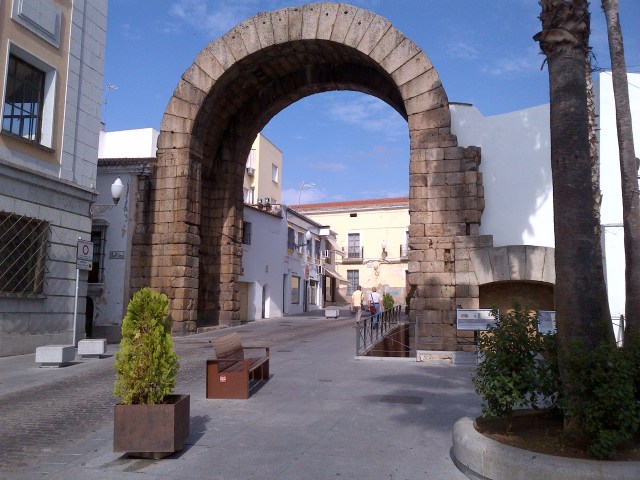
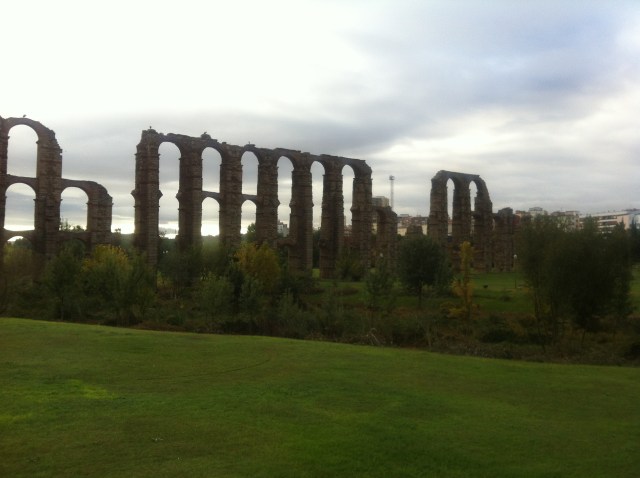
Throughout the city there are several other impressive Roman remains, including Trajan’s arch, the Temple of Diana, the aqueducts, and outside the original walls, the well-preserved circus used for chariot racing.
Trajan’s archTrajan’s archTemple of DianaThe remains of one of the aqueducts that carried water to the city, seen just after sunriseThe Mérida circus (photo from internet)
After the fall of the Roman Empire in the 5th century, the Visigoths replaced the Romans, and they in their turn were conquered, in the 8th century, by the Muslims from North Africa. The Islamic control of Mérida lasted until the 13th century, when they were defeated by the Christians. At Granada, in 1492, the last resistance of the Muslims in Spain was eliminated.
The Alcazaba, the Muslim fort, as seen from an island in the riverThe western wall of the Alcazaba, as seen from the Puente Romano
In the legends of Saint James, there is no mention of the route he may have taken on his return to Jerusalem, but it is likely that such a traveller from North-western Iberia would have passed through Mérida on the way south, to continue by boat to the Eastern Mediterranean.
I remain to be convinced that the legends of Saint James are anything other than legends, but I need no convincing that Mérida is a most interesting city.
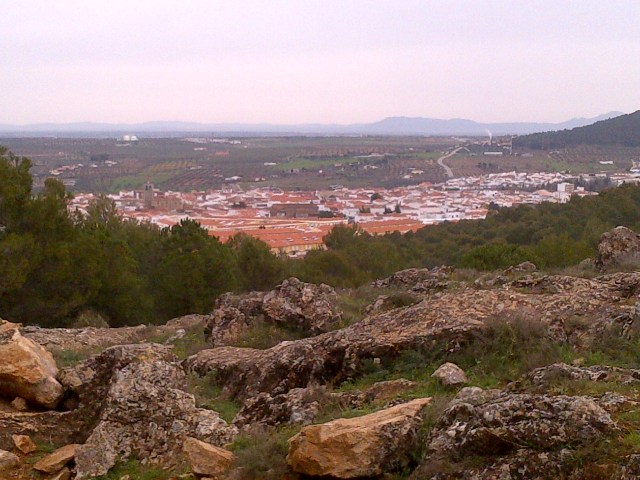
Once outside Zafra, the route climbed steadily to a ridge overlooking Los Santos de Maimona. From the summit, one could see the plain stretching to distant mountains. Mérida lies 65 km to the north of Zafra and takes three days of walking, spending the nights in Villafranca de Los Barros and Torremejía. Once again, between the overnight villages, there was nothing but occasional farmland and bush.
Looking down on Los Santos de Maimona
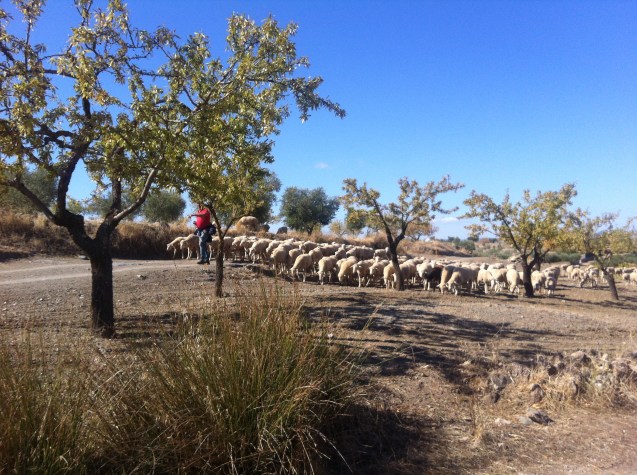
The land was parched. It looked as if it had not seen rain for a long time. At one time, after Santos de Maimona, we came across of a flock of sheep. The shepherd walked ahead, seemingly oblivious of what was following him. Four sheep dogs raced around, rounding up the stragglers and keeping the flock moving in the general direction of their master. It was not the first time that I have witnessed the shepherd-to-dog relationship, and I have never ceased to be impressed.
The shepherd leaving, the flocking following
From Villafranca de los Barros to Torremejía the path was straight, following the old Roman road. There is absolutely no shade, just grape vines and occasional olive groves as far as the eye can see. In one part, the road was being resurfaced, and for several kilometres we had to trudge through a thick layer of uncompressed dust.
A repaired through the vines
On a long straight path, with no bordering trees or bushes, one’s progress across the landscape is barely perceptible. The goal is there on the horizon, but on the horizon is where it seems to remain.
In the distance Torremejía
But eventually one arrives.
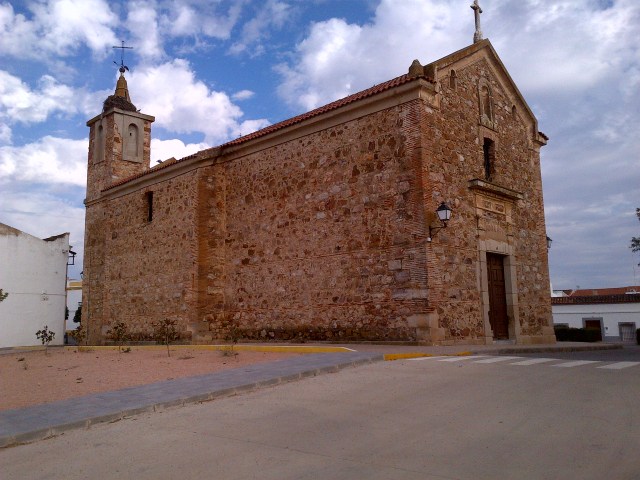
Grapes on their way to being pressedThe recently renovated Iglesia Parroquial in Torremejía
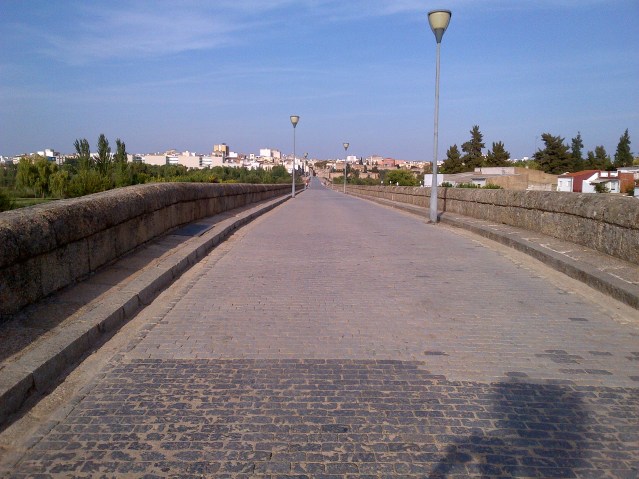
The next day was relatively easy and, in the early afternoon, we arrived at the Puente Romano, that leads across the river Guadiana to Mérida.
At 790 m, it is the longest surviving Roman bridge.
The Puente Romano over the river Guadiana, with its 60 surviving spans
























 The Irish Rover